October 2026
Katowice's Coal Sidings Become Solar Farms Instead
Once hauling coal to Silesian power plants, Katowice's idle rail sidings are now being reborn as solar farms on unusable industrial land
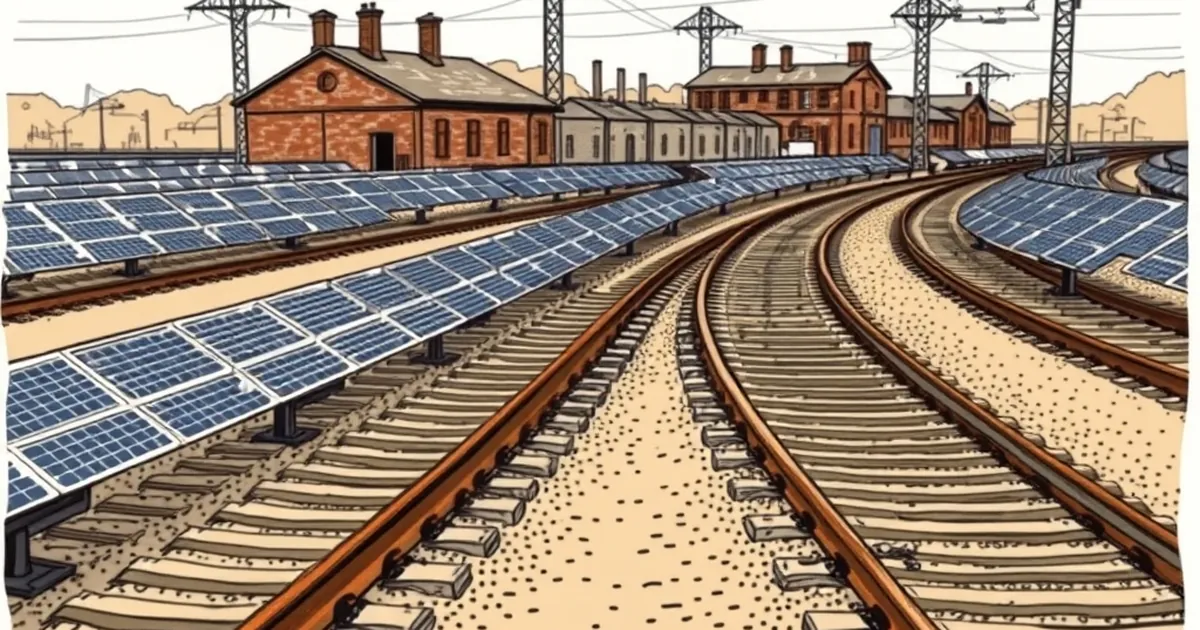
Katowice spent the better part of two centuries as the beating heart of Polish coal. The rail yards that once shuffled thousands of tonnes of black rock toward Silesian power plants and steelworks are now largely silent, their sidings rusting under weeds and leftover ballast. So what do you actually do with a few hundred hectares of industrial land that nobody wants to build apartments on?
The answer taking shape across the city is unexpectedly bright: you bolt photovoltaic panels to the ground and sell the electrons.
Why Coal Sidings Are Perfect for Solar
Brownfield land has a reputation problem. Developers eye it warily because of contamination, unstable ground, and the paperwork that comes with decades of heavy industrial use. But that same reputation is exactly why solar developers are circling.
A solar farm does not need clean soil. It needs flat ground, a grid connection, and a landowner willing to sign a long lease. Former coal sidings tick all three boxes.
The Grid Connection Is the Real Prize
Here is the part most people miss. The single most expensive and slowest element of any renewable project in Poland is getting connected to the transmission or distribution network. Operators like Tauron and PSE have queues measured in years, and in some regions new connection conditions are simply refused.
Coal sidings, though, already sit on substations built for heavy industry. The overhead lines, transformer bays, and cable corridors were sized for machinery that drew megawatts around the clock. When that load disappears, capacity frees up.
That leftover capacity is worth more than the land itself. A developer who secures an existing connection can shave years off a project timeline and millions of złoty off the budget.
Contamination Becomes an Advantage
On a former fuel depot or locomotive yard, nobody is going to complain about visual intrusion into a protected landscape. There are no neighbours to object, no orchards to shade, no prime agricultural soil to sacrifice.
Poland has historically been cautious about siting renewables on good farmland — a sensitivity that has shaped legislation and local politics. Industrial brownfields sidestep that entire argument.
What Is Actually Being Built in Katowice
Katowice is not the first Polish city to test this idea, but it is among the most symbolically loaded. The city's identity was forged in hard coal, and its post-mining transition has been painful, politically charged, and slow.
Several projects are moving through the pipeline on former railway and industrial plots in and around the city.
One concrete case worth watching sits on the site of a former locomotive depot and coal loading yard, where a developer has been converting a stretch of disused sidings into a ground-mounted array. The rails were lifted, the ballast was graded, and rows of panels went up on steel piles driven straight into the compacted substrate.
The site needed almost no earthworks. That is the quiet advantage of railway land: it was already engineered to carry weight and drain properly.
Scale Matters Less Than You Think
These are not gigawatt installations. Most are in the range of a few megawatts — enough to power a few thousand households, or to feed a large industrial campus or a municipal tram network.
That modest scale is a feature, not a bug. Smaller arrays can be built faster, financed locally, and connected to medium-voltage networks without triggering the multi-year transmission studies that kill bigger projects.
Who Owns the Land?
Ownership is the messiest part of the story. Former railway land often sits in a tangle of municipal, state treasury, and private hands, with unclear boundaries and legacy easements.
Katowice has an advantage here: the city has been actively consolidating brownfield plots for years, and it has a track record of using EU cohesion funds to prepare industrial land for reuse. That administrative groundwork is what makes a solar project possible at all.
The Economics Behind the Pivot
Why now, and not ten years ago? Three things changed.
First, the cost of panels and inverters collapsed. A ground-mounted installation that needed heavy subsidy in 2015 can now compete on merchant power prices in many Polish configurations.
Second, Poland's energy market tightened. Wholesale prices spiked after 2021, and the war in Ukraine made diversification from Russian fuel a national priority rather than a talking point.
Third, the grid connection bottleneck made brownfield sites disproportionately valuable. When you cannot get a new connection, you buy a site that already has one.
The Catch: Curtailment and Cable Costs
It is not free money. Poland's grid operator has been curtailing renewable output during sunny, low-demand hours, and solar-heavy regions are feeling it first.
There is also the cost of getting power from the panels to the point of use. On a sprawling former rail yard, that can mean kilometres of internal cabling and new switchgear — costs that eat into the returns.
And then there is the question every brownfield developer eventually faces: what happens when the lease ends? Decommissioning obligations need to be priced in from day one.
What This Means for the Rest of Silesia
Katowice's experiment matters far beyond its own boundaries. Silesia has thousands of hectares of comparable land: closed mines, shuttered coking plants, disused rail spurs, slag heaps, and settling ponds.
If the model works here, it works in Bytom, Zabrze, Sosnowiec, and dozens of smaller towns that are staring down the same transition without Katowice's budget or administrative muscle.
A Template, Not a Panacea
Solar will not replace the jobs coal provided. A five-megawatt array needs a handful of technicians during construction and almost nobody afterwards. That is a hard truth for a region where mining employed tens of thousands.
But it does something else that matters: it keeps the land productive, keeps the grid connection alive, and generates local tax revenue instead of remediation liabilities. It also builds the case for stacking other uses on the same site — battery storage, hydrogen pilot plants, or light industrial tenants that want cheap on-site power.
For anyone watching Polish infrastructure, the lesson is straightforward. When you are scouting renewable sites, stop looking only at greenfields and start pulling up the register of former industrial plots. The connection, the substrate, and the permits are often already there — you just have to look past the rust.