September 2026
Poland's Rail Sidings Are Dying With Their Owners
Poland's private rail sidings are vanishing as their owners go bankrupt, quietly erasing industrial infrastructure that once kept freight moving
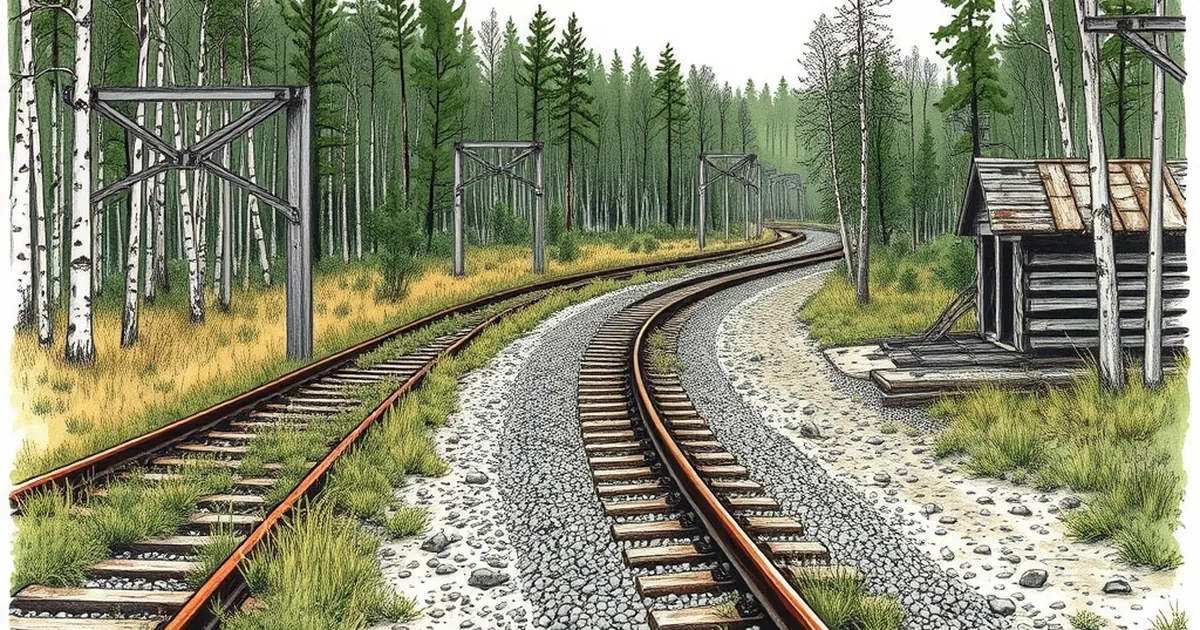
There is a stretch of single-track rail near Siedlce that hasn't seen a freight car in nearly four years. The sidings are still there — rusted switches, cracked concrete, a buffer stop swallowed by weeds. The company that used them went bankrupt in 2021, and with it went the last reason anyone had to keep the rails alive. When the owner dies, the siding dies too. But why does that matter for the rest of us, and what exactly is being lost when a private spur quietly disappears from Poland's rail map?
The Quiet Disappearance of Poland's Industrial Spurs
Poland's rail network is usually discussed in terms of the big picture: PKP PLK's 19,000-plus kilometres of track, the CPK megaproject, the east–west corridors feeding into Germany and Ukraine. What rarely makes headlines is the dense, invisible web of private sidings — bocznice kolejowe — that once connected nearly every factory, sugar plant, coal depot, and grain elevator to the national network.
These spurs were never glamorous. A typical siding is a few hundred metres of low-grade track, a single switch, maybe a small loading ramp. For decades they were the circulatory system of Polish industry: raw materials in, finished goods out, without a single truck touching a public road.
That system is collapsing. According to data cited by the Office of Rail Transport (UTK), the number of registered sidings in Poland has fallen from over 3,000 in the early 2000s to fewer than 1,500 today. Many of the survivors are technically active but functionally dormant — used a few times a year, if at all.
Why the Numbers Keep Falling
The pattern is consistent. A company changes ownership, merges, or moves production. The new management looks at the siding, sees a maintenance liability, and files the paperwork to shut it down. Once a siding is formally decommissioned, reactivating it is expensive enough that nobody bothers.
There's also a structural issue: sidings are almost always owned by the businesses they serve, not by PKP. That means they're subject to the same short-term financial logic as any other asset. A siding that doesn't generate measurable revenue gets cut in the next cost review.
Who Actually Owns the Problem?
This is where things get uncomfortable. A siding isn't just a piece of private property — it's a link in a public transport chain. When it disappears, the freight doesn't disappear with it. It moves to trucks.
The Road Freight Shift
A mid-sized factory that once shipped 40 wagons a month now dispatches 80 trucks instead. Those trucks use public roads, paid for by taxpayers, and they emit roughly three to four times more CO2 per tonne-kilometre than rail. The external costs are socialised; the savings are private.
Poland already has one of the most truck-dependent freight markets in the EU. Road transport carries around 75–80% of inland freight tonnage, well above the European average. Every siding that closes nudges that number higher.
The Municipal Blind Spot
Local governments often don't notice until it's too late. A siding closure is filed with UTK, not with the gmina. By the time a commune realises its industrial zone has lost rail access, the tracks have been lifted or the switch has been removed from the main line.
I spoke with a logistics manager at a food processing plant in Wielkopolska who described the moment his company's board voted to shut down their siding in 2019. "It wasn't a rail decision," he told me. "It was an accounting decision. Nobody in that room was thinking about the region."
Why Reviving a Dead Siding Is So Hard
Even when there's political will, the technical and legal path back is brutal.
The Cost Stack
Reactivating a decommissioned siding means: a new or restored switch on the main line (often the single most expensive element), track renewal, drainage, signalling checks, and a fresh safety approval from UTK. For a typical 500-metre spur, this can easily run into several million złoty before a single wagon moves.
Then there's the operational side. Rail freight in Poland is dominated by a handful of carriers, and serving a small single-customer siding is rarely attractive to them. A company that wants rail service often has to negotiate directly with PKP Cargo or a private operator — and the minimum volumes required can be punishing.
The Regulatory Gap
Unlike Germany, which has dedicated federal funding programmes for siding construction and reactivation (and has poured hundreds of millions of euros into them), Poland lacks a coherent national support scheme for private sidings. There have been pilot programmes and EU-funded calls, but nothing at the scale of the problem.
The result is a slow, unglamorous attrition. No single closure is dramatic. Collectively, they amount to a structural shift in how Polish goods move.
What a Smarter Policy Could Look Like
There are models worth copying. The Czech Republic and Austria both operate grant schemes that co-finance siding upgrades, on the logic that a private spur delivers public benefits — fewer trucks, lower emissions, less road wear.
Poland could do the same, and there are signs of movement. The Ministry of Infrastructure has flagged rail freight and intermodal terminals as priorities in various strategy documents, and EU cohesion funds for 2021–2027 include envelopes that could, in principle, be directed at siding infrastructure. The question is whether anyone will actually write the cheque.
A practical first step would be a national inventory: a public, updated map of active and dormant sidings, with ownership data. Right now, that information is scattered across UTK filings, PKP records, and municipal archives. You can't save what you can't see.
Second, a targeted grant programme for SMEs in industrial zones — co-financed at 40–60% — would change the maths for dozens of companies currently on the fence. The cost per tonne of CO2 avoided would likely compare favourably with many road-side interventions.
Third, and perhaps most importantly, the closure process itself needs a public-interest test. If a siding serves a strategic customer or sits inside an active industrial zone, its decommissioning should trigger a notification to the relevant gmina and voivodeship marshal. Right now, it triggers nothing.
The next time you see a rusted switch disappearing into the undergrowth beside a main line, remember what it represents. It's not just a dead asset. It's a missing option — one that Poland will need more, not less, in the coming decade as road congestion, emissions targets, and logistics costs all push in the same direction. The sidings aren't dying because rail lost. They're dying because nobody was paying attention.