October 2026
Gdańsk's Port Rail Yard Runs Out of Track Before Cargo
Gdańsk's port rail yard sits idle despite booming container traffic, exposing how outdated internal tracks undercut the Baltic hub's freight ambitions
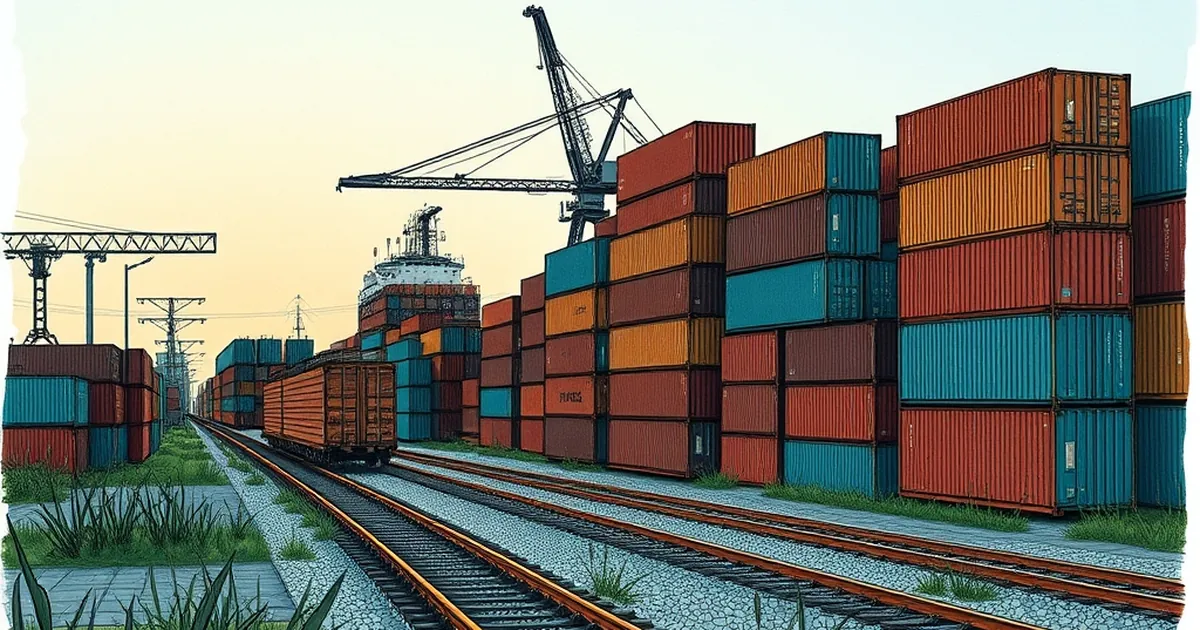
Gdańsk has spent the better part of a decade positioning itself as the Baltic's answer to Rotterdam — a port complex with enough ambition to pull freight away from Hamburg and Bremerhaven. The container terminals at DCT Gdańsk are humming, the deepwater quay handles the largest ships afloat, and the city's logistics parks keep filling up. So why is one of the port's key rail facilities sitting idle, with capacity it literally cannot use?
The answer, frustratingly, has nothing to do with demand and everything to do with the tracks themselves. Gdańsk's port railway network — the internal web of sidings, yards, and connections that moves cargo from quay to national grid — has run out of usable track before it has run out of cargo. That's a strange sentence to write about a port that just celebrated record container volumes, but it's the reality on the ground.
The Bottleneck Nobody Planned For
Ports don't work without rail. Roughly half of all container traffic leaving Gdańsk heads inland by train, bound for inland terminals in Kąty Wrocławskie, Poznań, Łódź, and increasingly for markets in the Czech Republic and Slovakia. That share is growing, and it's growing faster than anyone forecast when the current port rail layout was designed.
Here's the problem in plain terms: the port's internal rail network was built for a different era of cargo flows. The sidings that once served bulk terminals and smaller operators don't match the geometry of modern intermodal trains. A 740-meter train of double-stacked containers needs long, straight, well-signalled tracks with enough clearance. Gdańsk's port has plenty of track meters on paper — but much of it is fragmented into short stubs, curves with tight radii, and yards that can't hold a full train without splitting it.
The result is that trains queue. Not at the port gate, not on the national line, but inside the port itself, waiting for a path to open. Terminal operators report that they can load a ship faster than they can clear the boxes by rail. That's a luxury problem only in the sense that a heart attack is a luxury problem for someone who's been eating well.
When Cargo Sits Because the Track Ends
I spoke with a freight forwarder in Gdynia last autumn who described a shipment of automotive parts bound for a plant near Katowice. The containers discharged from a vessel on a Tuesday morning. They were ready for rail pickup by Tuesday afternoon. They actually left the port on Thursday night — not because of customs, not because of a missing document, but because the intermodal train that was supposed to take them couldn't be assembled inside the port in time. The train had to be built in two parts on two separate sidings and then joined outside the gate.
That's a two-day delay on a domestic route that should take one day. Multiply it by thousands of containers a month and you start to see why shippers get nervous. Some of them are already routing cargo through Hamburg again, or splitting volumes between Gdańsk and German ports to hedge their bets. A port that loses its rail reliability loses its inland customers, and inland customers are the ones who keep the terminals full when the shipping alliances reshuffle their services.
Why the Fix Is Harder Than It Looks
The obvious answer — build more track — runs straight into a wall of constraints that anyone who has worked on Polish infrastructure will recognize immediately.
Land, Money, and the Polish Permitting Maze
The port of Gdańsk is not surrounded by empty fields. It's hemmed in by the city, by the Martwa Wisła, by industrial land that belongs to a patchwork of owners, and by the existing road network. Adding rail capacity means either rebuilding what's there — which requires taking tracks out of service, which requires cargo to go somewhere else in the meantime — or finding new corridors. Neither is cheap, and neither happens on a political timescale.
Then there's the money. The port's rail infrastructure is a mix of assets owned by the Port of Gdańsk Authority, PKP PLK (the national rail infrastructure manager), and private terminal operators. That fragmentation is a classic Polish infrastructure problem: everyone agrees the network needs work, nobody agrees who pays for which meter of track. EU funding through the Connecting Europe Facility has helped, and the Baltic-Adriatic corridor designation gives Gdańsk access to serious money. But funding applications take years, and construction takes longer. In the meantime, the trains keep waiting.
The Signalling Problem Nobody Talks About
Here's a detail that gets lost in the big-picture debate: it's not just about how much track you have. It's about how quickly you can move trains through it. Gdańsk's port rail network still relies on signalling and control systems that are, to put it politely, not modern. Some of the yard movements are still coordinated by radio and paper. That caps throughput regardless of how many meters of rail you lay.
Compare that to Rotterdam, where the port railway runs on a centralized traffic control system that lets controllers see and route every train in real time. Gdańsk doesn't need Rotterdam's scale, but it needs Rotterdam's logic: digital control, automated routing, and a single operations center that can see the whole port rail picture. Some of that work is underway. Not enough of it is funded.
What's Actually Being Done — and What's Still Missing
There is progress. The Port of Gdańsk Authority has been upgrading the internal rail network in phases, and the ongoing works around the DCT terminal and the Pomeranian Logistics Centre have added capacity. PKP PLK has also been rebuilding the approach lines, which matters because a bottleneck inside the port is useless to fix if the line outside it can't handle the trains.
But the pace is the issue. Poland's rail investment pipeline is crowded, and port rail doesn't always win the argument against passenger rail or against the big east-west freight corridors. Gdańsk's port authority has been vocal about the need for a dedicated funding stream for port rail, and that argument is starting to land in Warsaw. Whether it lands before the next wave of container growth arrives is the open question.
The Forward View
The practical takeaway for anyone moving cargo through Gdańsk is simple: don't assume rail will be there when you need it. Build flexibility into your supply chain, and talk to your forwarder about realistic transit times rather than the ones on the schedule. For those of us who watch Polish infrastructure, the bigger lesson is that ports are systems, not just terminals. A deepwater quay is worthless if the tracks behind it can't carry the boxes away.
Gdańsk will fix this. The demand is there, the political will is building, and the EU funding taps are open. But "will fix" and "has fixed" are different things, and right now the port is living in the gap between them — with trains waiting on sidings that were never designed for the cargo they're carrying.