November 2026
Why late-night road works feel shorter than the queue they cause
Late-night road works seem to end faster than the queues they create, revealing a strange asymmetry in how we price and experience time
4 min read
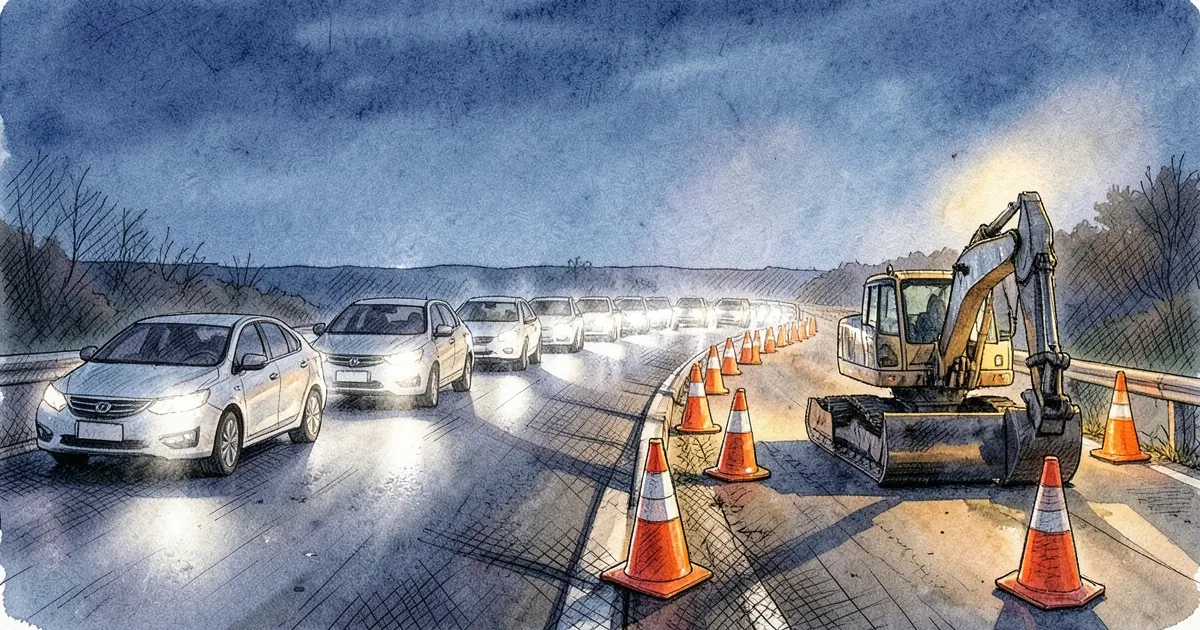
Most drivers who have waited in a single-lane crawl past a night resurfacing site will swear the queue lasted longer than the shift that caused it. The feeling is so common it barely seems worth questioning — yet it points at something genuinely strange about how we price time, and about why road agencies keep choosing the night shift even when the daytime alternative looks cheaper on paper.
The asymmetry between doing and waiting
Daniel Kahneman and Amos Tversky's work on loss aversion gives the first clue. Losses hurt roughly twice as much as equivalent gains please, which means a minute subtracted from a journey registers far less vividly than a minute added. When a contractor works at night, most drivers never see the labour at all — they see only the road, reopened, ordinary. The benefit is invisible and diffuse. The cost, when a lane closes, is visible, shared, and attributed to somebody.
There is a second asymmetry underneath it. Waiting is passive; work is active. A driver stuck in a queue has nothing to do but count the seconds, and attention directed at duration tends to inflate it. The same driver passing a lit-up site at 23:00 sees activity, machinery, people in hi-vis — a scene that reads as progress rather than delay, even if the delay is real. Psychologists call the general effect a difference in how we process occupied versus empty time, and it shows up in every domain where people queue for something they cannot see being made.
What the timetables actually say
Polish practice makes the logic explicit. According to a Sejm interpellation response from August 2024, the national road authority GDDKiA's maintenance contract guidelines state that night-time work which would significantly obstruct traffic, and which has no technological barrier to being done at night, should be carried out between 20:00 and 6:00. The rule exists precisely because the daytime cost of a closure is so much higher than the night-time cost.
The traffic numbers explain why. GDDKiA data cited by the logistics trade press show that nearly 80% of vehicles and 73% of heavy vehicles travel between 06:00 and 18:00, while only 16% of trucks move between 22:00 and 06:00. Closing a lane at noon hits the bulk of the demand; closing it at midnight hits a fraction. The arithmetic is not subtle.
But the guidelines are not always followed, and the exceptions are instructive. The same Sejm response describes resurfacing on national road 94 between Olkusz and Kraków in June 2024, where manual traffic control was used during peak hours; the contractor then paused work on the next section to clear the backlog after finishing the first. Elsewhere the pattern is cleaner. In Wrocław, major work requiring lane closures on ul. Piotra Skargi was scheduled exclusively between 19:00 and 5:00 to keep a central artery passable during the day. In Wieliczka, a contractor moved the start of a temporary traffic-organisation stage on DK94 to 21:00 specifically to reduce disruption — a change that itself took four to five hours to implement.
And sometimes the night shift is not a policy but an emergency. Gdańsk officials described night resurfacing on Obrońców Wybrzeża in July 2025 as an exceptional measure forced by rain delays and a hard 9 July deadline. The night was not chosen because it was cheaper; it was chosen because the calendar had run out.
Why the queue feels longer than the shift
Here the behavioural literature gets specific. Variable and unpredictable waits feel longer than steady ones of the same average length, because the uncertainty keeps attention engaged and the mind keeps rehearsing worst cases. A queue that might move at any moment is more draining than one that visibly counts down. This is the same mechanism that makes intermittent, unpredictable reinforcement so sticky in other contexts — the reason a four-minute hold at road works can feel like two, and the reason unpredictable rewards distort how long a wait seems to last.
The night shift, by contrast, is usually invisible to the people it benefits. Nobody queues at 02:00 to watch a paver. The work happens in a window almost nobody occupies, so the benefit never enters anyone's conscious ledger. What enters the ledger is the one morning the lane was still shut at 07:00 because the crew ran late.
There is also a social dimension. Queues are audiences. Drivers watching other drivers change their behaviour — closing gaps, refusing to let anyone in, edging forward — and the mutual observation makes the whole thing feel more adversarial than it is. Experiments on roundabout behaviour have found that gap times shrink by around 0.4 seconds when a queue is watching, which is a small number with a large effect on how tense a junction feels. A night closure removes the audience entirely.
The information fix that costs almost nothing
If the problem is partly perceptual, part of the solution can be too. Drivers tolerate a known wait far better than an unknown one, and the cheapest intervention is telling them what the wait is rather than what caused it. Signage and app notifications that show a countdown, or a realistic estimate, consistently outperform explanations of why the work is happening. The principle is the same one behind boards that display the wait rather than the cause: people can plan around a number, but not around a rationale.
For agencies and contractors, the practical implication is a scheduling rule with a communications layer on top. Night work where the traffic data justify it, as the GDDKiA guidelines already say; but also public commitment to the window — a stated reopening time that drivers can trust — and honest signalling when a deadline slips. The Wieliczka example, where a stage start was pushed to 21:00 and the change took hours to set up, is a reminder that night scheduling has its own logistics costs and cannot be improvised at 18:00.
The forward-looking question is not whether night works are worth it. On the traffic figures they plainly are. It is whether the agencies that schedule them will start treating the perception gap as a design constraint rather than an unavoidable grumble — publishing reopening times, syncing them with navigation apps, and measuring compliance the way they already measure pavement quality. A shift nobody sees still has to be believed in, and belief is cheaper to build than asphalt.