November 2026
Variable Rewards Make 4-Minute Road Works Feel Like Two
Variable rewards explain why a four-minute Polish road-works delay can feel like seconds or stretch into an eternity
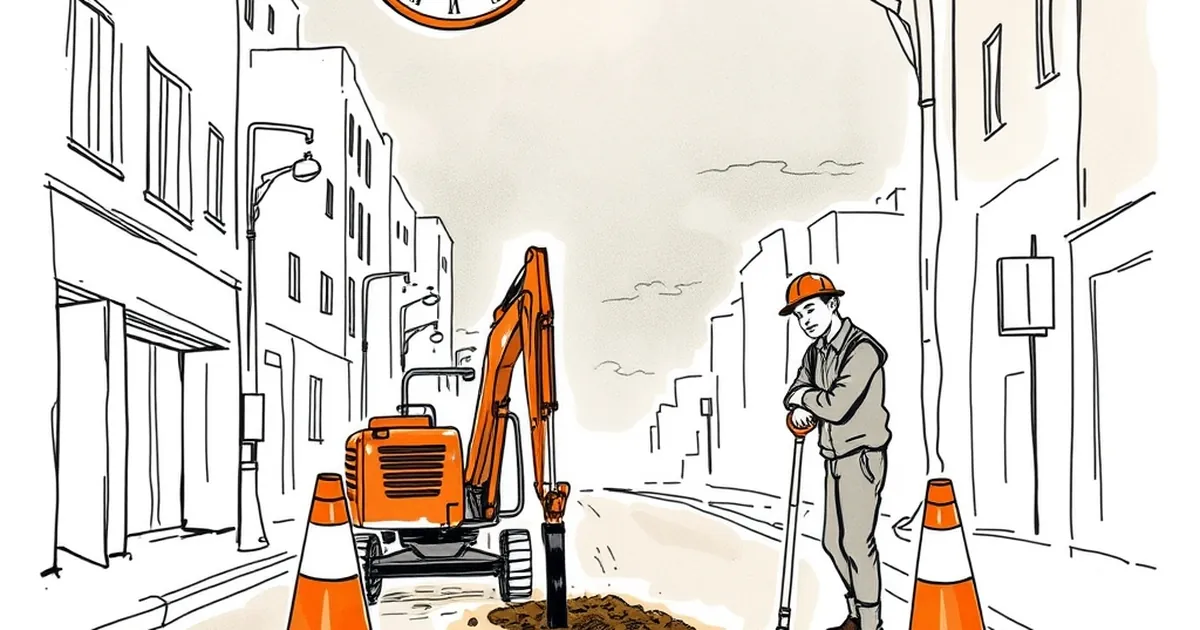
Four minutes. That's the figure that keeps surfacing in Polish road-works signage and in the contractor guidance that follows the GDDKiA's temporary traffic organisation standards — the rough duration engineers assume a driver will tolerate a single-lane bottleneck before frustration starts to bite. Anyone who has sat at the Błonie pinch on the A2, or threaded through the eternal resurfacing of Kraków's Aleja 29 Listopada, knows the felt experience rarely matches the number on the board. Sometimes four minutes passes in a blink of podcast and dashboard; sometimes it stretches into a small eternity of brake lights and existential arithmetic. The question worth asking is not how long the works actually take, but why identical waits feel so radically different — and what that gap tells us about how drivers, engineers and city managers should be thinking about delay.
The Board Says Four, the Brain Says Otherwise
There is a well-documented asymmetry in how humans experience time under uncertainty. When an outcome is predictable, the brain settles into a low-arousal groove; when it is not, attention sharpens and the perceived duration inflates. This is the same machinery that makes a delayed train feel longer than a delayed flight, even when the flight delay is longer in absolute minutes. The uncertainty, not the duration, is doing the work.
Road works are, by design, a low-information environment. A driver approaching a narrowing sees a board, a cone taper, a speed limit and very little else. Will it be one lane or two? Will the merge be orderly or a scrum? Will the guy in the Passat ahead decide to assert himself at the last metre? The brain cannot answer these questions in advance, so it allocates attention to answering them in real time — and attention is the currency in which perceived duration is paid.
This is where the psychology starts to matter for infrastructure. A four-minute delay with high uncertainty can feel longer than a six-minute delay with low uncertainty. The engineering instinct — minimise the objective number — is correct but incomplete. The behavioural instinct — minimise the unpredictability of the number — is the missing half.
Variable Rewards, Predictable Frustration
The concept most often invoked here is variable-ratio reinforcement, the schedule made famous by B.F. Skinner's work on operant conditioning in the 1950s. Skinner found that behaviour reinforced on an unpredictable schedule — sometimes rewarded, sometimes not — is far more persistent than behaviour reinforced every time. The slot-machine metaphor is the popular one, but the more relevant application for transport is subtler: unpredictable relief is what hooks attention, not just unpredictable reward.
A merge that sometimes flows and sometimes jams is a variable-ratio environment. The driver who has previously sailed through a bottleneck at 50 km/h without touching the brake learns to expect that outcome — and then spends the next encounter scanning for it, braking early, checking mirrors, second-guessing the gap. The relief, when it comes, is disproportionately satisfying. The frustration, when it doesn't, is disproportionately sharp. Neither response is rational in the cost-benefit sense; both are entirely predictable in the behavioural sense.
Kahneman and Tversky's loss aversion work is the other pillar. Losses loom roughly twice as large as equivalent gains, which means a driver who loses two minutes to a badly managed taper feels the loss more acutely than they would feel a two-minute gain from a well-managed one. The asymmetry is structural. It means the reputational cost of a single chaotic merge can outweigh the goodwill generated by a dozen smooth ones — a fact that any contractor managing a long-running corridor knows in their gut even if they have never read the paper.
The Śląska Interchange Lesson
A concrete illustration: the reconstruction of the Murckowska interchange in Katowice, which ran for the better part of two years and funnelled a large share of the city's north-south traffic through temporary layouts. What made the difference between tolerable and intolerable days, according to the traffic engineers who worked on the phasing, was not the raw capacity of the temporary lanes but the consistency of the merge geometry from week to week. Layouts that changed without warning — a taper shifted fifty metres, a lane closed earlier than the previous week — produced measurable spikes in queue length that could not be explained by demand alone. Drivers who had learned a pattern were forced to relearn it, and the relearning cost showed up as slower, more hesitant merging for days afterwards.
The lesson generalises. Predictability is a design parameter, not an afterthought. A slightly longer but stable detour will often outperform a shorter but variable one, because the brain can stop spending attention on the question of what comes next.
Designing for the Feeling, Not Just the Number
What would it mean to treat perceived duration as a design constraint alongside objective duration? A few practical directions are already visible in Polish practice and worth pushing further.
Communicate the range, not the point estimate. A board that says "4 min" invites the brain to treat four as a promise. A board that says "3–6 min" sets an expectation the driver can absorb. The uncertainty is still there, but it has been framed rather than hidden, and framed uncertainty is far less costly than ambush.
Stabilise the geometry. Contractors under schedule pressure are tempted to shift tapers as work fronts move. Every shift is a relearning event for thousands of drivers. Batching layout changes into predictable windows — say, overnight on a fixed weekday — converts a variable-ratio environment into a fixed-interval one, and the behavioural literature is unambiguous about which produces calmer behaviour.
Use the merge itself as a signal. The zipper merge, still resisted in much of Poland, works not only because it uses both lanes but because it gives drivers a clear, shared script. A script is the opposite of uncertainty. Where zipper merging has been introduced with proper signage and a short public-information campaign, the measured improvement in throughput is modest but the measured improvement in driver-reported stress is not.
Treat the first day of any new layout as a communications event. The variable-ratio hook is strongest on first exposure. A layout that is explained before it is encountered — via variable message signs a kilometre back, via the city's app, via the contractor's own feed — arrives as information rather than as surprise.
What to Watch Next
The forward-looking question is whether Poland's road authorities will start measuring the thing that actually determines public tolerance. Objective delay is already well instrumented — GDDKiA's traffic monitoring and the growing network of ANPR and radar sensors give a fine-grained picture of how long queues actually are. Perceived delay is not measured at all, and yet it is what drives the complaints, the political pressure and the reputational damage that shapes how much room contractors get on the next job.
A modest proposal: add a short, recurring driver-experience survey to the standard post-project review, asking not "how long did you wait" but "how predictable was the wait." The two answers will diverge, and the divergence is the design brief. The four-minute figure on the board is a useful starting point, but the number that actually governs behaviour is the one in the driver's head — and that one is built out of surprise, relief and the small, repeated gamble of the merge. Get the predictability right, and four minutes will start to feel like two. Get it wrong, and no amount of asphalt will fix the queue.