October 2026
Queues shorten when boards show the wait, not the cause
Polish road operators learned that variable message signs showing wait times rather than causes of delays change how drivers respond to uncertainty
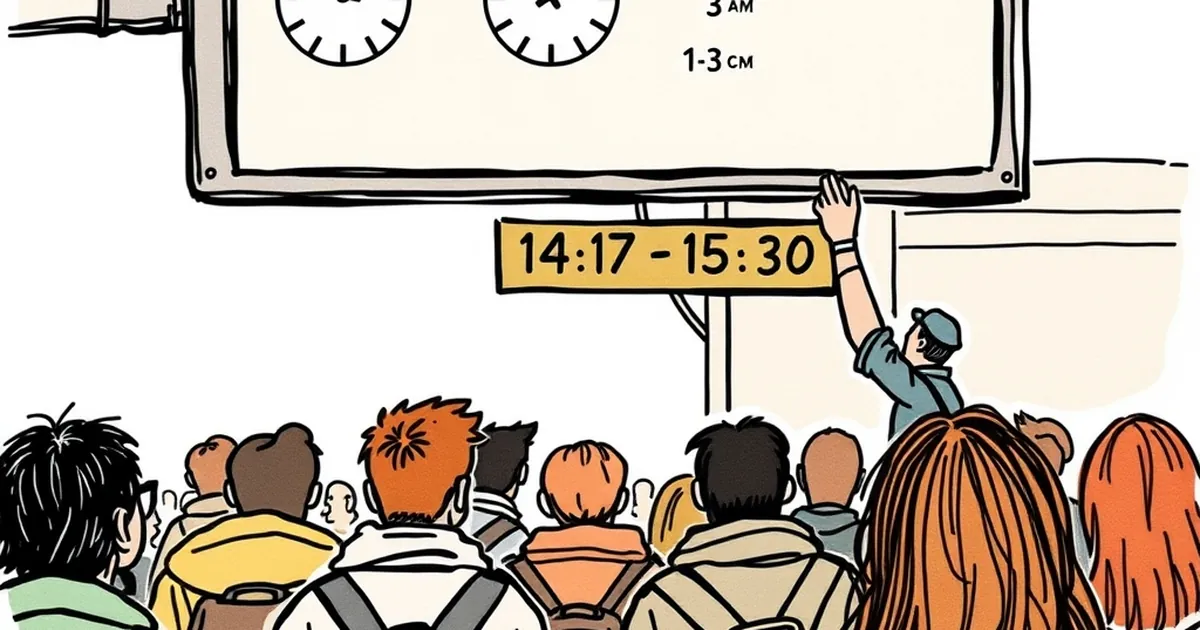
When a road agency announces that a bridge will close for eight months, drivers do not respond to the engineering facts. They respond to a number: how long will this cost me, today, on this trip? Polish road operators have spent the past decade learning this the hard way, and the lesson maps onto a much older body of work in behavioral psychology — people manage uncertainty poorly, and they manage it worst when the information they are given describes causes rather than consequences.
What the driver actually wants to know
A variable message sign that reads "Roboty drogowe — utrudnienia" tells a driver that something is wrong and nothing about what it means for them. A sign that reads "Objazd — +25 min" tells them the same thing in the only currency they were ever going to spend. The distinction sounds trivial until you watch what happens at the merge point.
Polish GDDKiA and several municipal traffic management teams have been moving toward travel-time displays on the S8, the A4 corridor and the Warsaw ring approaches, partly because the older cause-based messaging produced a well-documented problem: drivers who could not estimate the delay tended to either overreact (bailing into parallel local roads and overwhelming them) or underreact (staying on the main route until the queue forced a late, disruptive merge). Neither behavior is irrational. Both are what you get when the cost of a decision is unknown.
Loss aversion meets the merge lane
Kahneman and Tversky's work on loss aversion established that people weigh losses more heavily than equivalent gains, and that this asymmetry intensifies under uncertainty. A driver who is told "roadworks ahead" has no anchor for how much time they stand to lose, so the anticipated loss expands in the imagination. The result is a predictable pattern: a share of traffic diverts early and unnecessarily, clogging secondary roads that were never designed for the volume, while the main queue persists anyway.
Give the same driver a number — twenty-five minutes, thirty-five minutes — and the calculation changes character. It becomes a comparison rather than a guess. Twenty-five minutes against a known alternative route is a decision a person can actually make. This is not a subtle psychological point; it is the difference between a decision made under ambiguity and one made under risk, and the behavioral literature has been clear for decades that people handle the second far better than the first.
There is a second effect worth naming. When a displayed estimate turns out to be accurate, drivers update their trust in the sign itself. When it is wrong, they discount every future message. Variable-ratio reinforcement — the intermittent, unpredictable reward pattern that makes behavior so resistant to extinction — cuts against road operators here. Inconsistent information trains drivers to ignore signs, and once that habit forms it is expensive to reverse.
The concrete case: travel-time signs on the A4
The clearest Polish illustration comes from the travel-time measurement systems installed along the A4 between Wrocław and Gliwice, where inductive loops and camera-based re-identification feed delay estimates to overhead displays. Operators reported that during incident periods, the share of through-traffic diverting at the preceding interchange rose when a specific time was posted, and that the diversion was better distributed across available alternatives than the earlier blanket warnings had produced. The mechanism is straightforward: a specific number lets a driver compare, and comparison produces more consistent behavior across the population than a vague warning does.
The same logic appears in a completely different setting. London Underground's decision to publish live wait times on platform indicators, rather than only service-disruption notices, was followed by measurable improvements in platform crowding distribution — passengers spread themselves across the network differently when they could see how long the next train would take. The cause of the delay mattered less to them than its duration.
Why this is harder than it looks
Publishing a wait time is an operational commitment, not a communications one. A number on a gantry is a promise, and broken promises are worse than silence. That means the data pipeline behind the sign has to be honest: sensor coverage, re-identification accuracy, the treatment of stopped vehicles, and the fallback behavior when a segment goes dark all have to be designed before the first minute estimate goes up.
There is also a fairness question that Polish operators will recognize. Travel-time displays help the drivers who see them, but they also shift load onto local roads whose residents did not consent to becoming a bypass. Behavioral interventions in infrastructure rarely act on one population only. A sign that persuades 8 percent of motorists to leave the motorway is, from the perspective of the village at the next exit, a policy decision.
And there is the risk of over-precision. A display reading "23 min" implies a confidence the underlying model may not have. Behavioral research on numeric anchoring suggests that people treat precise figures as more credible than rounded ones, which is exactly backwards when the estimate carries a wide error band. Several operators have moved toward ranges or banded displays for this reason.
What comes next
The forward-looking question is not whether to show wait times but what else to show alongside them. Polish road authorities are already experimenting with predictive displays — not the current delay, but the delay expected when the driver actually arrives at the bottleneck. That is a meaningfully different cognitive task: it asks the driver to reason about a future state rather than a present one, and the evidence on how well people do that is less encouraging.
The more promising direction may be simpler. Pair the time with the cost of the alternative. A sign that reads "+25 min" is useful; a sign that reads "+25 min, objazd +18 min" turns an estimate into a choice. That is the point at which behavioral design stops being a courtesy and starts being infrastructure — and it is the point at which the agencies that get the data right will visibly outperform the ones that only get the message right.