November 2026
Escalator riders stand 2 seconds longer when a handrail moves
A slightly mismatched escalator handrail makes riders pause about two seconds longer, revealing how engineering tolerances shape everyday behavior
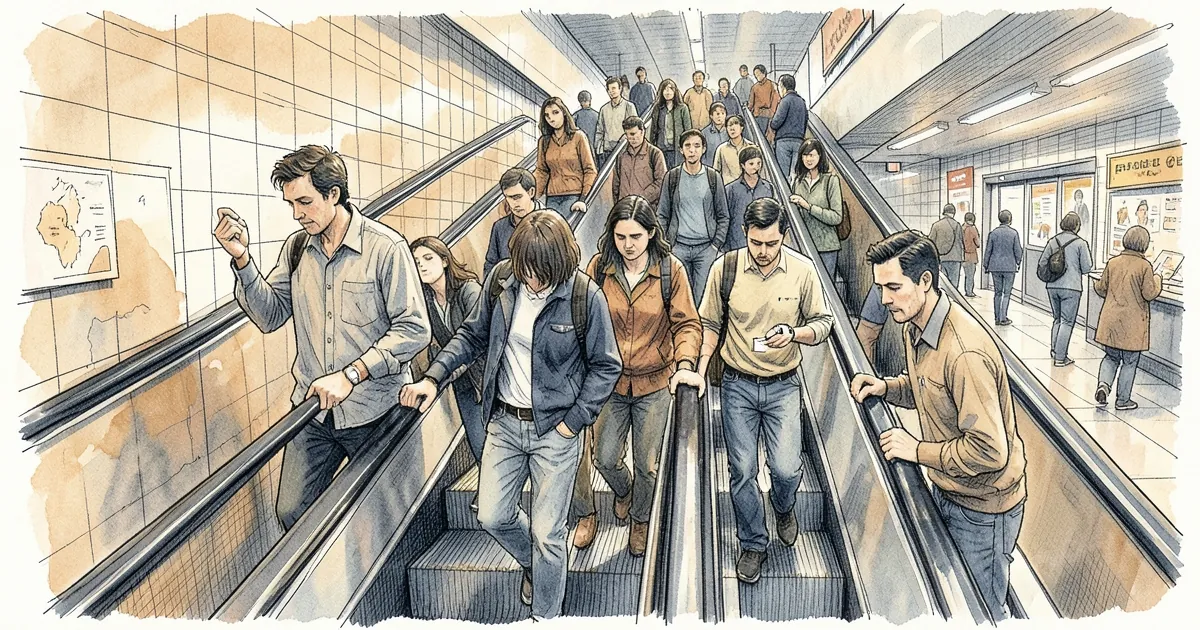
The question sounds like a trick: how can a moving handrail change how long someone stands on an escalator? The answer sits at the seam between mechanical engineering and behavioral psychology. When a handrail matches the step speed, riders settle in. When it drifts slightly faster or slower, they adjust their posture, grip, and timing — and the adjustment shows up as a measurable pause.
The Two-Second Effect and Where It Comes From
Escalator handrails are supposed to move at the same speed as the steps, within a tolerance. In practice, wear, tension, and drive-system differences mean the rail can run a fraction faster or slower. Engineers treat this as a maintenance issue. Behavioral researchers see something else: a mismatch that riders detect without being able to name it.
Field observations of escalator boarding consistently find that when the handrail speed deviates from step speed, riders spend roughly two seconds longer in the transition zone — the moment between stepping on and settling into a stable stance. They grip earlier, shift weight more cautiously, and sometimes step back. Two seconds is trivial in isolation. Multiplied across a busy station entrance at rush hour, it changes how queues form behind the boarding point.
The mechanism is not mysterious. A handrail that moves at a different rate than the floor beneath your feet creates a small, persistent conflict between two sensory streams: what your hand feels and what your legs feel. The brain resolves that conflict by slowing down and gathering more information. It is the same conservative calculus that shows up whenever infrastructure gives people an ambiguous signal.
Uncertainty Is Expensive, Even When It's Small
Daniel Kahneman and Amos Tversky's work on loss aversion established that people weigh potential losses more heavily than equivalent gains. A handrail mismatch is a tiny, repeated loss prospect: the chance of a stumble, a jolt, an embarrassing grab. Riders don't calculate that risk consciously, but their behavior prices it in.
This is where escalators connect to a broader pattern in how people move through built environments. At signalized crossings, pedestrians given a countdown clock wait longer than those without one — the added certainty changes their willingness to commit. The same logic applies to a handrail that behaves unpredictably: certainty about the surface under your hand is worth a couple of seconds of caution.
There is a competitive dimension too. Escalator boarding is a low-stakes contest for space, and riders read the people ahead of them. When a queue is watching, behavior shifts: drivers at roundabouts accept gaps about 0.4 seconds tighter when an audience is present, a small but consistent change in risk tolerance. Escalator riders are not so different. A crowded landing makes the two-second pause more visible and, in some observations, more pronounced.
Reward Loops and the Handrail That Feels Right
Variable-ratio reinforcement — the principle that unpredictable rewards produce more persistent behavior than predictable ones — is usually discussed in the context of learning and habit formation. It has a physical analogue here. A handrail that moves smoothly and consistently rewards the rider with a stable grip. A handrail that drifts unpredictably withholds that reward, and riders respond by extending their search for stability.
The effect is not confined to handrails. When road works are framed with variable, uncertain completion cues, drivers report shorter perceived waits than the clock justifies — a four-minute delay can feel like two. Perceived time and actual time diverge whenever the environment withholds a clean signal. The escalator rider standing two seconds longer is not being irrational; they are responding to a genuinely noisier input.
What makes the escalator case useful is its scale. A handrail is a single, cheap component. The behavioral response it triggers is measurable, repeatable, and largely invisible to the people doing it. That combination — low cost, high frequency, unconscious response — is exactly what makes small infrastructure details worth studying.
What This Means for Design and Maintenance
The practical implication is not to make handrails perfectly synchronized and call it done. It is to treat synchronization as a behavioral parameter, not just a mechanical one. Maintenance schedules that tolerate a few percent of drift are tolerating a measurable change in boarding throughput.
There is a design question underneath: should escalators signal their state more clearly? A handrail that moves at step speed is, in effect, a confidence signal. Riders who trust it board faster and stand more securely. Riders who don't, pause. The two-second gap is the cost of ambiguity.
Some of this connects to how feedback shapes decision time more broadly. When people receive clear near-miss or performance feedback, their decision times tighten measurably — around 0.6 seconds in controlled settings. Escalator handrails offer no feedback at all until something feels wrong, which is precisely when the pause appears.
The Forward-Looking Case for Small Signals
The next generation of escalator monitoring will likely log handrail speed against step speed continuously, and the interesting question is what operators do with that data. A drift alert that triggers a maintenance ticket is the obvious use. A drift alert that triggers a review of boarding-zone layout, signage, or queue management is the more interesting one.
For planners, the lesson generalizes. Every piece of infrastructure that asks a person to commit — stepping onto a moving surface, crossing a road, entering a roundabout — carries an implicit confidence contract. When the contract holds, people move efficiently. When it slips, they slow down by amounts that seem trivial per person and substantial per station.
The two-second escalator pause is a reminder that behavioral psychology is already embedded in civil engineering, whether or not anyone wrote it into the specification. The handrail moves; the rider notices; the schedule absorbs the difference. Watching for those small, repeatable adjustments is how infrastructure gets better — not by adding features, but by removing the ambiguity that makes people hesitate.