October 2026
Two-thirds of lift users press the button that does nothing
Two-thirds of lift passengers press buttons that change nothing, from door-close to their own floor, revealing a quiet quirk of everyday behaviour
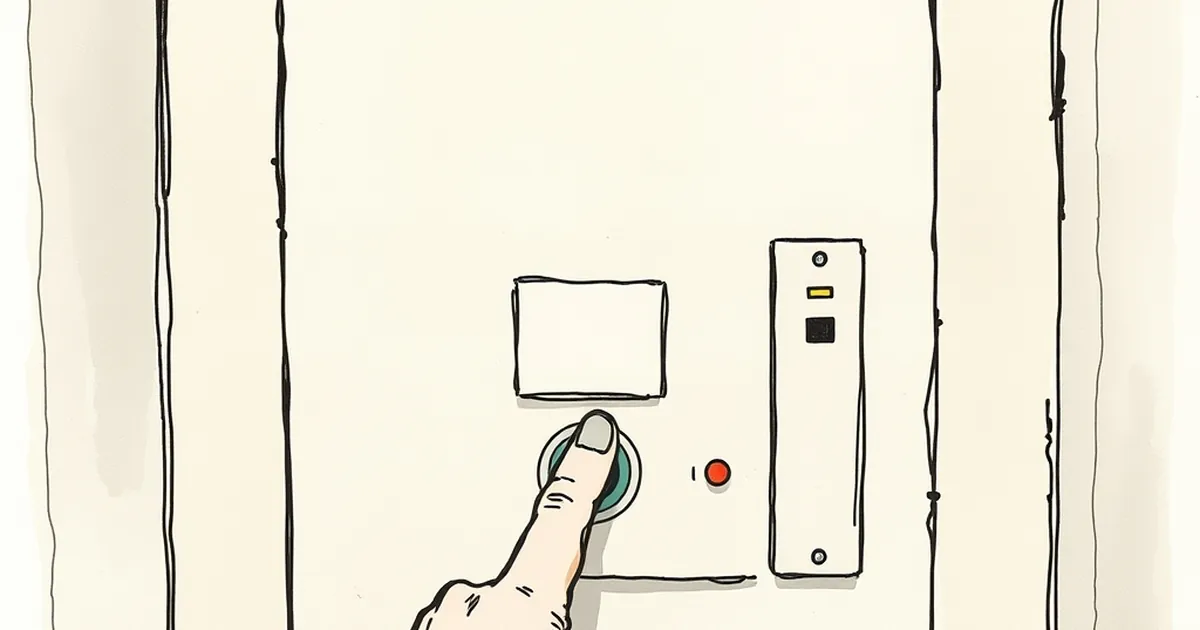
In Warsaw's Varso Tower, the fastest lift in the European Union climbs more than twenty metres a second, and a good share of the people inside it will still press the button for the floor they are already going to. The same happens in every office block in Kraków, every hospital in Wrocław, and every shopping centre in Poznań. Surveys of lift behaviour in Europe and North America consistently suggest that something like two-thirds of passengers press at least one button that has no effect on the journey — the door-close button being the classic case, since in most modern installations it is either disabled or does nothing at all outside a fire-service mode. The question worth asking is not why people do it, but what it tells us about how we make decisions in engineered systems that are, by design, already making those decisions for us.
The door-close button is a lesson in variable-ratio reinforcement
The door-close button is one of the most studied pieces of useless hardware in the built environment. In the United States, the Americans with Disabilities Act effectively requires that the close button on an automatic door take at least three seconds to act, precisely so that people with limited mobility are not caught by a fast-closing door. Many building operators go further and simply disconnect the button, leaving it as a placebo. New York City's subway lifts and thousands of office buildings across Europe run on exactly this principle.
Why does the behaviour persist? Because it is rewarded just often enough. Sometimes the doors close quickly after the press; sometimes they do not. That intermittent, unpredictable payoff is what behavioural psychologists call a variable-ratio schedule of reinforcement — the same pattern that B.F. Skinner documented in pigeons pecking at levers, and the pattern that makes the behaviour remarkably resistant to extinction. If the button worked every time, people would press it once and stop thinking about it. Because it works sometimes, they press it every time, and they press it harder when the lift is slow.
There is a second layer. Pressing the button reduces the small discomfort of standing still with nothing to do. In a crowded lift, it is also a social signal: I am doing something, I am not merely waiting. The button is less a control than a coping mechanism, and the fact that it is fake does not diminish its psychological utility one bit.
Loss aversion makes us distrust the machine
Daniel Kahneman and Amos Tversky's work on loss aversion established that people weigh losses roughly twice as heavily as equivalent gains. In a lift, the "loss" is a few seconds of waiting, and the "gain" is arriving marginally sooner. The asymmetry explains why passengers will press a call button that is already lit — the lift has been summoned, the system knows, but the passenger wants to be certain.
Anyone who has stood in a hotel lobby in Gdańsk watching four people press an already-illuminated call button has seen this in action. The button is lit. The display shows the car approaching. And yet the press happens, because the cost of not pressing — the nagging possibility that the system has somehow forgotten you — feels larger than the trivial effort of pressing. This is not irrationality in any strong sense. It is a reasonable response to a system whose internal state is invisible. The lift knows more than you do, and it does not tell you what it knows, so you assert control in the only way available.
Modern destination-control lifts, increasingly common in Polish office developments, remove the up/down buttons entirely: you type your floor on a keypad and are told which car to board. Behavioural studies of these systems report less button-pressing but more initial confusion, because passengers lose the familiar ritual of summoning. The uncertainty does not disappear; it moves.
Risk-taking and competition show up in the stairwell too
Lifts are a small stage for a larger phenomenon that infrastructure planners in Poland are now taking seriously: how people behave when a system gives them partial information and a limited set of actions. The same logic appears in road behaviour. A pedestrian at a crossing with a countdown timer is less likely to jaywalk than one at a crossing with no timer, because the timer converts uncertainty into a calculable risk. Remove the timer and people estimate — often badly — and take chances.
Competitive play sharpens this. In any system where people can compare their outcome to someone else's, the tolerance for waiting drops. Watch a lift lobby at 8:55 in a Warsaw office building and you will see people press the call button, then press it again when a colleague arrives, as if the second press carried more weight. It does not. But the presence of a competitor for the same car changes the calculation, and the button becomes a way of staking a claim. Building managers who have installed destination-control systems in high-traffic Polish offices report that the biggest complaint is not speed but the loss of the small social theatre of the lobby — the jostling, the button-pressing, the unspoken negotiation over who gets in first.
What engineers can learn from a button that does nothing
The interesting question for anyone who designs or maintains infrastructure is not whether to remove the fake buttons — many operators already have — but what the fake buttons were compensating for. They were compensating for opacity. A lift that told you, clearly and immediately, "I have registered your call, a car will arrive in 40 seconds" would make the button redundant in a way that a silent, unlit button never can.
This is the same lesson that is reshaping other parts of Polish infrastructure. Variable message signs on the A2 and A4 motorways, real-time departure boards at tram stops in Kraków, and the passenger information systems on PKP Intercity trains all work on the principle that uncertainty, not waiting, is what people find intolerable. Give them a number, even an unflattering one, and they stop pressing.
There is a cautionary note. In 2019, a widely reported study of hospital lift lobbies found that removing the door-close button entirely produced a measurable uptick in complaints, even though journey times were unchanged. The button was doing nothing, but its absence was felt as a loss — a small, clean demonstration of Kahneman's point. The lesson is not that fake controls are harmless. It is that removing them without replacing the sense of control they provided invites a backlash.
The next generation of lifts will not have buttons at all
The forward-looking version of this story is already being built. KONE, Schindler, and Otis all now sell lift systems that are called from a smartphone app before you reach the lobby, and several new office developments in Warsaw and Wrocław have specified them. The passenger's phone tells them which car to board and when. There is no button to press, fake or otherwise.
Whether that eliminates the behaviour or merely relocates it is an open question. Early adopters report that people still tap their phones repeatedly while waiting, checking and re-checking the app, for all the world as if the screen were a door-close button. The medium changes; the impulse does not. The real design challenge for the next decade of Polish vertical transport is not the hardware but the feedback loop — building systems that say what they are doing, in language people trust, so that the urge to press something, anything, finally has nothing left to do.