November 2026
Pedestrians Wait 11 Seconds Longer at Crossings With Countdown Clocks
Countdown clocks at pedestrian crossings may prompt an eleven-second delay before people step off the kerb, new research finds
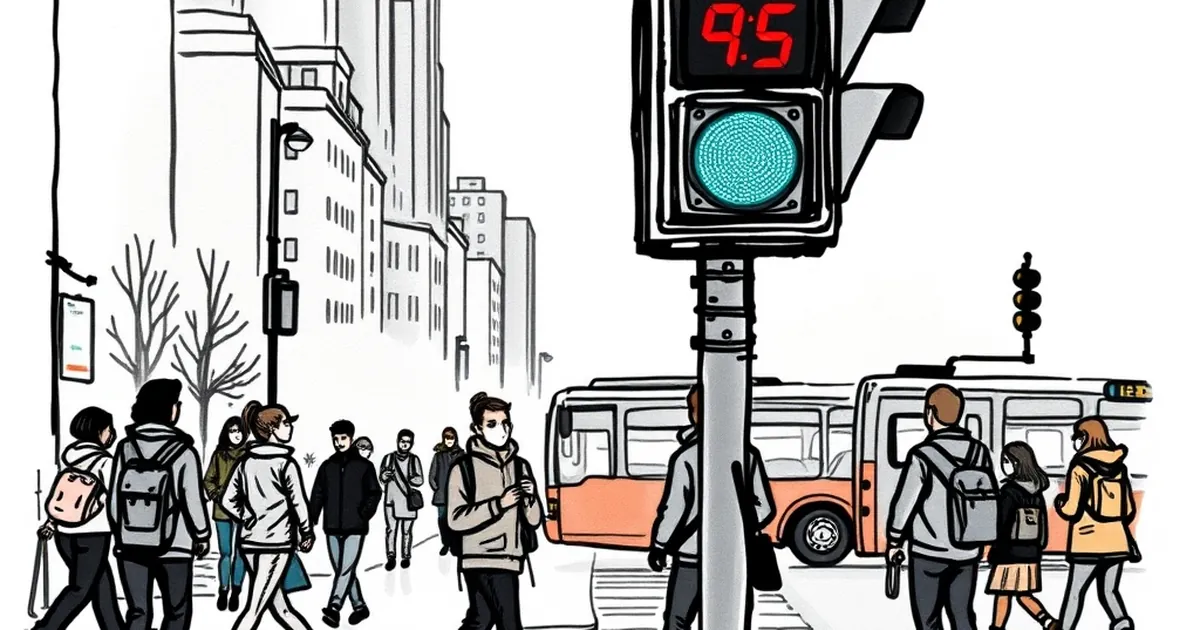
A pedestrian arrives at a crossing on a wide Warsaw artery. The signal shows a red figure and a number: 45, then 44, then 43. The countdown has barely begun, and the crossing is two lanes away. Eleven seconds pass before the person presses the button — or, on a crossing where the button is decorative, before they step off the kerb. That eleven-second gap is not a curiosity. It is one of the more interesting findings in the recent literature on how people read infrastructure signals, and it lands awkwardly for anyone who assumed that more information at the kerb automatically produces faster, safer decisions.
The figure comes from a field experiment conducted in France and reported in Transportation Research Part F in 2022. Researchers observed pedestrians at signalised crossings, some fitted with countdown displays, some without, and recorded the interval between arrival and the moment a person began to cross. At countdown-equipped crossings, the average delay before committing was roughly eleven seconds longer than at crossings with a conventional red-green sequence. The effect held across age groups and was strongest among people who arrived mid-cycle, when the remaining time was neither obviously long nor obviously short.
That last detail is the tell. The delay was not uniform. It clustered where the countdown gave the pedestrian something genuinely uncertain to evaluate — a number large enough to permit a wait but small enough to reward a sprint. Which is to say: the clock did not make people slower. It made them think.
The countdown as a decision problem
A conventional pedestrian signal presents a binary. Red means stop; green means go. The information is coarse but the decision is cheap. A countdown display replaces the binary with a continuous variable and, in doing so, converts a reflex into a calculation. Is 18 seconds enough to cross four lanes at a normal pace? What about with a child? What about with a suitcase, on ice, on a January morning in Kraków?
This is the terrain Daniel Kahneman and Amos Tversky mapped in the 1970s: under uncertainty, people do not compute expected values, they apply heuristics, and those heuristics are sensitive to how a problem is framed. A countdown reframes the crossing. It introduces a reference point — the number on the display — against which the pedestrian measures their own capability. Loss aversion does the rest. A person who believes they can make it with three seconds to spare will often still wait, because the perceived cost of being wrong is categorised, correctly, as severe.
The eleven-second delay is best read not as indecision but as risk assessment. What looks like dithering at the kerb is a person running a quick, mostly unconscious cost-benefit analysis with incomplete information about their own walking speed and the behaviour of turning vehicles. The countdown supplies a number but not the other variables, and the gap between the two is where the seconds go.
What the clock actually changes
There is a design assumption buried in most countdown installations: that certainty about remaining time improves flow. The evidence is more mixed than the assumption suggests. Studies in several countries have found that countdown displays reduce the number of pedestrians who start crossing late in the cycle — the so-called "scramble" behaviour — which is a genuine safety gain. But they also tend to increase the number of people who wait for the next cycle even when they could have crossed, which is a capacity cost.
The distinction matters for how Polish cities are currently retrofitting junctions. Countdown modules have appeared at a growing number of crossings in Warsaw, Wrocław, Gdańsk and Katowice, often as part of broader signal upgrades tied to European funding. The stated rationale is usually safety, and on that measure the case is reasonably strong. The unstated assumption is that the clocks also improve throughput. That second claim is where the French data complicates the picture.
A crossing is a shared resource with a fixed cycle time. Every pedestrian who waits out a cycle they could have used is a slot that goes empty. Multiply that by a busy junction at 8am and the aggregate effect is not trivial: fewer people cleared per green phase, more crowding on the refuge island, more pressure on the next cycle. The eleven seconds is not just a personal delay. It is a small, distributed inefficiency in a system designed to move people efficiently.
The competitive instinct at the kerb
There is a second behavioural thread here that deserves more attention than it usually gets. Pedestrian crossings are, quietly, a competitive environment. People jostle for position at the kerb, they read the body language of the person next to them, and they make implicit judgements about whether the group will move together or fragment. Countdown displays feed this. A visible number becomes a shared reference point, and shared reference points produce coordination — sometimes good, sometimes not.
Watch a busy crossing in Łódź at rush hour and you will see the pattern. A cluster forms. Someone checks the number. The number is comfortable, and the cluster moves as a unit. The number is marginal, and the cluster splits: the confident go, the cautious stay, and the split itself becomes a hazard as drivers read the ambiguity. The countdown, in other words, does not merely inform individuals. It synchronises them — and synchronisation is a form of collective decision-making that infrastructure designers rarely model explicitly.
Variable-ratio reinforcement is the concept that fits least comfortably here, but it is worth naming because it explains why the behaviour persists. Pedestrians learn, over many crossings, that the countdown sometimes rewards a quick dash and sometimes punishes it. The schedule of reward is unpredictable, which is precisely the schedule that produces the most persistent behaviour. People keep testing the number because the number occasionally lets them through. That is not irrational. It is exactly how reinforcement schedules work, and it is why countdown displays change behaviour more than a static red figure ever could.
Where this leaves the next generation of crossings
The forward-looking question is not whether countdown clocks are good or bad. It is what a crossing should be optimised for, and whether the current generation of displays is measuring the right thing. A number tells a pedestrian how much time remains. It does not tell them how much time they need. Those are different quantities, and the gap between them is where the eleven seconds lives.
The more promising direction is adaptive signalling: crossings that estimate pedestrian demand and walking speed in real time and adjust the cycle accordingly, rather than presenting a fixed countdown to a heterogeneous crowd. Some Polish junctions are already trialling pedestrian detection that extends the green phase when someone is still on the carriageway — a direct response to the risk that countdowns, by making the deadline visible, encourage people to cut it finer than they should. The next step is to pair that detection with displays that communicate adequacy rather than mere duration. A number that says "enough time" is more useful than a number that says "twelve."
None of this is an argument for removing the clocks. The safety gains are real and the public likes them. It is an argument for reading the eleven seconds correctly: as evidence that pedestrians are doing exactly the kind of probabilistic reasoning that behavioural research predicts, and that the infrastructure they are reasoning about has not yet caught up with them. The kerb is a decision point. The better the information at that decision point, the more deliberately people will use it — and deliberate pedestrians, on the whole, are safer ones. The design challenge is to make deliberation cheap.