October 2026
Roundabout Capacity Hidden in Driver Reaction Times
Polish roundabout capacity hinges on driver reaction time, a human variable that may no longer reflect how today's drivers actually behave
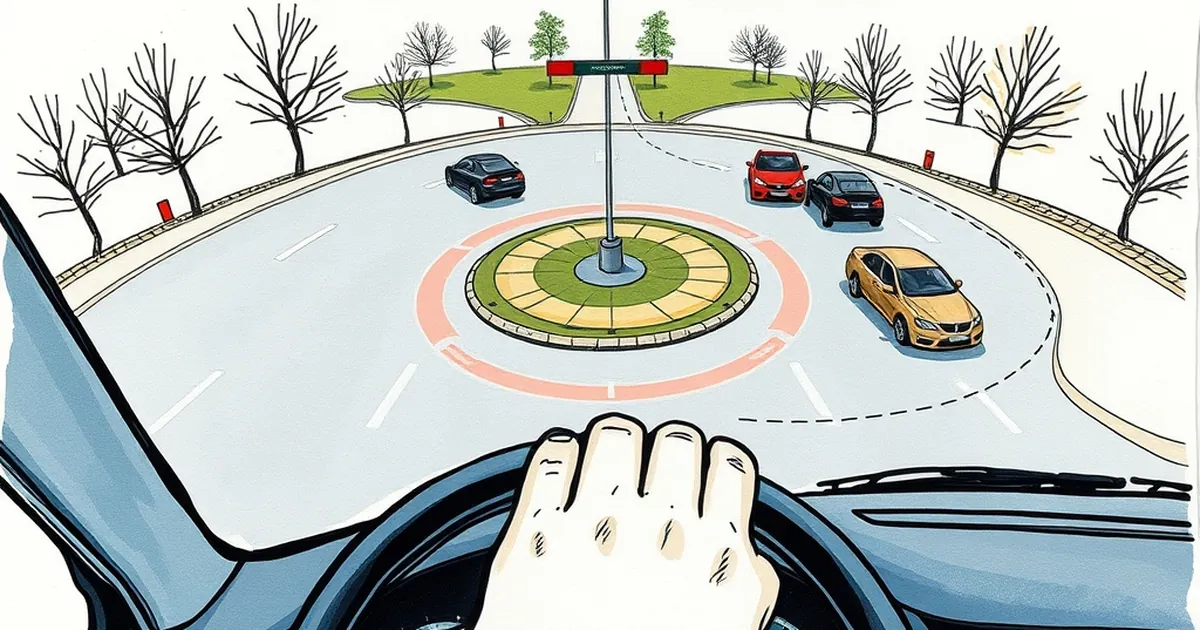
A driver approaching a roundabout in Warsaw or Kraków makes a decision in roughly the time it takes to blink twice. That fraction of a second — the gap between seeing a circulating vehicle and deciding whether to enter — determines how many cars a roundabout can move per hour. Polish road engineers have spent years refining geometric formulas for entry lanes, splitter islands, and inscribed circle diameters, yet the single most consequential variable remains stubbornly human: reaction time. The question worth asking is whether the standard values we assign to that variable still reflect how Polish drivers actually behave — and what changes if they don't.
The Number That Shapes Everything
Every roundabout capacity model in use across Europe, including Poland's inherited SIDRA and HCM-based methodologies, begins with a gap-acceptance assumption. The model asks: given a stream of circulating vehicles arriving at a certain headway, what is the probability that a waiting driver will accept the gap and enter? That probability depends on two things — the size of the gap and the driver's critical gap threshold, the minimum headway they'll accept.
Critical gap is not a physical constant. It is a behavioural one, and it varies with driver age, familiarity with the junction, weather, time of day, and cultural norms around assertiveness. The Highway Capacity Manual uses a default critical gap of roughly 4.1 to 4.6 seconds for single-lane roundabouts. Polish field studies, including work published by researchers at Politechnika Krakowska and Politechnika Warszawska, have recorded median critical gaps closer to 3.5 seconds at some urban sites during peak hours. That difference sounds trivial. It isn't. A reduction of half a second in critical gap can raise theoretical entry capacity by 15 to 25 percent on the same geometry.
Which raises an uncomfortable question: are Polish roundabouts underperforming because of their design, or because the models describing them assume drivers who don't exist?
Reaction Time Is Not a Single Number
Behavioural psychology has known for decades that reaction time is not a fixed property of a person. It is a distribution, shaped by expectancy, arousal, and task difficulty. The classic Hick-Hyman law states that reaction time increases logarithmically with the number of stimulus-response alternatives. At a roundabout, a driver is not responding to a single stimulus. They are simultaneously tracking circulating vehicles, monitoring pedestrians at the crossing, checking mirrors, and reading signage. Each additional piece of information adds milliseconds.
Research on driver behaviour — notably work by the Dutch institute TNO and by researchers using instrumented vehicles — consistently finds that simple visual reaction time in laboratory conditions (around 200–250 milliseconds) bears little resemblance to the decision latency observed in real traffic. Real-world gap acceptance decisions take one to three seconds, and the variance between drivers is larger than the variance within a single driver across trials.
This matters for capacity modelling because most formulas treat reaction time as a constant input. When you plug in a single number, you get a single output. But if the underlying distribution has a long right tail — a minority of drivers who hesitate for four or five seconds — those drivers disproportionately disrupt the flow behind them. A roundabout's real capacity is partly determined by its slowest consistent users, not its average ones.
Loss Aversion at the Give-Way Line
Daniel Kahneman and Amos Tversky's work on prospect theory introduced loss aversion: losses feel roughly twice as painful as equivalent gains feel pleasurable. At a roundabout entry, the driver faces a choice framed in exactly these terms. Entering a gap that turns out to be too small risks a collision — a loss. Waiting an extra second costs time — also a loss, but a smaller and more certain one. Most drivers, most of the time, will accept the certain small loss over the uncertain large one.
This produces a systematic bias toward conservatism at roundabout entries, especially among less experienced drivers. It also explains why roundabout capacity often improves not when geometry changes but when drivers gain familiarity with a specific junction. Regular users learn which gaps are genuinely safe, and their critical gap shrinks accordingly. A roundabout that feels tight to a first-time visitor may flow smoothly for commuters who pass through it daily.
There is a design implication here that Polish planners have begun to absorb: consistency across a network reduces the cognitive load of each individual decision. If every roundabout in a city follows similar entry geometry and marking conventions, drivers carry a learned critical gap from one junction to the next. If each one is bespoke, every approach resets the learning curve.
Variable Rewards and the Merging Decision
Behavioural research on variable-ratio reinforcement — the principle that unpredictable rewards produce persistent behaviour — is usually discussed in the context of habit formation. It has an unexpected analogue in traffic. A driver entering a roundabout is rewarded with a successful merge. The timing of that reward is variable: sometimes a gap appears immediately, sometimes it takes ten seconds. Over many repetitions, this variability trains drivers to keep attempting entry rather than waiting passively for a large gap.
The practical consequence is that roundabout throughput is partly self-regulating. When traffic is light, drivers accept smaller gaps because the reward comes quickly. When traffic is heavy, gaps become scarce, drivers become more selective, and capacity plateaus. This is why roundabout performance curves flatten at higher volumes rather than continuing to rise — a phenomenon well documented in capacity research but rarely explained through a behavioural lens.
Understanding this helps explain why simply widening an entry lane sometimes fails to deliver the expected capacity gain. The bottleneck isn't always the asphalt. It's the decision architecture of the drivers using it.
What Changes If We Take Behaviour Seriously
Polish road authorities are already moving in this direction, though often without naming it. The growing use of turbo-roundabouts — with physically separated lanes and raised dividers — is partly a behavioural intervention. By eliminating the choice of which lane to use, they reduce decision time and narrow the variance in critical gap. The result is more predictable capacity, even if peak theoretical throughput is similar to a conventional two-lane design.
Similarly, the trend toward clearer entry deflection and tighter corner radii at Polish roundabouts serves a behavioural purpose beyond speed control. It signals unambiguously that the driver must yield, reducing the ambiguity that inflates reaction time.
Looking forward, the most useful shift would be to treat driver behaviour as a design parameter rather than a correction factor. That means collecting local critical-gap data at Polish sites — not importing defaults from American or German manuals — and feeding it back into capacity models. It means recognising that reaction time at a give-way line is not a fixed human limitation but a variable shaped by geometry, marking, familiarity, and the perceived cost of being wrong.
The roundabout is, in the end, a machine for processing decisions. Its capacity is the sum of thousands of small judgments made under uncertainty, each one coloured by loss aversion, learned reward patterns, and the simple human reluctance to commit when the outcome is unclear. The engineers who understand this will build junctions that move more cars without adding a single lane.