September 2026
Why Poland's Inland Waterways Still Carry Almost Nothing
Poland’s rivers and canals span thousands of kilometres yet carry almost no freight, revealing the gap between waterway potential and economic reality
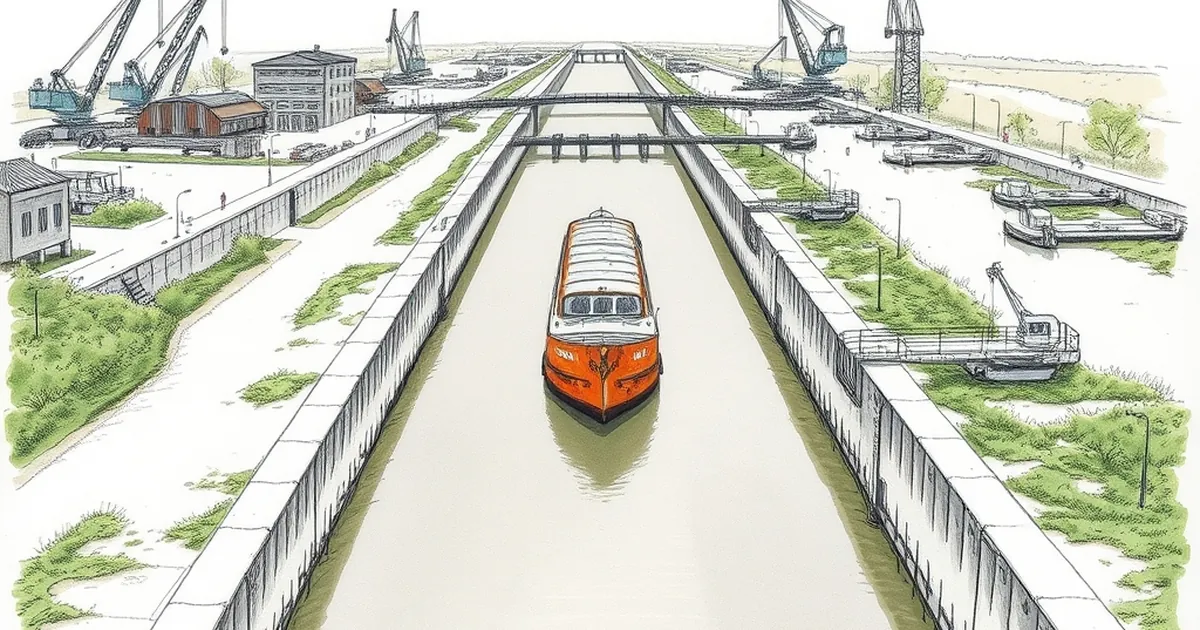
Poland has spent the last two decades rebuilding its road network and modernising its railways, yet the country's rivers and canals remain a curious economic footnote. The Odra, the Vistula, the Gliwice Canal — these should be freight corridors linking the Baltic to Central Europe. So why does inland waterway transport account for well under one percent of Poland's total freight tonnage?
A Network That Looks Impressive on Paper
On a map, Poland's inland waterways stretch across roughly 3,600 kilometres of navigable rivers and canals. That figure gets repeated in strategy documents and EU funding applications. It sounds like a serious transport asset.
The problem is that only a fraction of that length is reliably navigable for modern commercial barges. Poland's Central Statistical Office and the Ministry of Infrastructure have for years classified most of the network as having either "unsatisfactory" or "poor" navigability parameters. In practice, this means many stretches are too shallow for vessels carrying more than a few hundred tonnes.
The Vistula, Poland's longest and most symbolic river, is the clearest example. It is navigable in a meaningful commercial sense for only a few short segments. The rest is a river that looks majestic from a Warsaw bridge but is functionally useless for moving cargo at scale.
The Gap Between Class and Reality
Polish waterways are theoretically classified according to European standards (classes I through V). But classification on paper doesn't match the physical reality on the water. A river designated as class III should handle vessels up to 1,000 tonnes. In practice, low water levels on the Odra regularly force operators to load barges to half capacity or halt shipments altogether.
This is not a new problem. It has been documented for decades, and it persists because fixing it requires enormous, sustained investment in dredging, weirs, and lock modernisation.
The Structural Reasons Behind the Stagnation
Blame for the near-total absence of inland shipping doesn't rest on any single factor. It's a tangle of infrastructure neglect, economic logic, and political priorities.
Water Levels and Climate Pressure
Poland's rivers are fed largely by rainfall and snowmelt, which makes them highly seasonal. Summer droughts — increasingly common as the climate shifts — can drop water levels below the minimum needed for loaded barges. A shipper who cannot guarantee a delivery date is a shipper who loses customers.
Compare this to the Rhine or the Danube, where extensive engineering keeps water levels far more predictable. Germany and the Netherlands invested in their waterways for over a century. Poland did not, and the consequences compound every year.
The Economics of Scale That Never Arrived
Inland shipping only makes economic sense when you can move large volumes over long distances cheaply. That requires big barges, which require deep, wide, reliable channels. Poland has neither the channels nor, consequently, the fleet.
The country's inland fleet is small and ageing. Without consistent cargo volumes, no operator invests in new vessels. Without modern vessels and reliable routes, no shipper commits to water. It's a classic chicken-and-egg deadlock that market forces alone will not break.
Roads and Rail Absorbed the Attention
Here's the uncomfortable truth: Poland's freight sector grew dramatically over the past twenty years, but almost all of that growth went to trucks and, to a lesser extent, rail. Road haulage is flexible, fast, and doesn't care about drought. For most shippers moving goods between Polish cities or to German markets, a truck is simply the pragmatic choice.
The EU's push to shift freight onto waterways and rail — part of the broader Green Deal transport agenda — has not yet translated into enough funding or political will in Warsaw to change this equation. Inland waterways sit low on the priority list, behind road maintenance, rail modernisation, and even airport expansion.
One Concrete Case: The Odra's Troubled Record
Consider the Odra, which forms much of Poland's border with Germany and has the best natural case for commercial navigation. The river has a navigable route of several hundred kilometres, and for years there have been plans to upgrade it to a reliable international waterway.
Yet in recent years, low water levels have repeatedly shut down or severely restricted barge traffic. During drought periods, operators have reported being unable to load even a third of their vessels' capacity. Meanwhile, the 2022 environmental disaster on the Odra — a massive fish kill linked to industrial discharge and low water — focused public attention on the river's ecological fragility rather than its transport potential.
The Odra's story captures the whole dilemma. The river could carry freight. The demand exists in principle. But the infrastructure and water management aren't there, and every dry summer makes the case for waterborne transport harder to sell, not easier.
What Would Actually Have to Change
If Poland genuinely wanted inland shipping to carry meaningful volumes, the recipe is well known. It requires deep, consistent dredging and maintenance — not one-off projects, but a permanent budget line. It requires modern locks and weirs to regulate water levels. It requires a coherent national strategy that treats waterways as transport infrastructure, not just as flood risk or environmental assets.
Some of this is starting to appear. The government has signalled interest in reviving Odra navigation and has pursued EU funding for waterway projects. But the gap between announcements and dredgers in the water remains wide.
There's also a hard commercial reality: even with perfect infrastructure, inland shipping competes on cost and reliability. It wins on bulk commodities — coal, aggregates, fertiliser, grain — where speed matters less than price per tonne. Poland does move some of these by barge, but the volumes are modest and concentrated on a few routes.
For shippers who have spent years building road-based supply chains, switching to water means rethinking logistics from scratch. That only happens if the waterway option is demonstrably cheaper and dependable. Right now, it is neither.
A Reason to Watch the Water
The most practical takeaway for anyone watching Polish infrastructure is this: inland waterways will not transform overnight, and they probably shouldn't be the centrepiece of any freight strategy in the next five years. But they are worth monitoring closely, because the pressure is building from two directions.
First, EU climate policy will keep pushing member states to move freight off roads. Poland will eventually have to show progress on alternative modes, and waterways are one of the few cards it holds. Second, road congestion and driver shortages are making trucking more expensive and less reliable. The economic argument for water could strengthen faster than most people expect.
The rivers are already there. The question is whether Poland finally decides to make them work — or lets another decade pass while the barges stay moored.