November 2026
Who audits the ballast before it goes back under the track
Poland treats railway ballast as a construction product, so every load needs formal sign-off before reuse. Here is who audits it and what happens to failing...
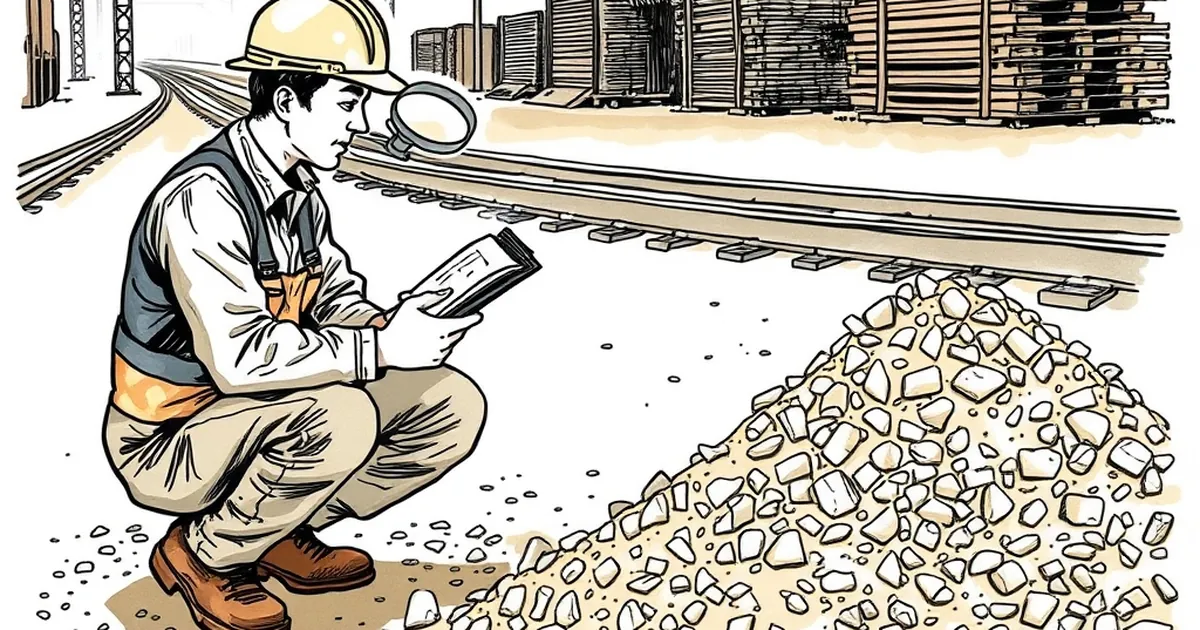
Ballast looks like the simplest thing on a railway: crushed granite, dumped, tamped, forgotten. Yet every tonne that goes back under the sleepers after a track renewal has to pass a gatekeeper. Who actually signs off on that material — and what happens to the loads that fail?
The quiet bureaucracy behind a pile of stones
In Poland, ballast is a construction product, and that changes everything. Under the Railway Transport Act and the technical specifications (warunki techniczne) issued by PKP Polskie Linie Kolejowe, ballast destined for the network must carry a declaration of performance and, in practice, a national technical assessment or a European Technical Assessment where relevant. The contractor cannot simply order "kruszywo 31,5/50" from the nearest quarry and tip it onto the formation.
The first auditor is the quarry itself. Producers operating under PN-EN 13450 — the European standard for railway ballast — run internal factory production control. That means gradation curves, Los Angeles abrasion tests, micro-Deval, frost resistance, and petrographic checks on every production campaign, not just at the start.
Then comes the external layer. Accredited laboratories — in Poland often units like the Road and Bridge Research Institute (IBDiM) or the Building Research Institute (ITB), plus a long list of private labs with PCA accreditation — carry out type testing and periodic surveillance. Their reports end up in a dokumentacja techniczna that follows the material to site.
The third auditor is the one people forget: the site engineer. Under the contract with PLK, the contractor's quality plan specifies acceptance testing frequency, and the inspektor nadzoru (supervising inspector) can order retests at any moment.
What "bad" ballast actually looks like
The failure modes are unglamorous but consequential. Excess fines below 31.5 mm reduce drainage and turn the ballast bed into a sponge. Flaky, elongated grains — measured by the shape index — break down faster under tamping. Poor frost resistance in a Polish winter means the layer disintegrates within a couple of seasons.
There is also the contamination question. Ballast reclaimed from an existing track during renewal is increasingly screened and reused, which is good economics and better for the aggregate supply chain. But reused material must be re-tested as if it were new. The standard does not care about the material's biography.
From quarry to trackbed: the chain of custody
A load of ballast moving from a quarry in Dolnośląskie to a renewal site near Olsztyn passes through several hands, and each hand leaves a document. The delivery note (WZ) identifies the batch. The declaration of performance references the type test. The site log records the delivery time, wagon or truck number, and the visual inspection.
Visual inspection is not a formality. Inspectors look for segregation — the coarse grains rolled to one end of the wagon during transport — and for visible clay or organic contamination. A load that looks wrong can be rejected before a single sieve is shaken.
Sampling is where arguments start
Sampling from a stockpile or a wagon is a technical procedure under PN-EN 932-1, and it is the most disputed step in the whole chain. Take the sample from the wrong spot and you can make good ballast look bad, or bad ballast look acceptable. Contractors and inspectors have been known to disagree sharply about whether a sample was representative.
This is why serious projects agree the sampling protocol in advance, in the quality plan, with named witnesses. It removes the temptation to renegotiate after the results land.
The Polish context: a market under pressure
Poland has been running one of Europe's largest railway investment programmes, financed heavily by EU funds, with the national railway programme (KPK) driving renewals across thousands of kilometres. That volume puts real strain on aggregate supply. When demand spikes, the temptation to stretch acceptance criteria grows — and so does the importance of the auditors.
There is a concrete example worth telling. During a renewal on a Lower Silesian line a few years back, a batch of ballast delivered to site showed an unusually high proportion of fines in the first sieve analysis. The contractor's initial reaction was to question the lab. A second, independently witnessed sample confirmed the result, and the batch was traced back to a screening problem at the quarry. The producer corrected the plant, the remaining deliveries passed, and the track was laid on material that met the standard. Nobody wrote a press release about it — which is exactly how the system is supposed to work.
Where the system leaks
The weak points are predictable. First, testing frequency: on smaller contracts, the minimum sampling rate can feel thin relative to the volume delivered. Second, laboratory capacity during peak season, when queues lengthen and results arrive after the ballast is already under the sleepers. Third, and most uncomfortable, documentation gaps when material is transferred between subcontractors.
Reused ballast is the newest pressure point. As PLK pushes to reduce virgin aggregate use, the screening and re-certification of recovered ballast becomes a quality control task in its own right. The auditors now have to check material that has already lived a life on the network.
What to watch if you work in this chain
If you are a contractor, lock the sampling protocol into the quality plan before the first wagon arrives, and budget for independent laboratory time in the schedule rather than treating it as an afterthought. If you are a supplier, keep your factory production control records audit-ready — the surveillance visit is not a formality and the paperwork is the product as much as the stone is.
For anyone following Polish rail investment, the interesting shift over the next few years will be digital. Batch-level traceability, with test results linked to delivery records, is the obvious next step, and it would close most of the documentation gaps that currently worry inspectors. The ballast under a renewed track is only as trustworthy as the paper trail behind it — and that trail is getting shorter and more machine-readable every procurement cycle.