November 2026
Two-thirds of road users misjudge their own braking distance
Two-thirds of drivers underestimate their own braking distance from 100 km/h, revealing why a daily skill stays so poorly calibrated
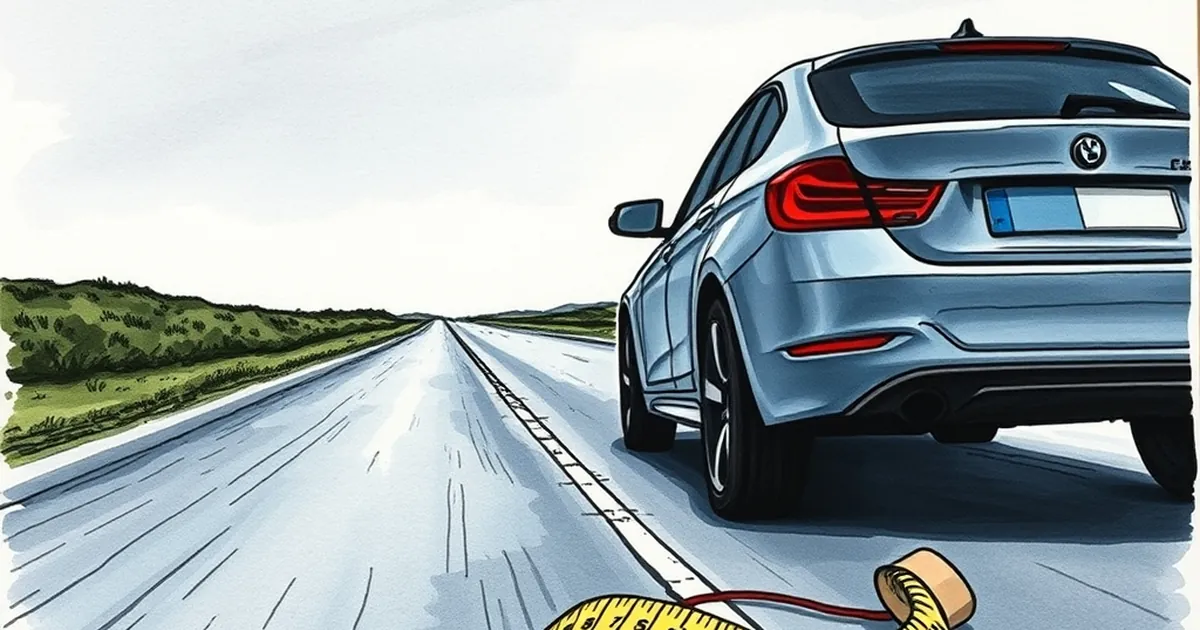
Ask a driver how far their car needs to stop from 100 km/h and you will usually get a confident answer. Ask them to walk that distance on a dry road and mark the spot, and the confidence collapses. Polish driver surveys and the roadside exercises run by regional road safety centres keep turning up the same result: roughly two out of three people underestimate their own braking distance, often by a wide margin. The interesting question is not whether drivers are bad at arithmetic. It is why a skill people practise every single day remains so poorly calibrated in their heads.
The gap between the number and the feel
The physics is not mysterious. Braking distance grows with the square of speed, so doubling velocity quadruples the distance needed to stop. From 50 km/h a passenger car on dry asphalt needs roughly 13 metres of braking, plus another 14 metres or so of reaction distance before the pads even bite. At 100 km/h those figures become about 50 and 28 metres. Add rain, worn tyres, or a loaded boot and the total climbs further.
Drivers, however, do not experience braking as a number. They experience it as a sensation: the dip of the nose, the press of the belt, the moment the scenery stops sliding. That sensation is a poor measuring instrument. At 100 km/h a modern car sheds speed so smoothly and quietly that the stopping event feels shorter and gentler than it is. The cabin is insulated, the suspension is stiff, the brakes are assisted. Everything about the feedback loop tells the driver "that was fine" — even when the margin was two car lengths and shrinking.
This is a textbook case of a system that rewards the wrong signal. The driver who brakes late and gets away with it receives a small hit of relief and a quiet sense of skill. The driver who brakes early receives nothing at all — no feedback, no reward, no confirmation that the caution was warranted. Over thousands of kilometres, the late braker accumulates reinforcement while the cautious driver accumulates silence.
Variable reinforcement and the habit of the near miss
Behavioural psychology has a name for this pattern. Variable-ratio reinforcement, the principle B.F. Skinner described in the 1950s, holds that behaviour rewarded unpredictably is the hardest to extinguish. A driver who brakes late most of the time and occasionally has a close call is being trained on exactly that schedule. Most late brakes end without consequence. A minority end with a jolt of adrenaline. The unpredictability is what cements the habit.
Kahneman and Tversky's work on loss aversion adds a second layer. Losing ten seconds of journey time to cautious driving feels like a small, certain loss. The potential gain — avoiding a collision — is large but probabilistic and abstract. People consistently over-weight the certain small loss. On a two-hour drive down the S7, that calculus plays out at every junction, and it plays out in favour of the later brake.
There is also the availability heuristic at work. A driver's mental model of "how long it takes to stop" is built from the stops they remember, and they remember the uneventful ones. The near misses fade. The one time the ABS kicked in on wet cobbles outside Radom becomes an anecdote, not a recalibration.
What the roadside tests actually show
The exercise run at dozens of Polish secondary schools and at events like the Road Safety Days organised by GDDKiA and local police is deliberately low-tech. A cone marks the point where the driver believes the car will stop from 100 km/h. The car then actually stops, and the gap between belief and reality is measured in metres — sometimes in tens of metres.
A recurring finding across these exercises, echoed in studies from the Swedish Road Administration and the UK's Transport Research Laboratory, is that miscalibration is worst among experienced drivers, not novices. Learners, still conscious of the physics they were taught for the exam, tend to overestimate. Drivers with ten or fifteen years behind the wheel underestimate, because their confidence has been built on thousands of uneventful stops rather than on any measurement.
The Polish context sharpens this. Average vehicle age on Polish roads sits well above the EU average, tyre quality varies enormously, and winter conditions extend the stopping distance dramatically. Yet the mental model most drivers carry was formed on a dry summer afternoon in a car that may no longer be the one they drive.
Designing feedback into a system that hides it
The engineering response has been to shorten the feedback loop artificially. Intelligent speed assistance, mandatory on new cars sold in the EU since 2024, does not brake for the driver but makes the current limit continuously visible and increasingly hard to ignore. Autonomous emergency braking, now standard on most new models, intervenes before the driver's own estimate matters. Both are, in effect, admissions that human calibration is unreliable and that the system should compensate.
There is a more interesting design question underneath. Infrastructure can either hide stopping distance or reveal it. A wide, smooth, well-lit arterial with gentle curves and generous sight lines flatters the driver's sense of control. A narrower road with textured surfacing, clear edge markings, and visible pedestrian crossings does the opposite — it makes the margin legible. The Dutch concept of "forgiving roads" and the Swedish Vision Zero approach both lean on this idea: design the environment so that the consequences of a misjudged stop are survivable, rather than assuming the driver will judge correctly.
In Poland, the ongoing programme of replacing single-carriageway national roads with dual carriageways and the steady rollout of section control on the S-roads are, whatever else they do, changing the feedback. Average speed cameras do not just penalise; they make the relationship between speed and consequence visible in a way that a fine arriving three weeks later never could.
What to watch for next
The most useful shift in the coming years may not be technological at all. Driver training in Poland still leans heavily on rules and manoeuvres; the calibration problem is a matter of judgement, and judgement is trained by feedback. A short, annual, ten-minute exercise — measure your own stopping distance once a year, in your own car, on the surface you actually drive — would do more for the two-thirds figure than any dashboard warning.
Watch for how insurers and fleet operators start to use telematics data on braking events. A company that can see its drivers' actual stopping margins has, for the first time, a measurement of the gap between belief and reality at scale. What they do with that data — whether they punish the late brakers or simply show them the number — will tell us a great deal about whether the calibration problem is solvable, or merely manageable.