September 2026
The Ballast That Arrives Before the Track Does
Why ballast is laid in Poland before tracks and sleepers appear, and what this sequencing reveals about modern railway engineering
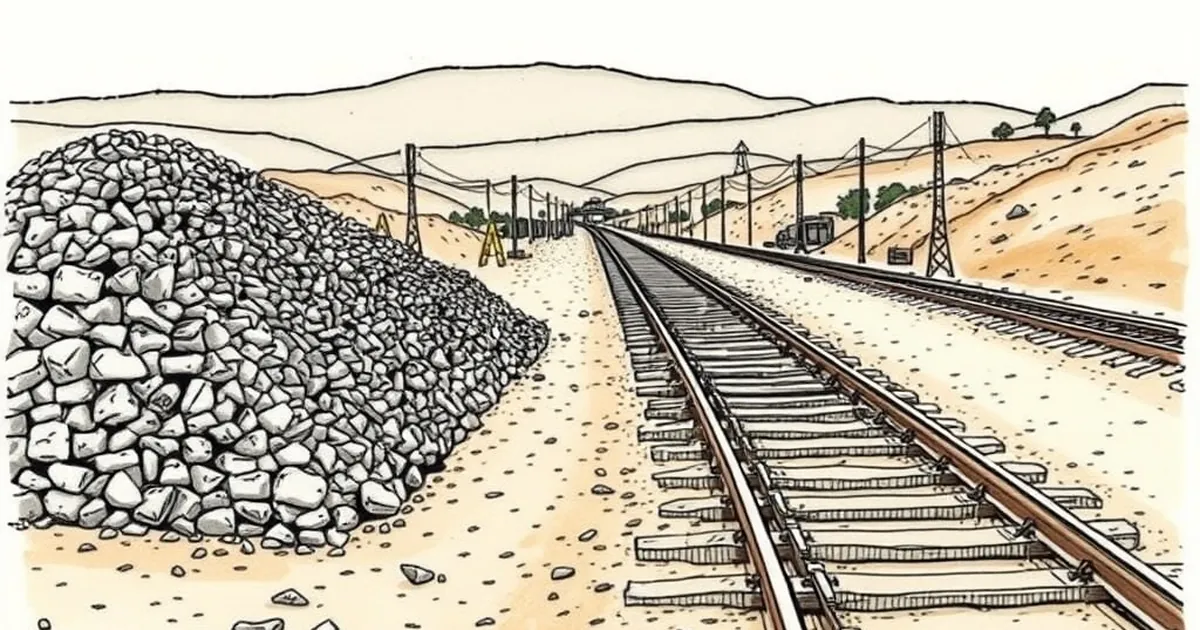
Drive along almost any stretch of Poland's rail network under modernization and you'll notice something odd: enormous piles of grey crushed stone sitting beside tracks that don't exist yet. Long before the first sleeper is laid or the first catenary mast rises, the ballast is already there — graded, compacted, waiting. Why does the stone arrive before the steel, and what does that sequencing tell us about how Poland builds railways in the 2020s?
The answer isn't a quirk of Polish contracting. It's a fundamental rule of railway engineering, one that PKP Polskie Linie Kolejowe and its contractors have learned to respect the hard way — and it explains a lot about why modernizing a line takes years even when the visible progress seems slow.
Why Ballast Goes Down First
Ballast — the crushed stone layer beneath the sleepers — is not decoration. It distributes the weight of trains across the subgrade, drains water away from the track bed, and holds the geometry of the rails in place against lateral forces. Without it, even the strongest rail would shift under a freight train within weeks.
But here's the catch: ballast only does its job if the ground beneath it has already settled. Freshly built embankments, replaced subgrade, and new drainage layers all compact over time, and if you lay track on top of ground that's still moving, you inherit a maintenance nightmare. So contractors drop ballast early, often in two or three stages, letting each layer settle and compact under its own weight and under controlled vibration before the next one goes on.
This is why a visitor to a worksite near, say, the E75 line between Białystok and Warsaw might see kilometres of finished ballast bed with no track on it at all. The stone is essentially doing the waiting so the track doesn't have to.
The Settlement Problem
Polish railway modernizations frequently involve complete replacement of the subgrade — the soil layer under everything. That subgrade was often laid down decades ago, sometimes a century or more, and it wasn't designed for 200 km/h passenger traffic or 25-tonne axle loads. When contractors excavate and rebuild it, they create a fresh, unstable surface that needs time.
Ballast placed on that surface acts as both a load and a test. If the subgrade can't carry the weight of the stone without deforming, better to find that out now than after the track is installed. Engineers monitor settlement for weeks or months, and only when the readings stabilize does the next phase begin.
The Hidden Sequence of a Rail Modernization
To an outsider, a railway project looks linear: design, build, open. In practice, it's a tightly interlocked sequence where every stage depends on the one before it, and ballast sits surprisingly early in the chain.
From Subgrade to Sleeper
The typical order on a Polish modernization contract runs roughly like this: demolition of the old track, earthworks and new drainage, subgrade replacement and compaction, then ballast — usually in a bottom layer and a top layer — followed by sleepers, rails, welding, tamping, and finally the overhead line and signalling.
Each step has its own waiting period. Concrete for foundations needs to cure. Welded rail joints need to cool. Tamping machines need a stable bed to work against. Skipping ahead doesn't save time; it creates defects that surface years later as speed restrictions and emergency repairs.
Why Contractors Stockpile Stone
There's also a logistics reason. Ballast is heavy, bulky, and produced at a limited number of quarries — in Poland, hard rock suitable for railway ballast comes from a handful of regions, including Lower Silesia and the Świętokrzyskie mountains. Hauling it by truck is expensive and disruptive to local roads, so contractors often deliver it by rail in long trains and stockpile it along the line.
Those stockpiles you see aren't waste or disorganization. They're a buffer against supply disruptions and a way to stage material where the tamping and regulating machines will need it. A single kilometre of double-track line can consume several thousand tonnes of ballast, and getting that volume to the right place at the right time is a project in itself.
A Concrete Example: What Happens When You Rush
Anyone who follows Polish rail news has seen the consequences of compressed schedules. During the intense modernization push funded by the 2014–2020 EU perspective, several lines reopened on time but developed geometry problems within a year or two, forcing temporary speed limits. In most cases, the culprit wasn't the rails or the sleepers — it was insufficient settlement of the layers beneath.
The lesson, now written into technical specifications, is that ballast and subgrade work cannot be compressed to fit a political deadline. PKP PLK's current standards for the 2021–2027 perspective are stricter about settlement monitoring and staged ballasting, which is one reason some projects look slower even though they're being built better.
What This Means for Timetables
For passengers, the practical effect is that a line might be closed for two years rather than eighteen months. For freight operators, it means planning detours further ahead. The trade-off is a track that holds its geometry at 160 or 200 km/h for decades rather than one that needs patching every few years.
Reading a Worksite Like an Engineer
Next time you pass a rail modernization site in Poland and see piles of stone with no track in sight, you're looking at the most patient part of the project. The ballast is there because the ground beneath it needs to prove itself, because supply chains demand early delivery, and because the sequence of railway construction has been refined over more than a century of hard-won experience.
The forward-looking note is this: as Poland pushes toward higher speeds on its main corridors — the Centralny Port Komunikacyjny rail component, the upgraded E65, and the long-discussed high-speed line — expect to see even longer gaps between ballast and rail. High-speed track is far less forgiving of settlement than the 120 km/h lines of the past. The stone arriving first isn't a sign of delay. It's a sign that someone, somewhere, is doing the maths properly.