November 2026
Temporary bridges outlive the traffic counts that justified them
Temporary bridges built for 18-month lifespans often outlive their traffic counts by decades, revealing how infrastructure planning, budgets, and memory quie...
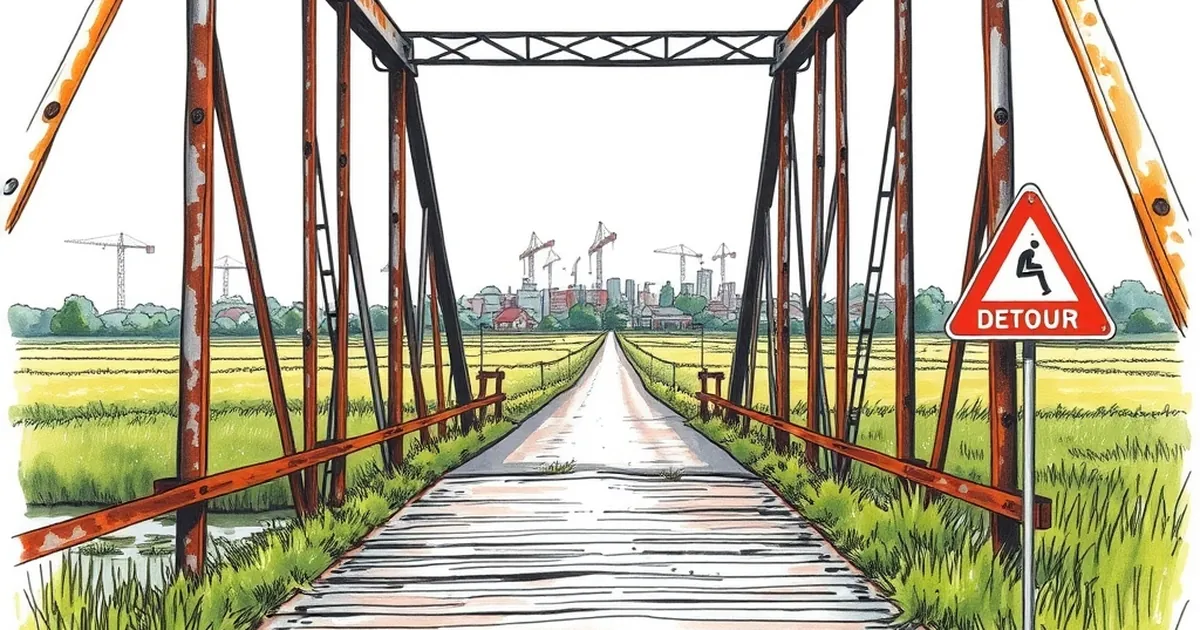
A temporary bridge is built for a reason, and that reason usually has a number attached: 8,000 vehicles a day, a three-year construction window, a detour that would add forty minutes to a school run. Then the permanent structure opens, the traffic count changes, and the temporary span stays. Anyone who drives Poland's secondary roads has crossed a bridge that was clearly never meant to be there this long.
So what happens when a piece of infrastructure designed for an 18-month lifespan quietly turns thirty? The answer says a lot about how we plan, budget, and forget.
The number that starts everything
Every temporary bridge begins as a calculation. Engineers model traffic volumes, detour lengths, emergency vehicle access, and the cost of a permanent replacement. The temporary structure is sized for that forecast — often with a design life of five to twenty years, depending on whether it's a modular Bailey-style panel bridge or a rented steel structure on abutments.
The forecast is the weak point. Traffic models assume the permanent bridge opens on schedule. They assume the surrounding road network stays roughly as it is. They assume the towns on either side grow at the rate in the regional plan.
In practice, all three assumptions slip. A bypass gets delayed by a procurement appeal. A new housing estate adds thousands of trips nobody counted. The permanent bridge takes eight years instead of three, and by the time it opens, the temporary one has become part of the local mental map — people give directions using it.
I've watched this play out on a stretch of road in Małopolska where a temporary crossing installed during a landslide repair in the late 1990s was still carrying local traffic well into the 2010s. The traffic count that justified it assumed a two-year fix. The slope kept moving.
Why temporary structures tend to stay
The funding trap
Temporary bridges are cheap to install and cheap to leave in place. Removing one costs money — dismantling, hauling, restoring the banks, redoing the approach roads. That line item rarely survives the first budget revision after the permanent bridge opens.
There's also an ownership problem. Once a temporary bridge stops being "temporary," nobody's capital plan owns it. The district road authority may not have it in its asset register. Maintenance becomes reactive: someone notices the deck plating is corroding, someone finds a contractor, someone patches it.
The demand that appears
Here's the part traffic models consistently miss: a bridge creates traffic. A crossing that didn't exist, or that replaced a long detour, changes where people drive, where they shop, where developers build. By the time the permanent bridge opens, the temporary one isn't redundant — it's carrying trips that only exist because it was there.
In many Polish gminas, a temporary crossing over a river became the de facto second crossing for a whole area. Removing it would push traffic back onto a single bridge, and the local council knows exactly how that vote would go.
The regulatory grey zone
Temporary bridges often sit outside standard inspection regimes. A permanent bridge in Poland falls under regular technical inspections with defined intervals and load ratings. A modular temporary structure may be inspected under the manufacturer's instructions, or under whatever regime the original installation contract specified — which may reference a project that closed years ago.
This is where things get uncomfortable. A structure designed for a 15-tonne load limit, still carrying farm machinery and delivery trucks two decades later, is a risk that nobody formally owns.
What a well-run temporary bridge actually needs
The good news is that the fix isn't exotic. Districts that manage this well tend to do a few specific things.
They register the temporary structure as an asset on day one, with a named owner and an inspection schedule that doesn't expire with the construction contract. They set a review date — not a removal date, a review date — tied to the permanent bridge's completion. And when the permanent bridge opens, they make an explicit decision: remove, retain as a permanent second crossing, or retain temporarily with a new end date.
That last option is the honest one. Retaining a temporary bridge as a permanent second crossing is often the right call — it improves resilience, shortens emergency response times, and costs a fraction of building a new bridge. But it should be a decision with a budget and an upgrade plan, not a drift.
The load rating conversation
If a temporary bridge is going to stay, its load rating needs to reflect reality. That means a proper structural assessment, upgraded guardrails and deck surfacing where needed, and signage that matches the actual capacity. It also means telling the freight operators who've been using it for years that the rules are now formal.
This is unglamorous work, and it's the kind of thing that gets deferred until an inspection report forces the issue.
The forward-looking bit
Poland's current wave of bridge renewals — driven by a mix of EU funding cycles and the backlog of post-war structures reaching end of life — will install a lot of temporary crossings in the next decade. Each one is a future orphan unless someone writes the exit condition into the contract.
My practical suggestion for anyone commissioning or overseeing a temporary bridge: put the review date in the contract, name the person responsible for it, and budget the removal or the upgrade before the first vehicle crosses. It costs almost nothing to write down. It costs a great deal to discover, fifteen years later, that a bridge designed for a two-year detour is carrying a school bus and nobody knows who's supposed to inspect it.