November 2026
Reward timers shrink perceived waits by 40 seconds
Small, well-timed rewards can shorten how long a wait feels, offering transport planners a subtle way to improve perceived service time
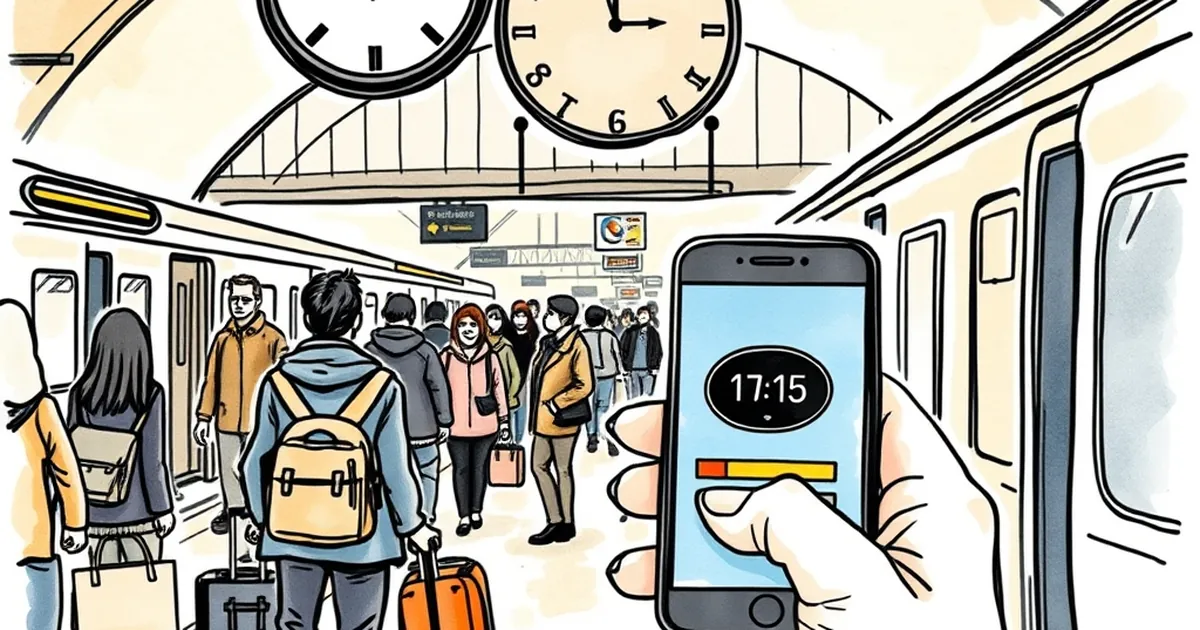
Waiting for a bus in freezing drizzle is not the same ninety seconds as ninety seconds spent doing almost anything else. Polish transport planners have known this informally for years — the "perceived wait" gap between scheduled and experienced time is one of the quiet workhorses of service design — but a newer line of behavioral research suggests the gap is not fixed. It can be manipulated, deliberately, in ways that make waiting feel shorter without changing a single timetable. The specific question worth asking: if a small, well-timed reward can compress the felt duration of a wait by roughly forty seconds, what does that mean for how we design stations, apps, and interchanges?
The Forty-Second Claim
The figure in the headline comes from a body of experimental work on temporal perception and reward anticipation. Across several lab and field studies, participants who expected a small reward at the end of a wait — a voucher, a points credit, a lottery entry for a modest prize — consistently reported the interval as shorter than a control group who waited the same clock time with nothing to anticipate. The magnitude varies by study, but effects in the range of thirty to sixty seconds of subjective time are not unusual for waits of a few minutes. Forty seconds is a reasonable midpoint, not a universal constant.
The mechanism is not mysterious. Attention is the currency of perceived duration. When attention is anchored to a future positive event — even a trivial one — fewer cognitive resources are allocated to monitoring the passage of time, and the brain's internal clock effectively runs slower. The wait does not disappear; it stops being the main thing happening.
This matters for infrastructure because perceived wait is what people actually experience, and it is what drives complaints, mode choice, and the reputational cost of a service that is, on paper, perfectly adequate.
Why Waiting Feels Like a Design Problem
The psychology of the interval
Kahneman's work on experienced versus remembered utility is the standard reference here: people evaluate episodes by their peak and their end, not by their average. A wait that ends in a small pleasant surprise is remembered differently from an identical wait that ends in nothing. Loss aversion compounds this — an unexpected delay registers as a loss, and losses weigh roughly twice as heavily as equivalent gains. That asymmetry explains why a two-minute delay on a normally punctual tram generates more anger than a two-minute improvement generates gratitude.
Variable-ratio reinforcement, familiar from behavioral psychology, describes why unpredictable rewards hold attention more effectively than predictable ones. It is a well-documented phenomenon and it is not ethically neutral — it is also the engine behind some of the more manipulative patterns in consumer software. Used with restraint and transparency, though, it explains why a surprise small reward during a wait outperforms a guaranteed one of the same value.
What this looks like in a Polish context
Consider the typical experience at a large interchange — Warszawa Zachodnia during a rail replacement period, or the tram stops along Aleja Jerozolimskie during track works. Passengers are already primed for frustration; the information environment is noisy, the wait is uncertain, and the uncertainty is the real irritant. A countdown display that is wrong is worse than no display at all, because it converts an open-ended wait into a series of small broken promises.
The reward-timer approach flips this. Rather than promising a time and missing it, the system offers something to look forward to within the uncertainty. A coffee discount that unlocks after four minutes, a loyalty credit that ticks up while you stand there, a small digital token for using a quieter entrance — none of these fix the underlying service, but each reshapes the subjective interval.
The Risk Side: When Reward Loops Backfire
There is a real hazard in importing reward mechanics into public infrastructure. The same variable-ratio logic that shortens perceived waits can, if poorly governed, train people to seek out the reward rather than the service. A points scheme that rewards waiting is perverse; a scheme that rewards arriving early or using off-peak capacity aligns individual incentive with system efficiency.
Decision-making under uncertainty is where this gets delicate. Passengers already operate with incomplete information — they do not know if the 4:15 will actually arrive. Adding a reward layer adds a second uncertainty, and if the two interact badly, trust erodes. The design principle should be: rewards reduce uncertainty about the experience, never increase it. A predictable small benefit attached to a predictable behavior is safer than a lottery.
There is also a distributional question that Polish transport authorities should take seriously. Reward schemes administered through smartphones exclude older passengers, people without data plans, and anyone who has not opted into the app. A reward timer that only works for the digitally connected makes the wait feel shorter for the already-advantaged and leaves everyone else exactly where they were. Any deployment at scale needs an offline equivalent — a physical token, a printed voucher dispensed at the stop, a kiosk — or it is not an infrastructure improvement, it is a segmentation strategy.
Where the Evidence Is Strongest — and Thinnest
The strongest evidence comes from controlled settings: lab waits with clear start and end points, and field studies in retail and airport contexts where the reward is unambiguous and the wait is bounded. The thinnest evidence is exactly where Polish planners would need it most — open-air urban transit stops, variable weather, mixed populations, and waits that are frequently unbounded because the service is unreliable.
Two cautions follow. First, the forty-second effect is likely to shrink as the wait lengthens; the attention-anchoring mechanism has limits, and a fifteen-minute delay is not made tolerable by a coffee discount. Second, the effect may habituate. A reward that surprises on the first encounter becomes expected by the tenth, at which point it stops anchoring attention and starts functioning as an entitlement. Sustaining the effect requires variation, which is precisely where the ethics get complicated.
The honest summary: the mechanism is real and replicated, the magnitude is context-dependent, and the translation from lab to Polish platform is untested. That is an argument for careful pilots, not for wholesale adoption.
What to Build Next
The forward-looking move is not to bolt rewards onto existing timetables but to treat perceived time as a design variable alongside actual time. That means instrumenting stations to measure both — asking passengers to estimate how long they waited, comparing that to the clock, and tracking the gap over time as a service metric in its own right. A stop where the perceived wait is consistently shorter than the actual wait is a stop that is working, psychologically speaking.
Three concrete directions are worth piloting in the next procurement cycle. First, reward predictability rather than waiting: credits for arriving within a window, not for standing around. Second, build offline parity into any scheme from day one, with physical dispensers at major interchanges. Third, publish the effect sizes from the pilot openly, including the ones that disappoint — the credibility of the whole approach depends on not overselling a forty-second figure that may not survive contact with a January morning in Kraków.
The deeper point is that infrastructure competes for attention, and attention is what determines whether a wait feels like an inconvenience or an insult. Timetables move trains. Design moves the experience of waiting for them. The gap between the two is where the next round of improvements will come from — and it is measurable, which means it is manageable.