October 2026
Rebar Sits in Yards While Sites Wait for Deliveries
Polish steel yards hold record rebar stock while construction sites face weeks-long delivery delays, exposing a puzzling gap in the supply chain
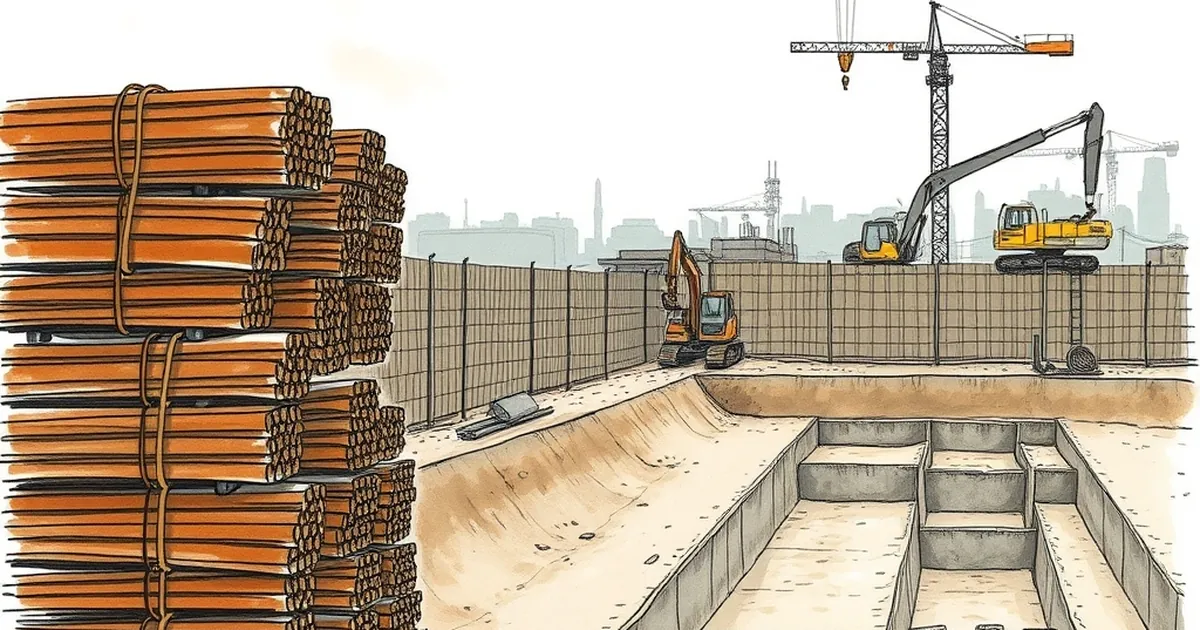
Steel yards across Poland are fuller than they have been in months. Yet site managers in Warsaw, Wrocław, and the Tri-City are still chasing deliveries that arrive weeks late, or not at all. How can the same material be simultaneously "in stock" and "unavailable"?
The Strange Disconnect Between Stock and Supply
Walk into any large steel distributor in Silesia or Wielkopolska and you will see rows of rebar, coils, and mesh stacked under open sky. Inventory levels at Polish steel service centres have climbed steadily since late last year. On paper, the market looks well supplied.
On the ground, the picture is different. Contractors report that standard B500SP rebar in popular diameters — 12 mm, 16 mm, 20 mm — is often quoted with lead times of three to five weeks. Some regional distributors admit they are prioritising long-standing clients and turning away smaller orders entirely.
The gap between what sits in yards and what reaches sites comes down to a handful of structural problems that have little to do with total steel availability.
Why "In Stock" Rarely Means "Available"
A distributor holding 5,000 tonnes of rebar is not automatically in a position to sell you 40 tonnes tomorrow. Much of that tonnage is already committed — sold forward to large general contractors, tied up in framework agreements, or reserved for infrastructure tenders won months ago.
What remains is often the wrong specification. A yard may be heavy on 8 mm stirrup steel while every residential project in the region is calling for 16 mm. Or the stock consists of cut-and-bent material fabricated for a specific project that has since stalled, making it useless to anyone else.
Logistics add another layer. Moving rebar requires flatbed transport, crane capacity at both ends, and coordination that many mid-sized distributors no longer have in-house. A load sitting 200 kilometres away might as well be in another country if nobody can schedule the truck.
The Squeeze on Polish Construction
Poland's construction sector has been running hot and cold simultaneously. Public infrastructure spending, boosted by EU cohesion funds, continues to drive demand for reinforcement steel in roads, rail, and flood defences. At the same time, residential developers have pulled back sharply as mortgage costs and buyer caution bite.
This split personality confuses the supply chain. Mills allocate production based on forecasts that assumed steady residential demand. When that demand evaporates, they redirect tonnage toward infrastructure grades and sizes. Distributors who built their business on serving housing developers suddenly find their usual product mix is wrong.
The Human Cost of Waiting
I spoke with a site manager on a residential project near Poznań who had scheduled a concrete pour for a mid-rise foundation. The rebar delivery was confirmed three times. On the morning of the pour, the truck did not arrive. The concrete pumps had already been booked and paid for.
The pour was pushed back eleven days. The concrete contractor charged a standby fee. The crane operator, hired for the week, sat idle for two of those days. The total cost of that delay — before accounting for the knock-on effect on the finishing trades — ran into tens of thousands of zlotys.
Multiply that story across hundreds of sites and you get a picture of an industry bleeding money not because steel is scarce, but because the system connecting yards to sites is broken.
What Is Actually Causing the Bottleneck
Several factors compound each other. None is catastrophic alone. Together, they create the paralysis we see today.
Fragmented distribution. Poland's steel distribution market remains highly fragmented. Hundreds of small and mid-sized players lack the capital to hold diverse stock or the fleet to guarantee delivery windows. Consolidation is happening, but slowly.
Just-in-time meets just-in-case. Contractors burned by past shortages now order earlier and in larger quantities than they need. This hoarding behaviour pulls material out of circulation and into site compounds, where it sits for months. Distributors see inflated demand signals and order more from mills. The bullwhip effect is alive and well.
Transport capacity. Poland faces a persistent shortage of qualified HGV drivers, and flatbed capacity is tight. Rates for steel transport have risen faster than the material itself. Some distributors quietly deprioritise deliveries to distant or awkward sites because the margin does not justify the logistics.
Payment terms. Smaller contractors often cannot meet the prepayment or short payment terms that distributors now demand. The result is a two-tier market: large players get material, smaller ones wait.
The Import Question
Imports from outside the EU — Turkey, India, Vietnam — have filled some gaps, particularly for standard rebar grades. But imported steel comes with its own complications: longer lead times, currency risk, and certification requirements that not every distributor handles smoothly.
Domestic mills, meanwhile, face their own pressures. Energy costs remain elevated compared to pre-2022 levels, and cheap imports put downward pressure on prices. Some producers have chosen to run at reduced capacity rather than compete on margin. Less domestic output means fewer options when a distributor needs a quick top-up.
What Contractors Can Do Now
Waiting for the market to fix itself is not a strategy. The contractors navigating this period best are the ones treating procurement as a core competency rather than an administrative afterthought.
That means building direct relationships with two or three distributors instead of chasing the lowest quote on every order. It means ordering earlier than feels comfortable and accepting the carrying cost as insurance. It means specifying standard sizes wherever the design allows, because exotic specifications are the first to disappear from availability.
Some larger firms have gone further, investing in their own small stockyards or partnering with fabricators to secure cut-and-bent supply under long-term agreements. The upfront cost is real, but so is the cost of a stalled pour.
For smaller contractors, cooperation is the lever. Joint purchasing groups — common in Germany and Scandinavia — remain rare in Poland but offer a way to aggregate demand and negotiate terms that individual firms cannot access.
A Market That Needs to Mature
The rebar paradox is not really about steel. It is about a distribution and logistics system that has not kept pace with the sophistication of the projects it serves. Poland builds motorways, bridges, and data centres to European standards. Its steel supply chain still operates, in many places, like a market stall.
The pressure of the past few years is forcing change. Distributors are investing in inventory management software. Mills are offering more flexible order sizes. Transport companies are experimenting with dedicated steel corridors.
None of this will resolve overnight. But the contractors who survive this period will be the ones who stop treating rebar as a commodity to be bought at the last minute and start treating it as a strategic input. The steel is out there, stacked in yards from Gdańsk to Katowice. The challenge is getting it from the yard to the pour — and that challenge is now as much about planning and relationships as it is about price.