October 2026
Rebar's Second Life: Poland's Scrap-to-Steel Gap
Poland exports valuable steel scrap while importing iron ore, revealing a missed opportunity to turn demolition waste into steel for its booming construction...
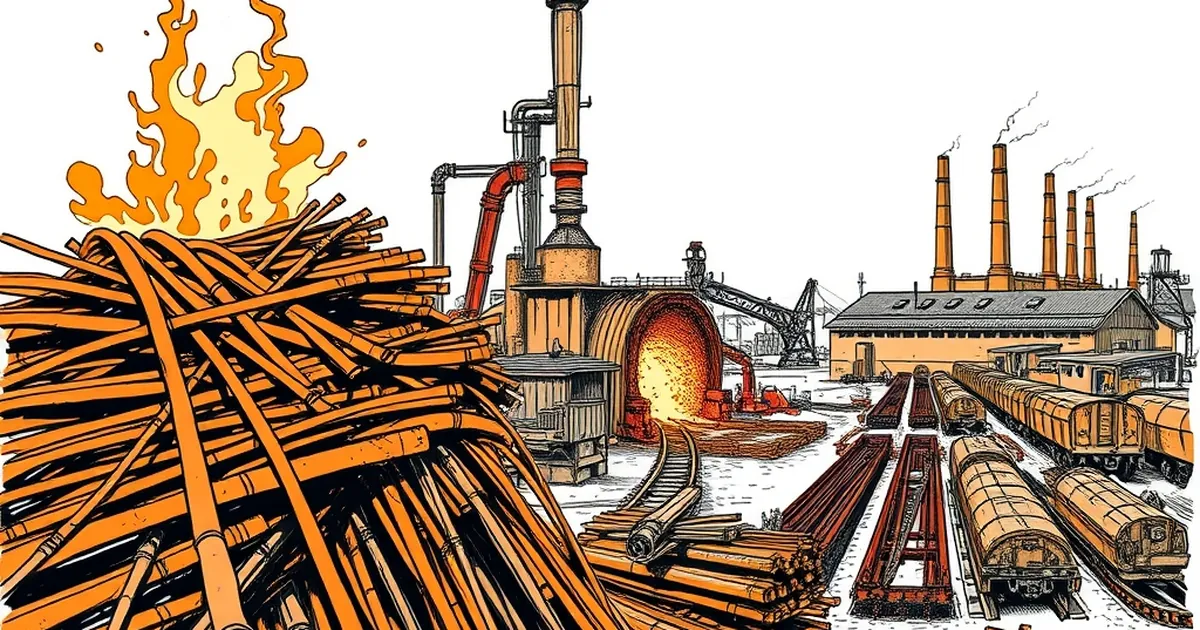
Poland tears down its old buildings, pulls rebar out of concrete, and ships a good chunk of that scrap abroad. Meanwhile, its steel mills import iron ore and pay a premium for energy. Why does a country with Europe's booming construction sector not turn its own demolition waste into the steel that holds up the next generation of towers?
The answer sits at the intersection of logistics, technology, and a global scrap market that does not care much about national borders. It is also a story about missed value hiding in plain sight.
The Scrap Paradox: Plenty of Metal, Not Enough Melt
Poland is, by volume, one of the larger steel scrap generators in Central and Eastern Europe. Demolition crews in Warsaw, Kraków, and the Upper Silesian conurbation pull tonnes of reinforcement bar, structural steel, and sheet metal out of buildings every month. The country's steel mills, concentrated around Katowice and a few coastal sites, have the furnaces to melt it.
So far, so circular. The problem is that a significant share of that scrap leaves Poland — by truck and by rail — heading to mills in Germany, Austria, and beyond. In return, Polish producers buy scrap back when domestic supply tightens, or they lean on imported ore-based steel. It is a trade pattern that looks inefficient from a purely national accounting perspective, but it makes sense to the people actually moving the metal.
The reason is grade. Not all scrap is equal, and the rebar coming out of a 1970s housing block is not the same product as the clean, sorted, high-quality scrap that a modern electric arc furnace wants to feed.
Why Rebar Scrap Is Awkward
Rebar, or stal zbrojeniowa in Polish, is embedded in concrete. Getting it out is dirty, labour-intensive work. Demolition contractors often crush concrete and then use magnets to separate the steel, but the result is a mix of sizes, coatings, and contamination — rust, concrete dust, sometimes paint.
That mixed material is harder to sell at a premium. It can be melted, but it requires more processing, more energy, and more careful blending to hit the chemical specifications that a mill needs for a given product. German and Austrian mills with sophisticated sorting operations can absorb that material more cheaply than many Polish facilities, so it flows west.
The Economics of Moving Metal
Scrap is a commodity, and commodities follow price signals, not patriotism. When the export price for heavy melting scrap (HMS) is high, it pays to load it onto a truck and send it to a buyer across the border. When domestic mills need feedstock, they raise their bids, and some of that material stays home.
This is not a uniquely Polish problem. It is how the European scrap market works. But Poland's situation is sharper because the country is simultaneously expanding its construction output and trying to decarbonise its steel sector.
The Decarbonisation Angle
Electric arc furnaces (EAFs) run on scrap. Blast furnaces run on iron ore and coke. If Poland wants to cut the carbon intensity of its steel, it needs more EAF capacity and more scrap feeding it. That is the direction the industry is moving, slowly.
The catch is that EAFs are picky about what they eat. A furnace producing high-grade flat steel for the automotive industry cannot simply dump in a load of rusty rebar and expect consistent output. It needs clean, sorted, chemically predictable scrap. That is exactly the material that is easiest to export and hardest to guarantee domestically.
So Poland ends up in a loop: it exports the scrap it cannot easily process, imports the high-quality scrap or ore-based steel it needs, and pays the logistics and energy costs on both legs.
What Would It Take to Close the Gap?
Closing the scrap-to-steel gap is not about banning exports or erecting trade barriers. It is about building the sorting, processing, and logistics capacity that lets Polish mills use more of what Polish demolition sites produce.
That means investment in shredders, eddy current separators, and — crucially — the kind of chemical analysis and blending infrastructure that lets a mill trust its feedstock. It also means better coordination between demolition contractors and steelmakers, so that material is sorted at source rather than mixed into a low-value pile.
A Concrete Example
Consider a mid-sized demolition project in a Polish city — say, the tear-down of an old industrial hall. The contractor crushes the concrete, pulls out the rebar, and ends up with a few hundred tonnes of mixed ferrous scrap. Without a local buyer willing to pay a decent price, the default move is to call a scrap trader who aggregates loads and ships them to the highest bidder, often across the border.
If that same contractor had a standing agreement with a nearby mill — one that specified grades, contamination limits, and a price formula — the material could stay in the country and feed a domestic furnace. That kind of contract exists in some markets. In Poland, it is still the exception rather than the rule.
The Policy Layer
There is also a policy dimension. The EU's circular economy rules and its carbon border mechanism both push in the direction of keeping valuable materials in circulation. But policy alone does not move metal. Someone has to build the facility, sign the contract, and pay for the truck.
Poland's steel sector has been through a turbulent decade, with ownership changes, energy price shocks, and pressure to decarbonise. That turbulence makes long-term investment in scrap processing harder to justify, even when the strategic case is obvious.
Meanwhile, the construction sector keeps generating demolition waste, and the scrap keeps moving. The gap is not a mystery. It is a set of incentives that currently favour export over domestic reuse.
What to Watch
For anyone following Polish infrastructure and construction, the scrap-to-steel gap is worth tracking because it sits at the junction of three big trends: the demolition wave hitting older housing and industrial stock, the decarbonisation of steel, and the EU's push for material circularity.
The practical takeaway for contractors and developers is simple: sort your scrap properly, and treat it as a revenue stream rather than a disposal problem. The mills that invest in feedstock flexibility will be the ones that can compete on cost and carbon. And the country that figures out how to keep its rebar in circulation — rather than watching it leave on a truck — will have a quieter but real advantage in the decades of rebuilding ahead.