October 2026
Rebar rusts in storage while sites wait six weeks
Rebar rusting under tarps on stalled sites raises hard questions about structural risk, inspection rejection, and who ultimately pays the bill
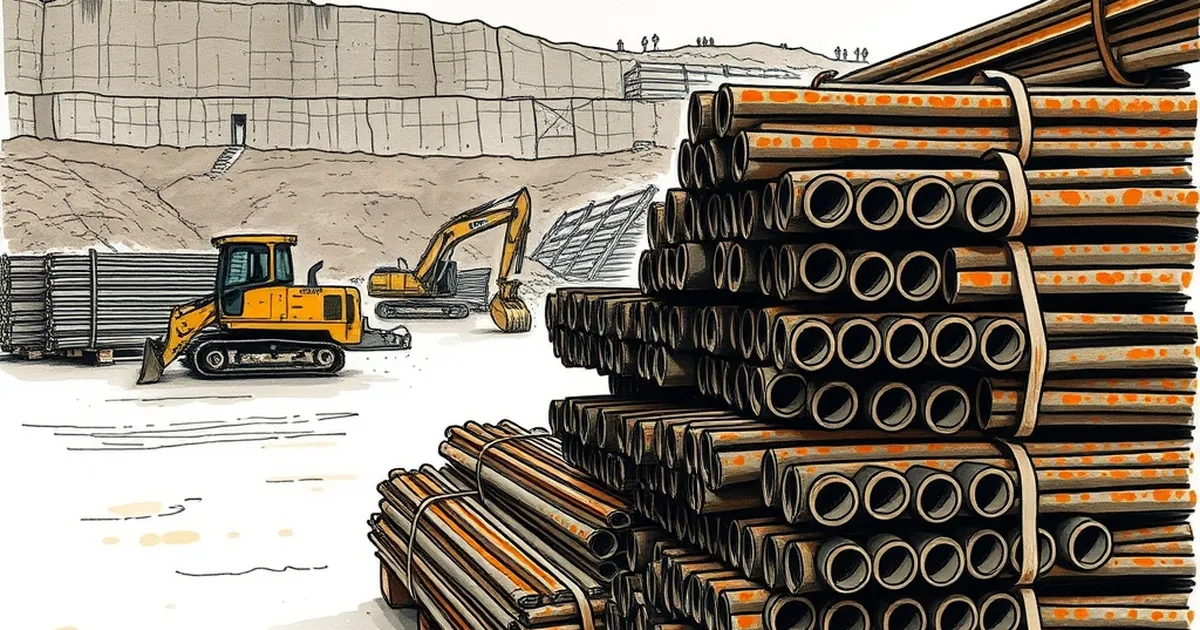
Steel reinforcement sits on a muddy pad behind a fence in Małopolska, under a tarp that flapped loose two storms ago. The site was supposed to start pouring in early March. It is now mid-April, the general contractor is still waiting for a revised building permit, and the top layer of rebar has gone the colour of burnt orange. So how much does that actually matter — and who ends up paying for it?
Rust on rebar is one of those problems every site manager recognises but few want to talk about on the record. It looks cosmetic until an inspector rejects a delivery, or until a structural engineer asks for a mill certificate and a corrosion assessment on steel that has been sitting outdoors for a season and a half.
Six weeks is not a rounding error
Polish construction schedules have been slipping badly since 2022, and reinforcement deliveries are arriving earlier than the work can absorb them. Contractors order rebar in bulk to lock in prices and hedge against mill allocation, then store it on site for weeks while formwork, permits, or preceding trades catch up.
Six weeks of outdoor storage in a Polish spring is a specific kind of punishment. You get freeze-thaw cycles at night, condensation on cold steel in the morning, driving rain in the afternoon, and then a warm dry spell that bakes the moisture in. Steel that goes through that loop repeatedly will show visible oxide film even under decent cover.
The question is whether visible oxide film is a defect. The honest answer is: usually not, sometimes yes, and the difference is decided by things nobody photographs.
What actually determines the damage
Three variables matter more than the calendar.
The first is bar type. Standard B500SP welded mesh and straight bar stock tolerate surface oxidation reasonably well. Pre-bent link cages and small-diameter stirrups are far more vulnerable, because tight bend radii concentrate stress and the mill scale cracks off at the bend, exposing fresh steel. Those are the first places you will see pitting.
The second is storage geometry. Rebar stacked directly on the ground wicks moisture up through capillary action and never dries at the contact points. Rebar on timber bearers with airflow underneath behaves completely differently. The single most common mistake I see on Polish sites is a neat, tight stack sitting on a concrete slab with a tarp thrown over the top — a configuration that traps condensation and guarantees a wet microclimate.
The third is atmosphere. Coastal sites and anything near a chemical plant or a de-icing salt depot will corrode faster. Central Poland in a normal spring is far more forgiving than a site in Gdańsk within a kilometre of the water.
The distinction engineers actually use
Structural engineers differentiate between surface rust and section loss. A thin, uniform oxide layer that rubs off with a wire brush and leaves a bright surface is generally acceptable, and most Polish site inspectors will pass it without much discussion.
What they will not pass is pitting, flaking, or measurable reduction in bar diameter. Once rust flakes, you have lost section, and the cross-sectional area is exactly what the reinforcement calculation depends on. That is the point at which the conversation moves from "brush it down" to "send samples for testing."
The Polish paperwork problem
Here is where it gets genuinely awkward. Under Polish construction law, rebar arrives with a mill certificate and a national declaration of performance. That paperwork certifies the steel as it left the mill. It says nothing about what happened during eight weeks in a yard.
If an inspector questions the steel, the burden falls on the contractor to demonstrate fitness. That usually means a corrosion assessment from an accredited lab — an unbudgeted cost and, worse, a schedule delay of one to three weeks on a project that is already late.
I have seen this play out on a mid-sized residential job near Kraków. The main contractor had ordered around 90 tonnes of rebar in February for a slab programme that slipped twice. By the time the crew started fixing, roughly a fifth of the stock — mostly bent stirrups in the bottom of the stack — showed flaking corrosion at the bends. The investor's inspector flagged it, the lab took samples, and the verdict came back that the straight bar was fine but 4.2 tonnes of stirrups had to be scrapped and re-ordered.
That is not a catastrophic loss. It is a two-week delay, a re-order at a worse price, and a very uncomfortable meeting. The general contractor ate the cost because the storage method was documented in the site diary as "stacked on slab, tarpaulin covered."
Storage is a design decision, not a housekeeping task
Most contractors treat rebar storage as a logistics afterthought. It deserves better, because the cost of getting it wrong is asymmetric — you save a few hours of labour on bearers and lose a fortnight of programme.
The practical rules are unglamorous and well established. Keep steel off the ground on timber or steel bearers with at least 150 mm of clearance. Store it in a way that lets air move through the stack. Slope any sheeting so water runs off rather than pooling, and never wrap the stack so tightly that condensation cannot escape. Rotate stock so the oldest bar gets used first.
There is also a scheduling point that gets missed. If rebar is going to sit for more than a month, it should not be on site. Most Polish distributors will hold stock in covered warehousing at a modest fee, and that fee is almost always cheaper than the remediation cost. The instinct to get material on site early is understandable in a market where lead times have been volatile, but early delivery without covered storage is a false economy.
For longer storage, a temporary corrosion inhibitor is worth considering on critical pre-bent elements. It is not standard practice in Poland yet, but it is common in Scandinavia and the UK for exactly this reason.
What to do before the inspector arrives
If you are looking at a stack that has been sitting since February, do not wait for the problem to be raised. Break the stack down, inspect the bottom layer and the bends first, and wire-brush a sample to see what is underneath. Photograph everything with a date reference and get it into the site diary.
If the rust is surface-only, document the assessment and move on. If it flakes or pits, get the lab involved early, before the inspector makes the call for you. And if you are writing a storage plan for the next project, put the bearers, the clearance, and the rotation rule in writing — because the site diary is the document that decides who pays when a tarp fails and nobody notices for a month.