September 2026
Poland's Bridge Auctions Reward the Lowest Bid, Not the Safest One
Poland's bridge tenders favor the lowest bid, quietly locking in safety risks long before any collapse makes the news
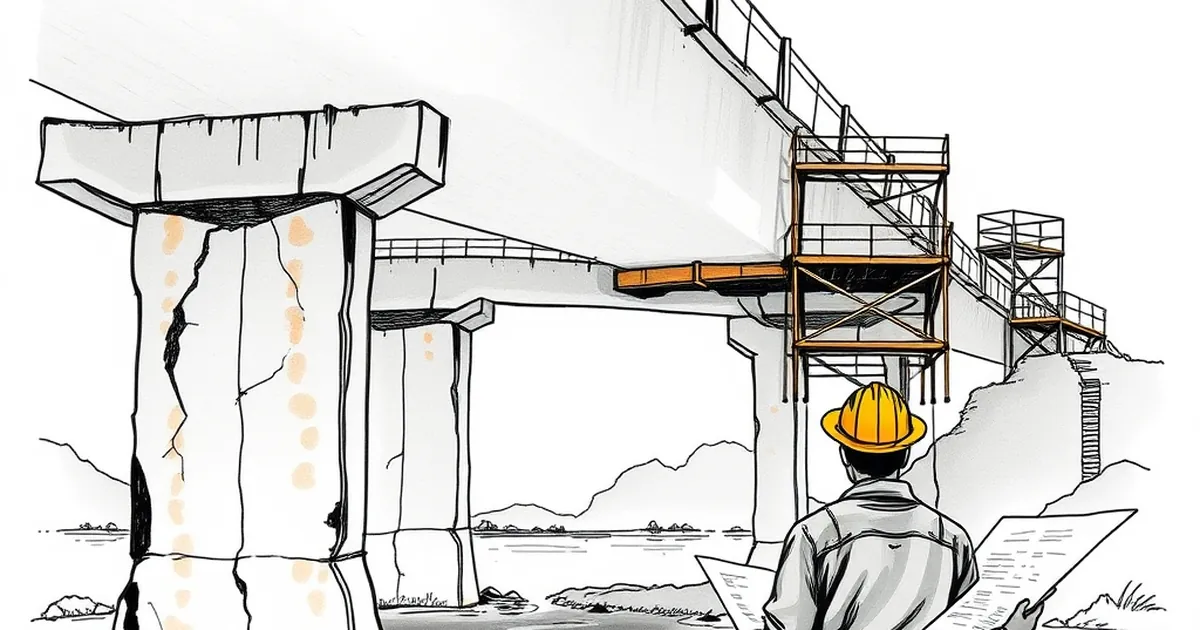
When a bridge collapses or an overpass has to be shut for emergency repairs, the public conversation in Poland tends to focus on the contractor, the inspector, or the weather. Rarely does it turn to the procurement rulebook itself — the scoring formula that decides, months or years earlier, which company gets to build the thing in the first place. Yet that formula is where many of the later problems are quietly locked in.
In Polish public tenders for road and bridge infrastructure, price is still the dominant criterion, and in practice the lowest bid usually wins. The question worth asking is not whether that saves money in the short term — it usually does — but what kind of behaviour it rewards over a multi-year construction cycle, and whether the incentives it creates line up with the outcome the public actually wants: a structure that is still standing, and still safe, in fifty years.
The arithmetic of a lowest-price win
The legal framework is not the villain here. Poland's Public Procurement Law allows contracting authorities to weigh quality criteria — technical merit, warranty length, experience, maintenance costs — alongside price. EU directives have pushed in the same direction for years. The problem is that using those criteria takes work: you have to define them precisely, defend them against appeals to the National Appeal Chamber (KIO), and accept the political risk of choosing a bidder who is not the cheapest.
Price, by contrast, is objective, defensible, and easy to explain to a mayor, a voivode, or a newspaper. So it wins by default.
The result is a scoring model where a bid of 98 million złoty beats a bid of 104 million złoty even when the second bidder proposes a longer warranty, a more conservative design, better-documented steel provenance, or a maintenance plan that would save the treasury millions over the asset's life. The six-million-złoty gap is visible on the day the tender is settled. The savings from the better bid — spread over decades, in the form of fewer closures and cheaper repairs — are invisible, and they belong to a future administration.
This is a textbook case of what behavioural economists call hyperbolic discounting: the tendency to weigh immediate, certain costs far more heavily than delayed, uncertain benefits. The immediate cost is a line in a budget. The delayed benefit is a bridge that doesn't need to be patched in year nine.
What the incentive structure actually rewards
Strip away the formal language and a lowest-price tender is a reward loop. A contractor that trims costs — thinner margins, cheaper subcontractors, tighter schedules — is rewarded with the contract. A contractor that prices in contingency, skilled crews, and slower but more careful execution is punished by losing.
The variable-ratio problem
There is a second layer that makes this loop unusually sticky. Winning a tender is not a predictable event. A firm that bids aggressively will win some contracts and lose others, on a schedule it cannot fully control. That pattern — effort followed by an uncertain, intermittent payoff — resembles what psychologists call variable-ratio reinforcement, the schedule that produces the most persistent behaviour in both animals and humans. It is a well-documented finding going back to B.F. Skinner's work, and it explains why firms keep bidding low even after a project has gone badly: the next win might be the one that works out.
The industry has learned, rationally, that the way to survive is to win first and negotiate the consequences later. Claims, variations, and disputes become the real business model, not an exception to it.
Loss aversion on both sides of the table
Loss aversion, described by Daniel Kahneman and Amos Tversky, cuts in two directions. For the contracting authority, choosing a bid 6% above the lowest offer feels like a loss — a decision that will be questioned. For the contractor, losing a tender it bid aggressively on feels like a loss of work, of crew retention, of market position. Both sides are pushed toward the same outcome: the cheapest number on the table.
What gets lost is the thing neither party is directly rewarded for — the long-run condition of the asset.
What the research says about low bids and later problems
The pattern is not unique to Poland, and it has been studied. A widely cited body of work on "abnormally low tenders" in European construction found that bids significantly below the estimated contract value correlate with a higher incidence of change orders, schedule overruns, and quality disputes. The mechanism is not mysterious: a bid below the cost of doing the work has to be recovered somewhere. It is recovered in variations, in substituted materials, in reduced site supervision, or in a contractor that simply runs out of money mid-project.
Poland has its own examples. The collapse of a section of the Gdańsk bypass (Obwodnica Trójmiasta) in 2021, during work on an overpass, killed one worker and injured several others. Investigations pointed to problems in the execution phase, including issues with temporary structures and the pace of work. The tender for that contract was, like most road tenders in Poland, decided primarily on price. That is not a claim that a different scoring formula would have prevented the accident — that would be too simple. It is a claim that the procurement decision and the safety outcome belong to the same story, and Poland tends to tell them separately.
A more structural example is the recurring pattern on bridge refurbishments, where the winning bidder's price leaves no room for the archaeological surveys, utility relocations, or design changes that almost always appear. The project then stalls, the contract is renegotiated, and the final cost exceeds what a more realistic bid would have been — with the added cost of months of disruption for the people using the route.
The counterargument, taken seriously
It would be easy, and wrong, to conclude that lowest-price tenders are simply a mistake. They exist for good reasons. Public money is finite. Price competition disciplines inflated bids and protects against favouritism, which in Poland's construction market is not a hypothetical concern. A system that allowed authorities to freely pick "the best" bidder would create its own risks, and the KIO's strict scrutiny of non-price criteria reflects a real history.
The honest position is narrower: price-only scoring works acceptably when the work is simple, well-specified, and low-consequence. It works badly when the work is complex, hard to specify in advance, and consequential if it fails. Bridges are the second kind. They are, by nature, the category where the lowest bid is least likely to be the safest one.
Where this could actually go
The forward-looking question is not whether Poland should abandon price competition, but how to make the quality it already claims to want — durability, safety, maintainability — into something a bidder can be rewarded for, and a contracting authority can defend.
Three practical directions are already visible in the market. First, life-cycle costing: scoring bids on the estimated cost of construction plus decades of maintenance, rather than construction alone. This shifts the calculation toward design choices that reduce future closures. Second, warranty and defect-liability periods that are long enough to matter — ten years rather than five — so that a contractor's incentive to build well extends past the final payment. Third, scoring the bidder's own safety and quality record, not just its price and its references, using data that is already collected but rarely feeds back into procurement.
None of these are radical. All of them require someone to accept a slightly higher number on the day the tender is decided, and to explain why. That is the hard part, and it is a political problem as much as a technical one.
The next time a Polish bridge is closed for repairs earlier than expected, it is worth asking a question that rarely appears in the coverage: what did the tender actually reward? The answer is usually in the documents, and it usually says the cheapest number won. Changing that does not require new engineering. It requires deciding, deliberately, that the cheapest number is not the only thing worth measuring.