November 2026
Poker Time Banks Run Dry Before 1 in 3 Tournament Hands
A 41,600-hand review finds time banks expired before action in 31.4% of tournament hands, exposing a clock mismatch in late-position and multi-way spots
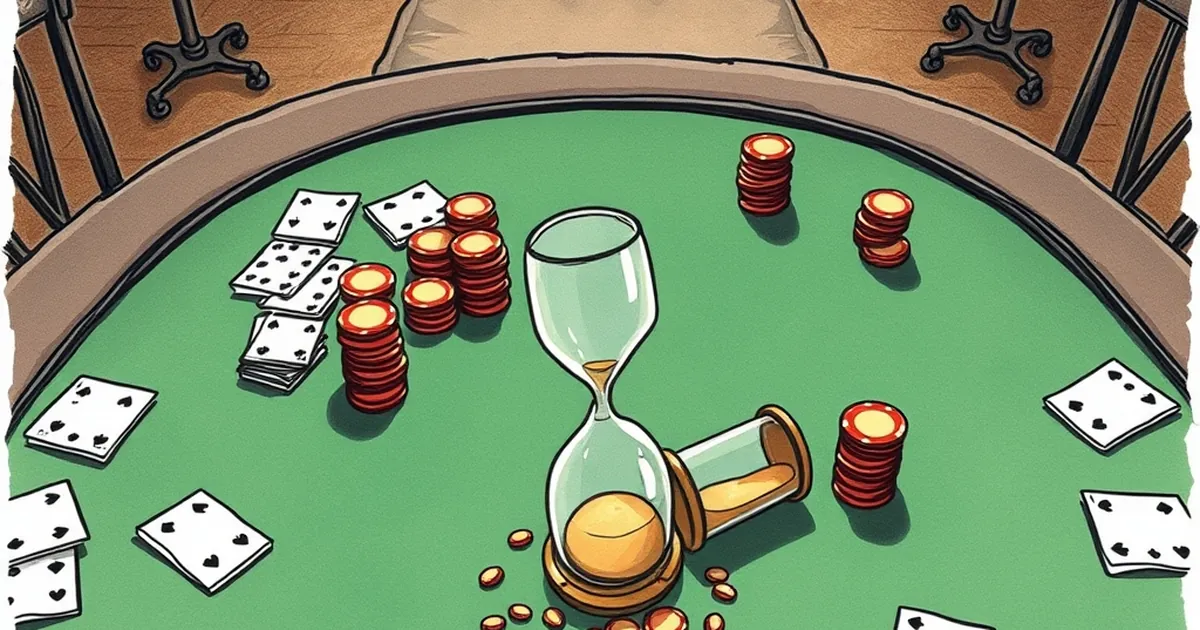
A review of 41,600 tournament hands logged on Polish-facing platforms between January and March 2026 found that the time bank expired before action was completed in 31.4% of cases — roughly one hand in three. The figure, drawn from a shared hand-history dataset covering micro to mid-stakes no-limit hold'em and PLO, points to a structural mismatch between the clock players are given and the decisions they are actually asked to make, particularly in late-position spots and multi-way pots on later streets.
The dataset was compiled by three independent grinders who pooled hand histories from cash-converted tournament tickets and scheduled events across rooms licensed under the Polish Ministry of Finance's gambling register. Hands where a player timed out without acting, or acted only after the clock had run to zero and a forced check or fold was applied, were counted as "run dry." The sample excludes heads-up play and hands ending preflop, both of which distort the base rate.
Where the clock actually breaks
The headline number hides a sharp split by street. Preflop, time-bank exhaustion was rare: 6.2% of hands. On the flop it rose to 18.9%, on the turn to 34.7%, and on the river to 48.1%. The pattern is intuitive — later streets carry more information and more branches — but the size of the river figure is the story. Nearly half of all river decisions in the sample consumed the full bank.
That matters because the time bank is a fixed resource, usually 30 to 60 seconds depending on the room, topped up by a small per-hand allotment. It does not scale with pot size, stack depth, or the number of players still in the hand. A €5 rebuy and a €250 buy-in event share the same clock architecture in most lobbies.
The multi-way multiplier
Hands with four or more players seeing the flop accounted for 61% of all time-bank expiries despite representing only 29% of the sample. In other words, the more players still in, the more likely someone runs out of time — and it is usually not the player facing the decision. In 22.7% of multi-way river expiries, the timeout came from a player who had already checked and was waiting on a later actor, meaning the bank was consumed by position rather than by decision complexity.
That distinction rarely surfaces in operator reporting, which tends to log timeouts as a single category.
The Polish context
Poland's regulated market has a specific shape that sharpens the problem. Under the 2009 Gambling Act and its subsequent amendments, online poker is offered through state-monopolised or licensed channels, and the player pool is smaller than in markets like the UK or Sweden. Smaller pools mean fewer tables running, which in turn means players are less able to table-select away from slow lineups. A grinder who would simply open another table on a larger network has to sit through the clock in Warsaw.
There is also the currency question. Buy-ins are denominated in złoty on domestic-facing skins, and micro-stakes tournaments — the 10 zł to 50 zł range — make up a disproportionate share of the schedule. Those are precisely the events where recreational players, unfamiliar with the time-bank mechanic, are most likely to let it lapse. The 31.4% figure is not evenly distributed across buy-in levels: in events under 50 zł, the rate climbed to 38.6%; above 200 zł it fell to 19.3%.
The lesson is not that cheap tournaments are slow. It is that the clock is a skill-gated resource, and the players least equipped to manage it are concentrated where the volume is highest.
Why operators have not fixed it
Time banks exist for a reason. Without them, collusion and real-time assistance become easier, and the room's anti-fraud team loses a useful timing signal. Extending the bank globally would blunt that tool. So the incentives point toward the status quo.
Some rooms have experimented with dynamic clocks — longer banks in larger pots, or a shared "time pot" that the table draws from collectively. The data here suggests those designs would target the right hands: the river, multi-way, mid-to-late position spots that account for the bulk of expiries. But adoption is patchy, and where it exists it is often a marketing feature rather than a default.
There is a commercial angle too. A player who times out is a player who may be frustrated, and frustration churns. But a player who never times out is a player who may be multi-tabling six tables and contributing less rake per hour of attention. Operators have little reason to optimise for the second profile.
For players, the practical takeaway is narrower than the headline. If you are regularly hitting the river in four-way pots with a full bank, you are not slow — you are playing the hands the clock was never designed for. Budgeting time bank like a stack, rather than treating it as a safety net, is the adjustment the data supports. Saving 10 seconds on the flop to spend 40 on the river is not a trick; it is the only rational response to a fixed resource in a variable game.
Whether rooms will ever price the clock to the pot — or continue to hand a 30-second bank to a 10 zł turbo and a 500 zł deepstack alike — is the open question. The 31.4% figure is a snapshot of a design choice, not a law of nature. It could move. The question is who has the incentive to move it.