September 2026
Gdzie budować, gdy grunt jest podmokły?
Building on wetland in Poland demands careful ground assessment, as cheap green plots often hide peat and silt beneath
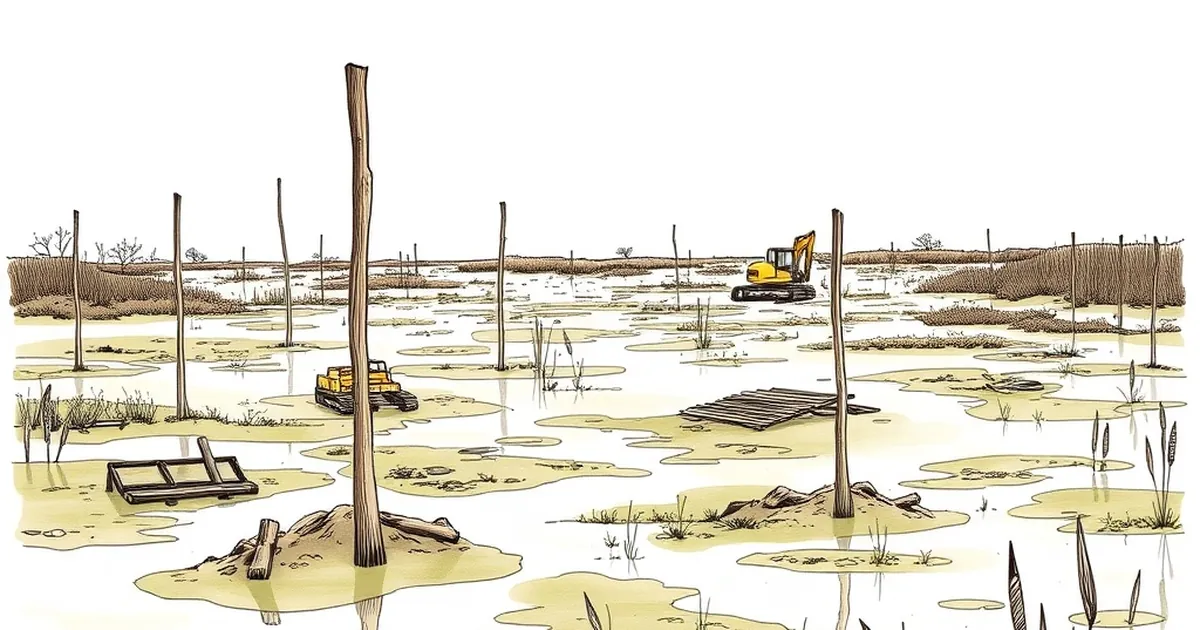
Poland's lowland heart is wet. From the Biebrza marshes to the floodplains of the Vistula and the Odra, a huge share of the country's most attractive development land sits on peat, silt, and waterlogged sand. So when a plot looks cheap, flat, and green, the first question a builder should ask isn't about price — it's about what's underneath.
Building on a mokradło is not impossible. It is, however, a discipline in itself, and getting it wrong is one of the most expensive mistakes in Polish construction. Here's how to think about it.
Why wet ground is a different kind of problem
A dry, sandy subsoil behaves predictably. You dig, you pour, and the soil carries the load. Organic, water-saturated ground does none of that.
Peat and gyttja are the classic culprits. They compress under load, sometimes by tens of centimetres, and they do it unevenly. A building that settles a few millimetres on one side and several centimetres on the other will crack — no matter how strong the walls are.
There's also the water itself. When the groundwater table sits at or near the surface, any excavation becomes a battle. Pits fill up, slopes slump, and heavy machinery sinks. And in Poland, this isn't a fringe scenario: the Mazowsze, Podlasie, and river valleys across the country are full of exactly this kind of terrain.
The good news is that geotechnics has spent a century solving this. The bad news is that the solutions cost real money, and skipping the diagnosis is how projects go wrong.
First, find out what you're actually standing on
Before you design anything, you need a geotechnical survey — a proper one, not a neighbour's opinion. This is the single most important step on a wet plot.
What the survey must tell you
A good geotechnical report answers three questions. How deep does the weak layer go? How much will it settle under your building's load? And where does the water table sit through the year, not just on the day of drilling?
In practice, that means boreholes — several of them, spaced across the plot — plus laboratory testing of the organic soil. A single probe in the corner tells you almost nothing about a plot that varies from peat to sand within twenty metres.
Reading the ground like a local
There are cheap signals worth knowing before you even commission a survey. Rushes, sedges, and alder stands usually mean high, persistent groundwater. Rust-coloured mottling in the soil points to a fluctuating water table. And old drainage ditches on or near the plot are a hint that someone has been fighting the water for decades.
If a plot floods after spring melt, that's not a one-off. It's the baseline.
The main ways to build on weak, wet ground
Once you know the subsoil, you choose a strategy. There are essentially four families of solutions, and they range from cheap-and-limited to expensive-and-bulletproof.
1. Remove and replace
The simplest approach: dig out the weak material and backfill with compacted gravel or crushed stone. It works well when the organic layer is shallow — say, up to two or three metres — and when you can keep the excavation dry.
The catch is dewatering. On a genuinely wet site, you'll need wellpoints or deep wells running continuously during the works, plus somewhere to discharge the water. On a large plot, this gets expensive fast.
2. Displacement and stone columns
Instead of removing the soft soil, you improve it in place. Stone columns — vibro-replacement — punch columns of compacted aggregate down through the weak layer, transferring load to firmer ground below and accelerating consolidation of the surrounding soil.
This is a workhorse method in Polish road and industrial construction. It's faster than excavation and generates far less spoil to haul away, which matters when you're working near a river valley with protected habitats.
3. Piles down to solid ground
When the weak layer is deep, piling is often the honest answer. Driven or bored piles carry the building's load past the peat and silt to a competent bearing stratum — dense sand, gravel, or glacial till.
Piles are expensive, and on a wet site you also need a robust pile cap and often a ground beam system to tie everything together. But they solve the settlement problem at its root, and they're the standard choice for anything tall or heavy.
4. A raft or a raised platform
Sometimes the smartest move is to spread the load and let the ground do what it will. A stiff raft foundation distributes weight across the whole footprint, reducing differential settlement to tolerable levels. On very soft ground, engineers sometimes design the raft to float — accepting some settlement, but keeping it uniform.
A variant is to raise the building on a compacted fill platform, lifting the finished floor above the flood level and giving the foundation a working surface. This is common in river valleys where flooding, not just settlement, is the risk.
The example that sticks in my mind
A few years ago I walked a plot near a small river in Mazowsze that a developer had bought cheaply. The plan was a row of terraced houses. The geotechnical report came back with three metres of peat over loose sand and a water table half a metre below the surface.
The original budget assumed simple strip foundations. The revised design needed stone columns plus a raised fill platform, and the cost jumped by roughly a third. The developer went ahead anyway — but only after renegotiating the land price, because the seller had quietly known about the ground conditions for years.
The lesson wasn't that the plot was unbuildable. It was that the ground conditions should have been priced in from day one, before the offer, not after.
What this means for your next project
If you're looking at a wet plot, the sequence is always the same: survey first, design second, negotiate the price third. The geotechnical report is not a formality — it's the document that decides whether your project is viable.
And there's a broader shift worth watching. As Poland tightens flood-risk mapping and protects more wetland under Natura 2000, the easy dry plots get scarcer and the wet ones get more attention. That pushes the industry toward smarter, lower-impact ground improvement — stone columns over mass excavation, floating rafts over deep piling where the loads allow.
The engineers who understand waterlogged ground will be the ones building on the land everyone else walks away from.