October 2026
Gauge Changes Strand Poland's Broad-Gauge Coal Fleet
Poland's 1,520 mm coal fleet faces an uncertain future as Ukraine regauges its tracks and the country's coal era winds down
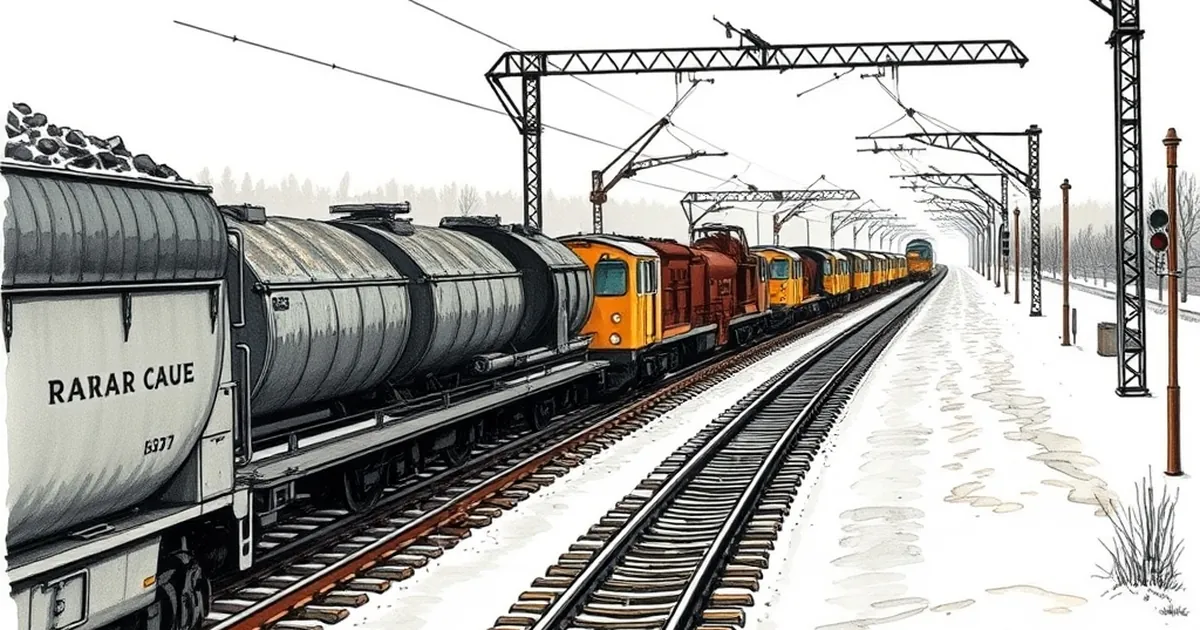
For three decades, the broad-gauge line from the Bogdanka mine to the Polish-Ukrainian border was the quiet workhorse of Polish energy logistics. Today, its future is anything but quiet. With Ukraine standardising its track gauge and Poland's coal era winding down, what actually happens to the 1,520 mm fleet that once hauled millions of tonnes eastward?
The Line That Was Never Supposed to Change
The Linia Hutnicza Szerokotorowa — known to almost everyone in the industry simply as LHS — is the longest broad-gauge railway in Poland. Running roughly 400 kilometres from the Sławków terminal near Katowice to the border crossing at Hrubieszów, it was built in the 1970s to feed Soviet-bloc steelworks and carry iron ore, coal, and sulphur between Poland and the USSR.
Its 1,520 mm gauge matched the Soviet standard, not the 1,435 mm used almost everywhere else in Poland. That single design decision defined the line's entire operational logic — and its entire fleet of rolling stock.
For years, LHS was a niche but profitable corridor. It moved bulk commodities in both directions, and its broad-gauge wagons, locomotives, and maintenance infrastructure were purpose-built around a gauge that had no connection to the rest of the Polish network.
A Fleet With Nowhere to Go
Here is the structural problem in one sentence: broad-gauge rolling stock cannot run on standard-gauge track, and there is no easy conversion. A 1,520 mm wagon cannot simply be re-gauged like a model train set. Bogies, axles, braking systems, and clearances are all engineered around the wider track.
That means Poland's LHS fleet is effectively captive. It can operate on the LHS corridor and into Ukraine — and almost nowhere else. When the demand for that corridor shifts, the fleet cannot follow the market. It stays where it is, depreciating.
Why Ukraine's Gauge Decision Matters So Much
For years, the assumption in Warsaw was that LHS would remain valuable precisely because Ukraine used the same broad gauge. Transshipment at the border was the whole point: Ukrainian trains could roll straight into Poland without reloading cargo.
That assumption is now under pressure. Ukraine has been steadily moving toward 1,435 mm standard gauge, driven by its ambition to integrate with European rail networks. The European Union's TEN-T corridors all assume standard gauge, and Ukraine's post-war reconstruction plans lean heavily on European connectivity.
The Slow Unwinding of a Border Advantage
Ukraine's gauge transition will not happen overnight — it is a decades-long, enormously expensive project. But the direction of travel is clear, and markets price in the future, not just the present.
The moment Ukraine no longer needs broad-gauge interchange at Hrubieszów, the strategic rationale for LHS weakens considerably. Not disappears — the line still serves Polish industry and could pivot to other cargo — but weakens. And a weakened corridor cannot justify maintaining a dedicated broad-gauge fleet indefinitely.
For Polish operators, this is the uncomfortable part. The assets are long-lived, the demand signal is fading, and the exit options are limited.
Coal's Decline Is the Second Blow
If Ukraine's gauge shift were the only problem, LHS might adapt. But it is arriving at the same time as Poland's coal transition, and that combination is what makes the situation acute.
Coal has historically been one of the dominant commodities on broad-gauge services into and out of Poland. As Polish mines close and power generation shifts toward gas, renewables, and nuclear, coal volumes on every rail corridor are falling. LHS is not immune.
What Actually Happens to Idle Broad-Gauge Wagons
Let me give you a concrete picture. A typical broad-gauge hopper wagon on LHS has a service life measured in decades. When a coal contract ends, that wagon does not get reassigned to a container service on the standard-gauge network — it physically cannot.
So it sits. It goes into a siding near Sławków or Zawadówka. It accrues maintenance costs, certification obligations, and storage fees. Operators either scrap it, sell it to Ukrainian or Kazakh buyers who still run broad gauge, or hold it in the hope that demand returns.
None of those options is attractive. Scrapping destroys value. Selling into a shrinking broad-gauge market means accepting a discount. Holding means paying to wait for a recovery that may never come.
Can LHS Reinvent Itself?
There is a more optimistic reading, and it deserves a fair hearing. LHS is not only a coal line. It has moved iron ore, fertilisers, grain, and increasingly containerised cargo. Sławków has ambitions to become a genuine intermodal hub connecting broad-gauge Asia traffic to European standard-gauge networks.
The concept is compelling on paper: a transshipment terminal where goods arriving from China or Kazakhstan on 1,520 mm wagons get reloaded onto standard-gauge trains for onward European delivery. Poland becomes a bridge, not just a destination.
The Transshipment Bet and Its Limits
The catch is that transshipment is exactly the activity that becomes less necessary if Ukraine and the wider region converge on standard gauge. If the whole Eurasian landmass eventually runs on 1,435 mm, the value of a broad-gauge bridge erodes.
That said, the timeline matters enormously. Full gauge convergence across Ukraine, Central Asia, and China is a multi-decade prospect at best. In the meantime, LHS retains real utility — and the fleet retains real value, provided operators are honest about the shrinking window.
The practical question for Polish logistics planners is not whether broad gauge survives forever. It is how to extract value from these assets during the transition rather than after it.
What This Means for Polish Infrastructure Planning
The broader lesson here extends well beyond one railway line. Poland has spent years investing in infrastructure built around assumptions — coal dependency, eastern trade patterns, a specific gauge — that are now shifting faster than the assets depreciate.
Rail infrastructure is uniquely unforgiving in this respect. A road can be repurposed in months. A broad-gauge rail corridor with a dedicated fleet takes years, sometimes decades, to redirect or retire.
A Forward-Looking Note for Operators
If you run or finance rail assets in Poland, the LHS situation is a case study in stranded-asset risk. The gauge is the constraint that makes everything else harder: you cannot redeploy, you cannot easily resell, and you cannot pivot to new markets without new capital.
The operators who will come out ahead are those treating the broad-gauge fleet as a transitional asset with a defined useful life — not a permanent fixture. That means locking in long-term cargo contracts while they still exist, exploring resale into still-broad-gauge markets like Kazakhstan and Belarus where politically feasible, and investing in transshipment capacity that works regardless of which gauge wins.
Poland's broad-gauge coal fleet is not dead yet. But it is on a clock, and the clock is now ticking in two directions at once — eastward, where the gauge is changing, and inward, where the coal is running out.