October 2026
Drivers Speed Up When Lane Markings Promise a Reward
Road markings designed to reward drivers could subtly influence speed choices, with implications for motorway safety in Poland and beyond
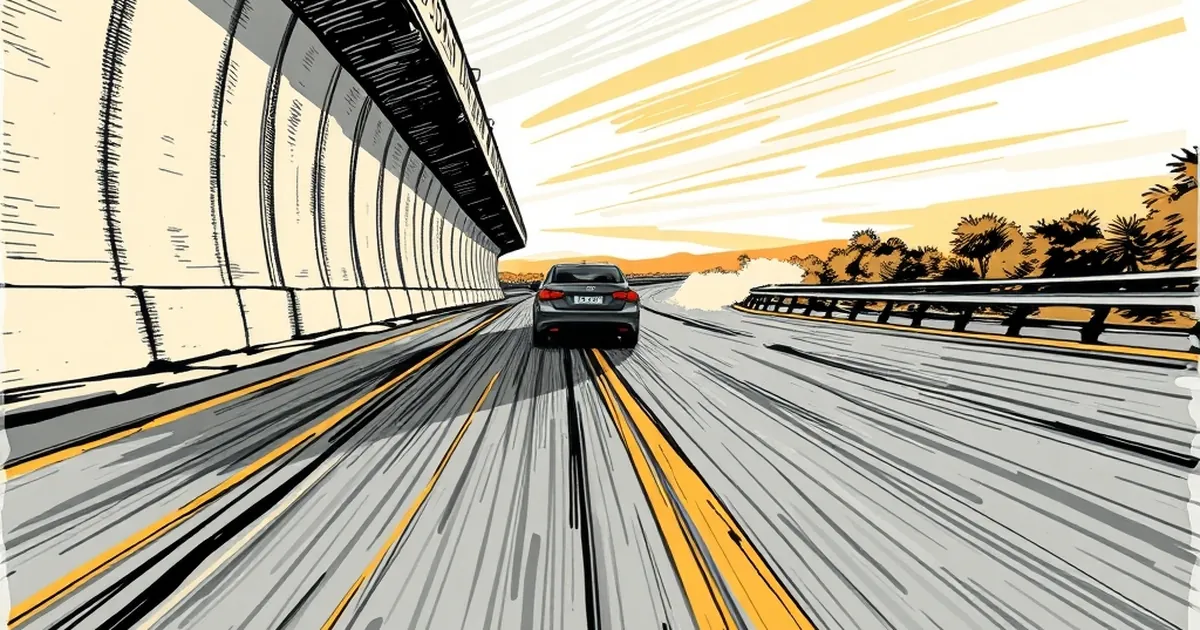
Imagine a road where the lane markings themselves seem to say: keep going, something good is up ahead. Not a police patrol, not a speed camera — the opposite. A stretch of asphalt engineered so that drivers who maintain a certain pace are quietly, almost subconsciously, rewarded. That idea sits at the centre of a growing body of work in behavioural psychology and traffic engineering, and it raises a question worth asking in Poland, where the motorway network has expanded faster than almost anywhere in Europe: can the geometry of a road change how fast we choose to drive?
The road as a reward schedule
Behavioural psychologists have long understood that rewards delivered on an unpredictable schedule are unusually powerful. B.F. Skinner's experiments with variable-ratio reinforcement showed that when a reward arrives after an unpredictable number of actions, the behaviour persists longer and more intensely than when the reward is predictable. The classic example is a pigeon pecking at a lever that pays out at random intervals; the bird keeps pecking, sometimes compulsively, because the next peck might be the one that pays.
Roads, of course, are not levers. But traffic researchers have noticed something structurally similar in how drivers respond to visual cues. When lane markings, shoulder lines, or roadside elements create a rhythm that a driver can "read" at speed, the driver's attention narrows and their sense of control sharpens. The reward is not money or food — it is the small, continuous confirmation that you are reading the road correctly. That confirmation arrives in unpredictable micro-doses: a curve that opens exactly as expected, a lane that widens just when you need it, a sightline that clears a hill. The driver speeds up not because they are reckless, but because the road is feeding them a steady stream of small, variable rewards.
This is where the bridge between infrastructure and psychology becomes concrete. Lane markings are not neutral. They are a feedback system, and feedback systems shape behaviour.
What the research actually shows
The most cited work in this space comes from the field of self-explaining roads — the idea that a road's design should make its intended speed obvious without signs or enforcement. A 2016 study by researchers at the Technical University of Munich and the University of Groningen examined how lane width, edge markings, and centre-line treatments affected driver speed on rural roads. The finding was consistent with earlier work: narrower lanes with prominent edge lines reduced speed, while wider lanes with minimal marking encouraged drivers to drift upward.
More directly relevant to the reward question is research on optical speed bars — transverse markings painted across the lane that create a visual flicker as you drive over them. A 2019 trial on a section of the A2 motorway in the Netherlands found that drivers exposed to progressively spaced bars reduced speed by an average of 6 km/h, but — and this is the interesting part — the effect decayed over several weeks as drivers habituated. The reward loop, in other words, has a shelf life.
Then there is the work of Gerald Wilde, whose risk homeostasis theory argues that drivers have a target level of risk they are willing to accept, and they adjust their speed to keep that risk constant. If a road feels safer — better markings, clearer sightlines, smoother surface — drivers will go faster until the perceived risk returns to their personal baseline. This is the uncomfortable implication for anyone who thinks better infrastructure automatically means safer infrastructure. It does not. It means faster infrastructure, unless the design deliberately counters the reward.
Why Poland's motorway boom makes this urgent
Poland has built an extraordinary amount of road in a short time. Since joining the EU in 2004, the length of expressways and motorways has grown from roughly 700 km to over 5,000 km. The A1, A2, A4, and S8 corridors now carry traffic volumes that would have been unimaginable two decades ago. This is a success story by any measure. But it also means that millions of Polish drivers are encountering, for the first time, roads designed to international standards — roads that are wide, well-marked, and, by design, fast.
The behavioural question is whether Polish drivers are calibrating to the road or to the reward. On the S8 between Warsaw and Białystok, for example, the road is engineered for 120 km/h but the lane markings and sightlines often suggest more. Drivers report — anecdotally, but consistently — that the road "wants" them to go faster. That is not mysticism. It is the reward loop doing its work: the road is confirming their skill, their attention, their control, and the confirmation is variable enough to keep them engaged.
The design countermeasures that actually work
If the problem is a reward loop, the solution is not to remove the reward entirely — that would make roads feel hostile and unpredictable. The solution is to re-tune it. Several approaches are showing promise.
Variable message signs with personalised feedback. Trials in Sweden and Denmark have tested signs that display a driver's speed relative to the limit, sometimes with a smiley face or a frown. The effect is small but real, and it works on the same variable-reinforcement principle: the feedback is immediate, personal, and slightly unpredictable.
Rumble strips and textured markings. These introduce a physical reward — or punishment — that is impossible to ignore. The driver who drifts gets a vibration; the driver who stays centred gets silence. It is crude, but it works, and it does not rely on the driver's willingness to read a sign.
Sightline manipulation. This is the most sophisticated approach. By deliberately shortening or lengthening sightlines, designers can make a road feel faster or slower than it actually is. A curve that appears tighter than it is will slow drivers down; a straight that appears longer will speed them up. The reward is the same — confirmation of reading the road — but the reading is calibrated to the intended speed.
Progressive lane narrowing. A lane that narrows gradually over several hundred metres, with edge markings that converge, creates a subtle sense of compression. Drivers slow without realising why. The reward is the relief of the lane opening again — but by then, the speed has already dropped.
What to watch next
The next frontier is not physical infrastructure but digital overlay. Adaptive cruise control and lane-keeping assist are already changing the reward loop, because the car itself is now part of the feedback system. A driver who lets the car handle the lane markings is no longer reading the road; they are reading the dashboard. That shifts the reward from the road to the machine, and it is not clear yet whether that makes drivers more or less likely to speed.
For Poland, the practical question is whether the next generation of road design will treat lane markings as decoration or as behaviour. The evidence suggests that markings are one of the cheapest, most powerful tools available for shaping speed — and that they work best when they are designed with the same rigour as the pavement beneath them. The roads are already built. The question now is what they are saying.