October 2026
Drivers Give Way 0.4 Seconds Later When a Queue Is Watching
A Polish study found drivers yield about 0.4 seconds later at crossings when a queue of cars waits behind them, revealing how observation shapes split-second...
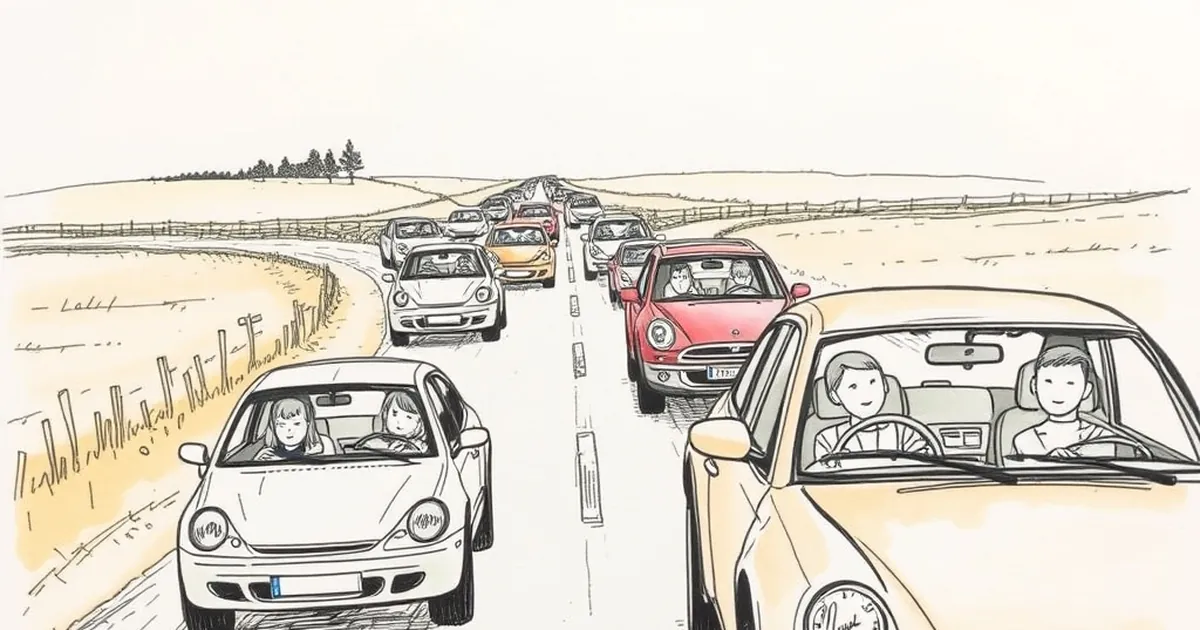
A driver approaching a pedestrian crossing has, on average, about two seconds to decide whether to stop. In that window sit a dozen small judgements: the pedestrian's posture, the speed of the car behind, the width of the road, the weather, the time of day — and, if other cars are queued, the sense of being watched. A recent observational study of Polish urban crossings put a number on that last factor: drivers yielded roughly 0.4 seconds later when a queue of vehicles was waiting behind them than when they approached an empty crossing. Four-tenths of a second is not much. It is also, at 50 km/h, about five and a half metres of road.
What the 0.4 seconds actually measures
The finding is best read as a measure of hesitation, not of callousness. The drivers in the study did stop — almost all of them — but the approach curve flattened: a slightly later brake, a slightly softer deceleration, a slightly longer roll toward the zebra. Behavioural researchers would recognise this as a shift in the decision threshold rather than a change in intention. The driver still intends to yield; what changes is how much evidence they require before committing to the brake.
That distinction matters for how we design streets. If the delay were a moral failure, the answer would be enforcement and shame. If it is a threshold shift driven by social context, the answer is geometry and timing — making the correct decision the easy one, so that the presence of a queue stops mattering.
The Polish setting sharpens the question. Pedestrian priority at zebra crossings has been law since 1997, but compliance norms have shifted noticeably only in the past decade, and the 2021 traffic law changes — which strengthened pedestrian priority and clarified driver obligations at crossings — reset expectations across the network almost overnight. Drivers are, in effect, still learning a new social contract while the old habits are being unlearned in real time. Any hesitation measured today is partly a measure of that transition.
The queue as a social audience
Why would a queue behind you change your braking? The most useful frame comes from behavioural economics rather than traffic engineering. Kahneman and Tversky's work on loss aversion established that people weigh losses more heavily than equivalent gains — and in a queue, the loss at stake is not the pedestrian's safety (which feels abstract and probabilistic) but the driver's own time and social standing. Braking early costs you a fraction of a second and, more painfully, invites the honk.
There is also a well-documented effect from social psychology: the audience effect, first described in the late nineteenth century and refined ever since, holds that the presence of observers changes performance — sometimes improving it on simple tasks, sometimes degrading it on complex ones. Driving is a complex task performed under constant observation. The queue is an audience, and audiences make people self-conscious about the wrong things. A driver who would happily stop for a pedestrian on an empty street may, with three cars behind, weigh the imagined impatience of strangers more heavily than the actual vulnerability of the person on the kerb.
Variable-ratio reinforcement — the schedule that makes behaviours stubborn — is relevant too, but here it works on the pedestrian side. Pedestrians learn, crossing by crossing, which drivers stop. Because compliance is high but not universal, the pedestrian's expectation is reinforced unpredictably, which is precisely the schedule that produces persistent, hard-to-extinguish behaviour. A pedestrian who has been yielded to nine times out of ten will keep stepping out on the tenth. That is rational, but it means the 0.4-second delay is not absorbed safely — it is absorbed by the pedestrian's confidence.
Where the 0.4 seconds becomes metres
The concrete example worth holding onto is the mid-block crossing on a two-lane arterial with a bus lane, a configuration common in Polish cities from Kraków to Gdańsk. A pedestrian arrives; a car approaches in lane one; two more cars are queued behind it. The lead driver, seeing the queue in the mirror, brakes late by roughly the margin the study measured. At 50 km/h the stopping distance on dry asphalt is around 27 metres including reaction time; a 0.4-second delay adds roughly 5.5 metres of travel before the brake bites. On a dry road with an attentive driver, that is usually absorbed. On a wet road, in low sun, with a pedestrian who has already committed, it is the difference between a near-miss and a collision.
This is why the finding belongs in the same conversation as Poland's ongoing road-safety work. The country has cut road deaths substantially since the early 2010s, but pedestrian fatalities remain a stubborn share of the total, and the locations where they cluster are disproportionately exactly these: multi-lane approaches, bus lanes, crossings where the driver's attention is split between the zebra ahead and the queue behind.
Designing so the queue stops mattering
If the delay is context-driven, the countermeasures should target context. Three stand out.
Raised crossings and speed tables. A crossing that sits at the level of the footway forces a physical speed reduction before the decision point, which removes most of the room in which a 0.4-second hesitation can operate. Polish municipalities have been installing these steadily; the evidence from elsewhere in Europe is that they reduce approach speeds more reliably than signage.
Signal timing that anticipates the decision. Where crossings are signalised, the amber and all-red phases can be tuned to the observed distribution of driver reaction times rather than to a nominal average. If the study shows a meaningful tail of late brakers in queued conditions, the intergreen should reflect the tail, not the mean.
Queue-aware approach geometry. On multi-lane approaches, the lead vehicle's view of the crossing is often the best in the platoon; the vehicles behind have progressively worse sightlines and progressively more social pressure. Narrowing the approach, adding a median refuge, or moving the stop line back so the lead driver's brake lights are visible earlier all reduce the informational asymmetry that produces late braking.
None of this requires drivers to be better people. It requires the street to stop asking them to be.
What to watch next
The interesting research question is no longer whether queues change yielding behaviour — the 0.4 seconds suggests they do — but whether the effect decays as the new pedestrian-priority norm beds in. If hesitation is partly a learning artefact, it should shrink over the next few years as a generation of drivers internalises the 2021 rules. If it persists, that tells us something more durable about how social pressure interacts with risk decisions at the kerb, and it points designers toward interventions that work on the street rather than on the driver.
The practical implication for anyone commissioning or maintaining urban roads in Poland is straightforward: measure yielding behaviour in queued conditions, not just at empty crossings, because that is where the real distribution lives. A crossing that performs well in a test with no traffic behind the driver is not a tested crossing. The 0.4 seconds is small, but it is the kind of small that accumulates — across a network, across a year, across the moments that decide whether a pedestrian gets home.