October 2026
Drivers Accept 8-Second Gaps That Signals Would Never Allow
Why Polish drivers treat an eight-second gap at unsignalised crossings as normal, and what that reveals about road design and driver behaviour
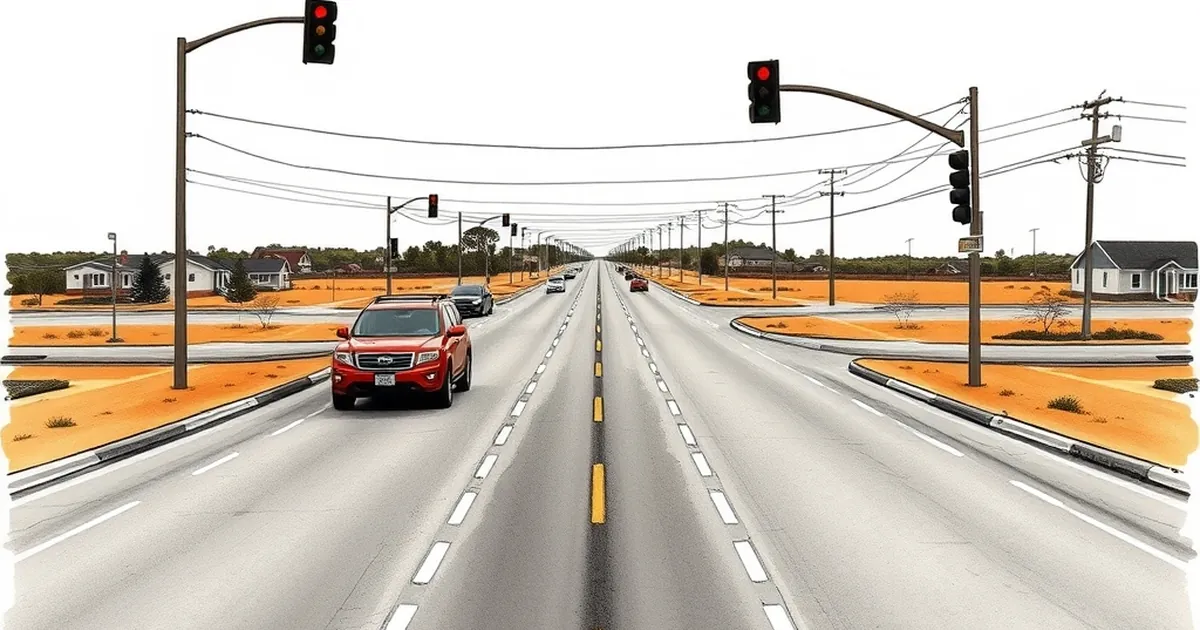
The eight-second gap is the quiet anomaly of Polish road design. Stand at a pedestrian crossing on a two-lane road outside a town and watch: a driver approaching at 70 km/h, a pedestrian waiting on the kerb, and a decision made in under two seconds that a traffic engineer with a signal plan would spend three months justifying. The driver lifts, the pedestrian steps out, the gap closes to something between six and eight seconds of travel time — and both parties accept it as normal. Put a signal head on the same crossing and the same driver will brake hard for amber. The question worth sitting with is why the unmanaged version feels safer to everyone involved, and what that tells us about how road users actually make decisions.
The gap that no signal plan would ever sign off
Polish signal design follows the Rozporządzenie on road signs and signals and the ministry's technical guidelines, which set intergreen times — the all-red plus amber clearance — on the basis of approach speed, reaction time, and vehicle deceleration. For a 70 km/h approach the intergreen typically lands somewhere between four and six seconds depending on geometry and gradient. That number is not a comfort target; it is the minimum time a signal controller must guarantee before releasing a conflicting movement. Designers then add a buffer for heavy vehicles and for the fact that some drivers will not begin braking until they are already past the stop line.
An eight-second gap is roughly double that. It is not a legal requirement, it is an emergent social norm — and it holds remarkably consistently across Polish roads where there is no signal at all. Drivers who would never run a red light will happily accept a pedestrian crossing gap that a signal engineer would call reckless, because the two situations are not being evaluated by the same part of the brain.
Why unmanaged gaps feel safer than managed ones
The illusion of control sits with the driver
At a signalised crossing, the driver's task is binary and delegated: read the light, obey it. Responsibility for the decision has been transferred to a controller in a cabinet by the roadside. When the light turns amber at an awkward distance, the driver experiences a loss — the loss of a green they had already mentally banked — and Daniel Kahneman and Amos Tversky's work on loss aversion tells us that losses loom roughly twice as large as equivalent gains. The result is the familiar amber surge: drivers accelerate to avoid the loss rather than brake to accept it.
At an uncontrolled crossing the driver keeps the decision. There is no amber to beat, no controller to blame, and no discrete moment at which the right to proceed is revoked. The gap is negotiated continuously, and continuous negotiation produces a different kind of attention — one that is slower, more conservative, and oddly more courteous. The eight-second gap is not a failure of regulation. It is what happens when regulation steps back and the driver is left holding the responsibility.
Variable-ratio reinforcement on the approach
There is a second mechanism, and it is the one transport psychologists return to again and again. B.F. Skinner's variable-ratio schedules describe behaviour reinforced after an unpredictable number of responses — the pattern that produces the most persistent, most resistant-to-extinction behaviour in the operant literature. Uncontrolled crossings deliver exactly this. Most approaches pass without incident; occasionally a pedestrian appears late, or a cyclist emerges from a driveway, and the driver's scanning is reinforced. The unpredictability is what keeps the scanning alive.
A signalised crossing, by contrast, is a fixed-interval schedule. Green means go, and the reinforcement for scanning is weak because the environment has been made predictable. Predictability is the whole point of a signal — but it also licenses a lower level of attention. This is not an argument against signals. It is an argument for understanding what a signal buys and what it quietly spends.
What the eight-second gap actually measures
Eight seconds at 70 km/h is about 155 metres of approach. That is a long sight line, and it is why the norm holds: on a straight, open approach the driver can see the pedestrian early, and the pedestrian can see the driver. The gap is a joint product of visibility and speed, not a fixed social convention.
Change the geometry and the number collapses. On a crest, around a bend, in rain, or after dark the same driver will accept a far shorter gap — and the pedestrian, unable to read the driver's intent, will often step out anyway. Polish accident statistics have long shown that unprotected pedestrian crossings outside built-up areas concentrate serious injuries disproportionately, and the mechanism is exactly this: the eight-second gap is a fair-weather norm that does not survive reduced visibility.
There is a useful parallel in the Dutch Sustainable Safety approach, which treats the road network as a hierarchy in which the function of a road determines its design speed and its furniture. Where the function is "traffic distribution," pedestrians are separated; where the function is "access," speeds are physically calmed to 30 km/h so that any gap is survivable. The eight-second gap is a symptom of a road trying to do both jobs at once — carrying through traffic and hosting pedestrians — and relying on driver judgment to reconcile them.
Where the gap breaks down, and what to do about it
The most interesting research on this question comes from the observation that drivers systematically overestimate how much time they have and underestimate how much time pedestrians need. A pedestrian stepping off the kerb needs roughly two seconds to establish visible intent and another two to clear a lane; a driver needs about 1.5 seconds of perception-reaction before the brakes do anything. Eight seconds leaves a margin, but not a generous one, and it evaporates the moment either party misjudges.
Three practical directions follow, and none of them require a signal head.
Make the gap visible rather than assumed. Raised crossings, speed tables, and textured surfacing communicate "this is a place where the gap must be longer" without a controller. Polish municipalities have been installing these on drogi gminne for years; the case for extending them to the approaches of uncontrolled crossings on drogi powiatowe is strong and cheap.
Use in-road lighting and active warning signs where the sight line is short. These are not signals — they do not revoke anyone's right to proceed — but they shorten the time it takes a driver to notice a pedestrian and therefore lengthen the effective gap. The behavioural point is that they preserve driver responsibility while improving the information on which the decision rests.
Design for the speed you want, not the speed you sign. A crossing on a road with a 70 km/h limit and no calming is a crossing where the eight-second gap is being asked to do the work of geometry. Lower the approach speed physically — a chicane, a narrowing, a gateway — and the same eight seconds becomes a far safer number.
The forward-looking question for Polish road authorities is not whether drivers should accept eight-second gaps. They already do, and they will keep doing so wherever the road invites it. The question is whether the road network should be designed on the assumption that drivers will behave like the careful, negotiating agents they are at uncontrolled crossings — or whether it should keep pretending that a signal head is the only thing standing between a pedestrian and a bad afternoon. The evidence from the gap itself suggests the first assumption is the more honest one, and the more useful place to start.