October 2026
Commuters Rate a 2-Minute Sign Delay Worse Than a 9-Minute Ride
Commuters find a two-minute blank sign more frustrating than a nine-minute wait, revealing how uncertainty weighs heavier than measured delay
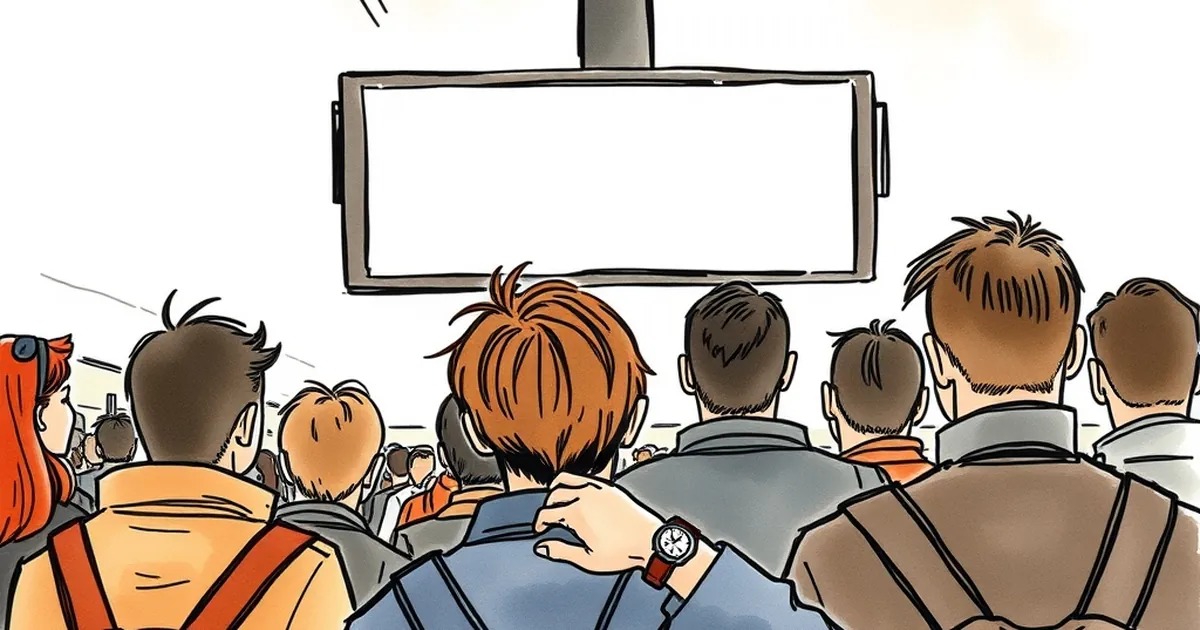
A sign at a platform edge tells a passenger the next tram is nine minutes away. A second sign, malfunctioning, leaves that same passenger staring at a blank display for two minutes before flickering back to life. Ask which experience is worse and most people will not hesitate: the blank sign. The wait is shorter, the journey identical, and yet the uncertainty of not knowing registers as a heavier burden than the delay itself. That gap between measured time and felt time sits at the centre of how Poland's transport authorities design, fund and justify the information systems that increasingly govern daily movement through its cities.
The arithmetic of waiting versus the psychology of not knowing
Behavioural research has long separated the duration of a wait from the experience of it. Richard Thaler, working in the 1980s, described how people evaluate outcomes against reference points rather than absolutes, and waiting without information denies the traveller any reference point at all. A nine-minute countdown is a known quantity; a blank screen is an open question that the mind fills with worst cases.
Kahneman and Tversky's work on loss aversion adds a second layer. A delay that is announced and quantified can be planned around — a coffee, a phone call, a shift in route. A delay that is merely implied, with no number attached, feels like a loss of control rather than a loss of minutes. The passenger is not comparing two minutes against nine. They are comparing certainty against uncertainty, and the second comparison almost always loses.
Polish operators have learned this the hard way. When Warsaw's ZTM rolled out dynamic passenger information displays across tram stops, the complaints that reached the operator were rarely about total journey time. They were about displays that went dark, showed a stale timestamp, or contradicted the app. A display that says nothing at all is judged more harshly than a display that says something unwelcome.
Variable-ratio reinforcement and the slot-machine platform
There is a less comfortable parallel worth drawing, and it comes from the psychology of reward schedules. B.F. Skinner's experiments established that behaviour maintained on a variable-ratio schedule — where a reward arrives after an unpredictable number of responses — is the most resistant to extinction. Predictable rewards produce steady behaviour; unpredictable ones produce persistent, sometimes compulsive, checking.
A passenger information system that works most of the time but fails unpredictably trains exactly this pattern. The traveller who has been burned by a blank display once begins checking the app, then the display, then the app again. Each successful check is a small reward; each failure is a small punishment. The result is not a calmer commuter but a more vigilant one, and vigilance is cognitively expensive. Studies of public transport satisfaction consistently find that reliability of information ranks alongside punctuality in passenger priorities — and in some surveys it outranks it, because information is the thing passengers can actually observe in real time.
The practical consequence for infrastructure planning is that a display's uptime is not a secondary technical metric. It is a psychological variable with measurable effects on how a city's transport system is perceived.
What the research on decision-making under uncertainty tells us
Decision research offers a useful frame here. When people face uncertainty, they do not simply average the possible outcomes; they weight probabilities non-linearly, overestimating small risks and underweighting moderate ones. A two-minute information blackout is a small probability event in any single journey, but across a year of commuting it accumulates into a salient memory. Passengers remember the day the board died, not the two hundred days it worked.
There is also the matter of competitive play — not in the sense of sport, but in the sense of how people compare their own experience against an imagined alternative. A commuter who sees a functioning display at a neighbouring stop, or a friend's screenshot of a working app, experiences their own blank screen as a relative deprivation. This is the same mechanism that makes queue-jumping feel worse than queueing. The absolute wait is identical; the comparison is not.
Polish cities have an advantage here that is easy to overlook. The country's transport authorities have invested heavily in real-time data infrastructure over the past decade, integrating GPS feeds from bus and tram fleets into central systems that push updates to displays and apps. That investment is what makes a two-minute blackout possible in the first place — a static timetable cannot fail, because it never promised anything. The question is whether the systems built on top of that infrastructure are engineered for graceful degradation or for silent failure.
Designing for the blank screen
The forward-looking question for operators is not how to eliminate display failures, which is impossible, but how to make failure legible. A display that shows "no data — next tram per timetable: 14:32" is psychologically different from a display that shows nothing. The first preserves the passenger's reference point; the second removes it. The engineering cost of the first is trivial. The behavioural cost of the second is not.
Some operators have begun treating information continuity as a service-level agreement rather than a best-effort feature, with fallback states defined and tested. Others have not. The gap between the two is not technical sophistication but a recognition that passengers are not measuring minutes — they are measuring whether the system can be trusted. That recognition, more than any display hardware, is what separates a transport network that feels reliable from one that merely is.