October 2026
Commuters Rate 4-Minute Delays Worse Than 12-Minute Waits
Why commuters remember unexpected four-minute delays as worse than predictable twelve-minute waits, and what that gap means for transport planning
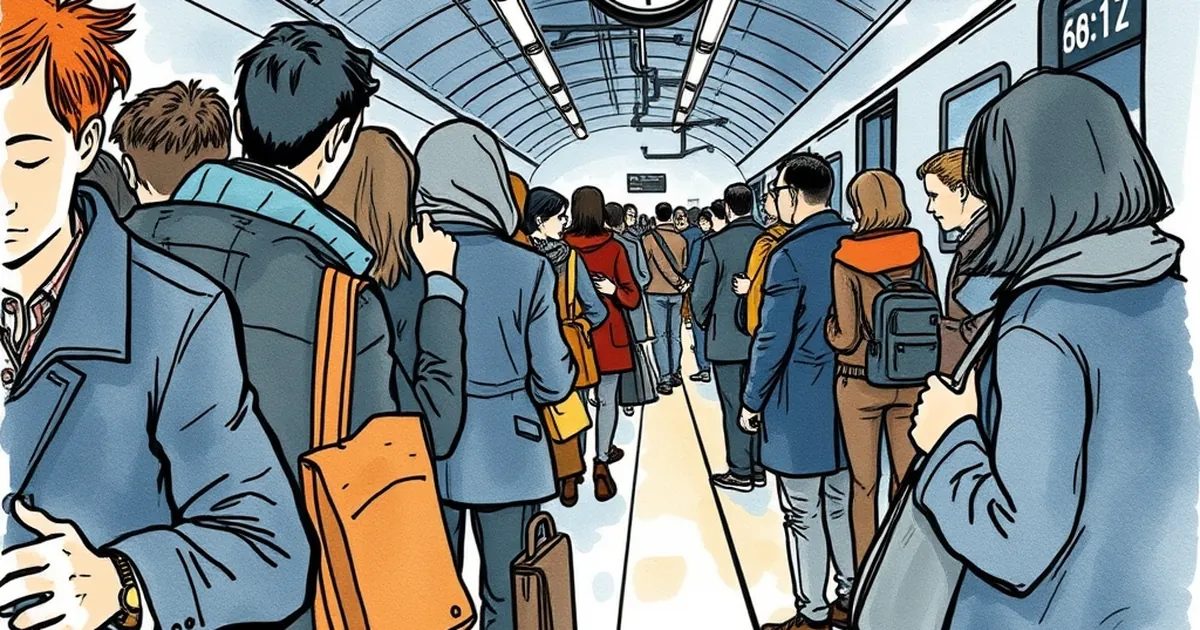
Ask a Warsaw commuter whether they would rather lose four minutes without warning or wait twelve minutes knowing the train is late, and most will pick the second. Ask them how they feel about the two experiences a week later, and the answer often flips. The gap between those two answers — between measured time and remembered time — is where transport planning, behavioral psychology, and the daily life of a Polish city meet. It also explains why a project that shaves ninety seconds off an average journey can fail politically while one that simply makes the timetable honest can succeed.
The clock and the calendar disagree
Transport economics has traditionally been built on a tidy premise: time is money, and a minute saved is a minute earned. That premise underpins cost-benefit analyses across Europe, including the feasibility studies behind Polish rail upgrades and tram extensions. But a growing body of research suggests that travellers do not weigh minutes evenly. They weigh uncertainty, control, and fairness — and those weights are not linear.
The best-known illustration comes from the UK's rail regulator. In a study of passenger priorities, researchers found that passengers valued a minute of unexpected delay considerably more heavily than a minute of scheduled journey time — by some estimates, several times over. A reliable four-minute delay that nobody warned you about stings more than a twelve-minute wait you could plan around: time to buy a coffee, answer emails, or simply stop watching the departure board.
This is not irrationality. It is a rational response to a different question than the one engineers ask. The engineer asks: how many minutes? The commuter asks: could I have done something about it?
Loss aversion arrives at the platform
Daniel Kahneman and Amos Tversky's work on loss aversion established that losses loom larger than equivalent gains. A commuter who expects to arrive at 8:42 and arrives at 8:46 has experienced a loss relative to expectation. A commuter who expects 8:54 and arrives at 8:54 has experienced nothing at all — even though their absolute journey was longer.
The implication is uncomfortable for anyone who manages infrastructure: managing expectations may matter as much as managing minutes. A tram that is consistently two minutes late becomes, in the mind of its regular riders, a tram that leaves two minutes later. The annoyance fades. A tram that is usually punctual but occasionally and unpredictably late produces a persistent, low-grade vigilance — the commuter leaves home early "just in case," and that buffer is a real cost, paid daily, that never appears in any spreadsheet.
Polish cities have been quietly learning this. Warsaw's tram priority system, which gives trams signal preference at intersections, was justified largely on journey-time grounds. But its underrated benefit is consistency: fewer unpredictable stops mean fewer surprises, and fewer surprises mean riders trust the timetable enough to stop padding their departures.
Variable-ratio reinforcement, in the wild
Behavioral psychologists describe variable-ratio reinforcement as the schedule that produces the most persistent behaviour — rewards that arrive unpredictably keep an organism engaged far longer than rewards that arrive on a fixed pattern. It is usually discussed in the context of learning and habit formation, and it is worth understanding precisely because it cuts both ways.
Applied to a transport network, unpredictability keeps people checking. They refresh the app, they peer down the street, they build in slack. The checking behaviour is the symptom; the missing trust is the disease. A network that is merely slow but predictable allows riders to stop checking — and that cognitive relief is a genuine service improvement, even if the stopwatch disagrees.
What a four-minute delay actually costs
It is tempting to dismiss all this as a matter of feelings. It is not. The buffer time that commuters build into their journeys is a measurable economic drag — hours of productive life surrendered each year to insurance against a network's unpredictability.
Consider a concrete case. A commuter who leaves eight minutes early every morning to protect against a delay that occurs, on average, twice a week is not losing eight minutes twice a week. They are losing eight minutes every day, because the buffer is indivisible. Across a working year, that is roughly thirty hours — more than three full working days — spent standing on a platform or sitting in a tram that they did not need to catch.
Multiply that across a metropolitan area of two million people and the aggregate figure becomes the kind of number that should appear in every transport business case. It rarely does, because buffer time is invisible: it does not show up in journey-time models, it does not generate complaints, and it does not appear on any dashboard. It simply quietly erodes the case for public transport relative to the car, which — crucially — offers the illusion of control even when it is objectively slower.
The control premium
That word, control, keeps surfacing in the behavioural literature on transport choice. Studies of mode choice across European cities consistently find that drivers overweight the flexibility of the car and underweight its costs — parking search time, congestion unpredictability, the mental load of the route. Part of that overweighting is the sense that when something goes wrong in a car, you can do something about it. When a tram fails to appear, you can only wait.
This is where infrastructure design becomes behavioural design. Real-time passenger information, once a novelty, is now close to universal on Polish urban networks — and its value is not primarily informational. It converts an unknown wait into a known one. A board that says "6 minutes" is doing something a timetable cannot: it is handing control back to the passenger, who can now decide whether to wait, walk, or reroute. That decision, even when the outcome is identical, changes the experience of the delay.
The same logic applies to interchange design. A connection that is physically short but psychologically opaque — a long corridor with no sightline to the platform — feels riskier than a longer walk you can see the whole way. Passengers systematically avoid interchanges they cannot predict, even when those interchanges are faster on paper. Planners who model only distance miss this entirely.
Risk-taking and the competitive frame
There is a further wrinkle worth naming. Behavioural research on competition and risk-taking suggests that people accept uncertainty more readily when they feel they are playing rather than being played upon. A cyclist choosing a route through a busy city is taking a calculated risk and, surveys suggest, often enjoys the competence that risk confers. A commuter stranded by an unexplained cancellation is taking no risk at all — they are simply subject to one. The difference between agency and exposure is the difference between a challenge and an insult.
This is why communication during disruption matters so much more than its raw informational content. A clear announcement that a line is suspended, with an estimate and an alternative, converts exposure into a problem to be solved. Silence converts it into something closer to betrayal — and betrayal is remembered.
Designing for trust, not just throughput
The forward-looking question for Polish infrastructure is not how to make journeys faster. On many corridors, the easy minutes have already been taken. The question is how to make journeys legible — how to build a network whose behaviour a rider can predict without effort, and whose failures it explains before anyone has to ask.
Three practical directions follow. First, treat punctuality variance, not just the mean, as a design target — a line that is reliably ninety seconds late is a better product than one that is usually on time and occasionally six minutes late. Second, invest in the moments of disruption, not just the moments of smooth running: a well-handled cancellation buys more goodwill than a hundred uneventful trips. Third, and least glamorous, stop treating passenger information as a courtesy and start treating it as capacity. A rider who knows what is happening is a rider who is not burning buffer time, not refreshing an app, and not quietly concluding that next year they should just drive.
The four-minute delay will always feel worse than the twelve-minute wait. That is not a flaw in commuters. It is a specification — one that the next generation of Polish transport projects would do well to design to.