October 2026
Commuters Overestimate Saves 6 Minutes on Timetables That Never Change
Transport psychology reveals why commuters overestimate time saved on unchanged timetables, and what it means for Poland's rail investment
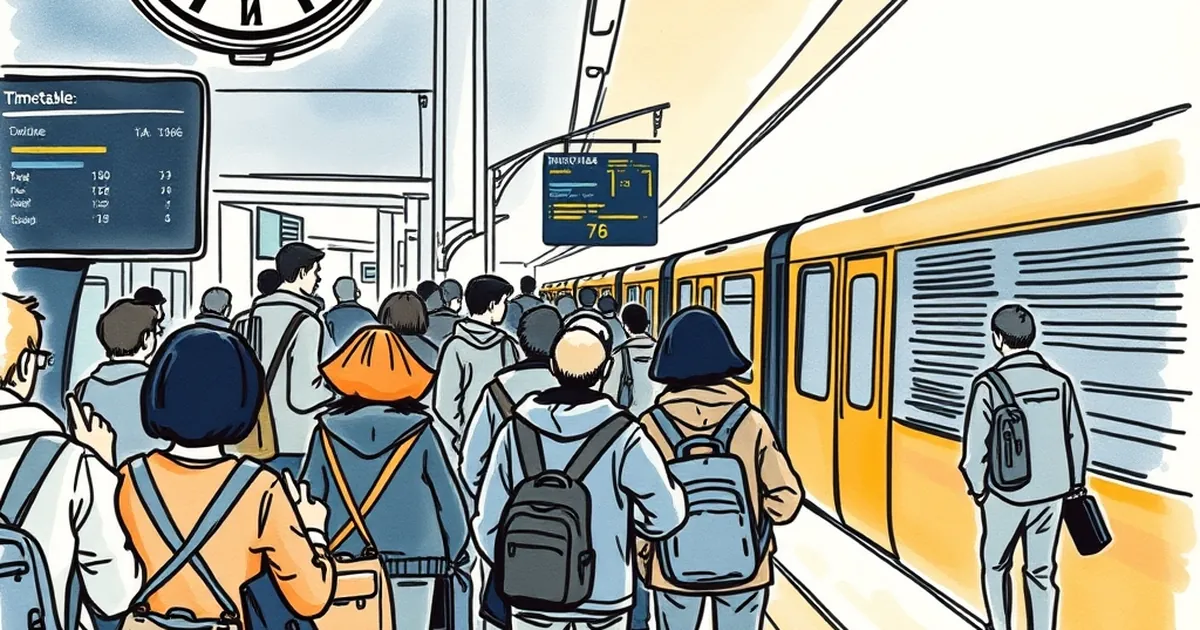
A commuter standing on a cold platform in Katowice at 6:40 a.m. is not, whatever the timetable says, waiting six minutes. Ask them afterwards and they will often insist the train was late even when it arrived on the minute. The gap between measured time and remembered time is one of the more durable findings in transport psychology, and it matters enormously in Poland right now, as billions of złoty flow into rail modernization, bus corridors, and interchange upgrades. If the perceived improvement in a journey is driven by something other than the clock, then the way we design, announce, and justify infrastructure needs to account for it.
The Six-Minute Illusion
The number in the headline is not arbitrary. Studies of commuter perception have repeatedly found that travelers overestimate waiting and transfer time by a meaningful margin while underestimating time spent in motion. A widely cited Swedish field study of bus and rail passengers found that actual waiting time was consistently judged longer than it was, sometimes by 50 percent or more, while in-vehicle time was compressed in memory. A six-minute wait can register as ten.
This is not stupidity or ingratitude. It is how attention works. Time spent watching for a vehicle, scanning a departure board, or standing in weather is time spent in a state of vigilance, and vigilance is expensive. The brain allocates more processing to it, and retrospective judgment follows the allocation. Time spent seated, reading, or half-asleep passes with far less encoding, so it feels shorter. The asymmetry is reliable enough that transport planners have a name for it: waiting time is weighted, in many demand models, at roughly 1.5 to 2.5 times in-vehicle time.
For a country investing heavily in shortening journey times, that weighting is a strategic fact. Saving four minutes on a train that was already comfortable may barely register. Saving four minutes of exposed standing on a platform may register as a transformation.
What the Mind Does With Uncertainty
Daniel Kahneman and Amos Tversky's work on loss aversion established that losses loom larger than equivalent gains. Applied to transport, a delay of ten minutes stings more than an early arrival of ten minutes pleases. Commuters do not evaluate a service against an abstract baseline; they evaluate it against an expectation, and unmet expectations are coded as losses.
Uncertainty compounds this. A journey that takes 40 minutes reliably is generally preferred to one that takes 35 minutes on average but occasionally takes 55. Travel time variability has a real cost, and researchers have tried to price it. Work on the "reliability premium" suggests passengers will pay a substantial share of their value of time simply to reduce the variance of arrival, not the mean. In practice this means a timetable that promises a modest but dependable improvement can outperform a faster service that is erratic.
There is a second mechanism at work: variable-ratio reinforcement, the schedule pattern that delivers reward unpredictably. It is best known from behavioral psychology laboratories, and it produces persistent, sometimes compulsive engagement. A train that usually comes on time but occasionally does not keeps the passenger in a state of checking. The platform display becomes a slot the commuter watches. This is not a metaphor for anything sinister; it is simply an accurate description of why unreliable service is exhausting in a way that reliable slow service is not.
The Concrete Case: Announcements and the Board
Consider a small, well-documented intervention class: real-time passenger information. Trials across European networks have found that installing accurate countdown displays at stops reduces reported anxiety and improves satisfaction scores even when actual punctuality is unchanged. Passengers are not getting home faster. They are being relieved of the vigilance cost of uncertainty, and they report the service as better.
Polish operators have leaned into this. Dynamic Passenger Information systems on tram and bus networks in Warsaw, Kraków, Wrocław, and Gdańsk now show predicted arrivals rather than scheduled ones. The interesting finding from operator surveys is that satisfaction gains often outpace measurable performance gains. The board does not move the vehicle. It moves the experience of waiting.
There is a cautionary flip side. When a display shows a countdown that turns out to be wrong — the classic "2 minutes" that stays at 2 minutes for eleven minutes — trust collapses faster than it would have without the display. Behavioral research on automation and alarm systems calls this the cry-wolf effect. A prediction system that is right 85 percent of the time may generate more frustration than no system at all, because each failure is a broken promise rather than an absence of information. The design lesson is unglamorous: accuracy of the data feed matters more than the polish of the screen.
Competitive Play and the Commuter's Inner Scoreboard
There is a strand of behavioral research on competition and self-comparison that transfers surprisingly well to daily travel. People track their own performance against a reference point — the usual train, the usual route, the personal best. Commuters who have a habitual service develop a private benchmark, and deviations from it are noticed and remembered disproportionately.
This is why a single bad week can sour a passenger on a line that has been fine for a year. The reference point shifts. Loss aversion does the rest. Operators who understand this stop treating individual delays as isolated events and start treating them as reference-point violations, which is a different problem requiring a different response — proactive communication, recovery service, and honest expectation-setting rather than cheerful reassurance.
It also explains the appeal of the small competitive pleasures of travel: beating the light cycle on a bike commute, catching the earlier tram, the satisfying precision of a well-timed interchange. These are reward loops, and they are cheap to design for. A station layout that makes a cross-platform transfer feel like a win rather than a scramble is doing behavioral work, not just civil engineering work.
Designing for the Remembered Journey
The forward-looking question for Polish infrastructure is not whether to keep shortening timetables. It is whether to keep treating the timetable as the whole product. The evidence says the remembered journey is assembled from waiting, uncertainty, expectation, and reference points, and those are design variables.
Three practical directions follow. First, treat reliability and information accuracy as capital investments with measurable returns in satisfaction, not as operational afterthoughts. A countdown display that is right is worth more than a faster train that is unpredictable. Second, design interchanges to reduce exposed waiting — enclosed waiting areas, short and legible walking distances, and shelter that makes a six-minute wait feel like three. Third, communicate in a way that respects the reference point: when a service will be disrupted, say so early and specifically, because a managed disappointment is coded very differently from a surprise.
The six minutes were never really six minutes. They were whatever the passenger's attention made of them, and that is something a well-designed station, an honest display, and a dependable timetable can actually change. The next round of investment in Polish transport will be judged less by the stopwatch than by what people remember standing on the platform.