October 2026
Ballast Trains Arrive Before the Track They Serve
Ballast trains often reach new railway corridors years before the track itself, revealing a counterintuitive construction logic that shapes every rail upgrade
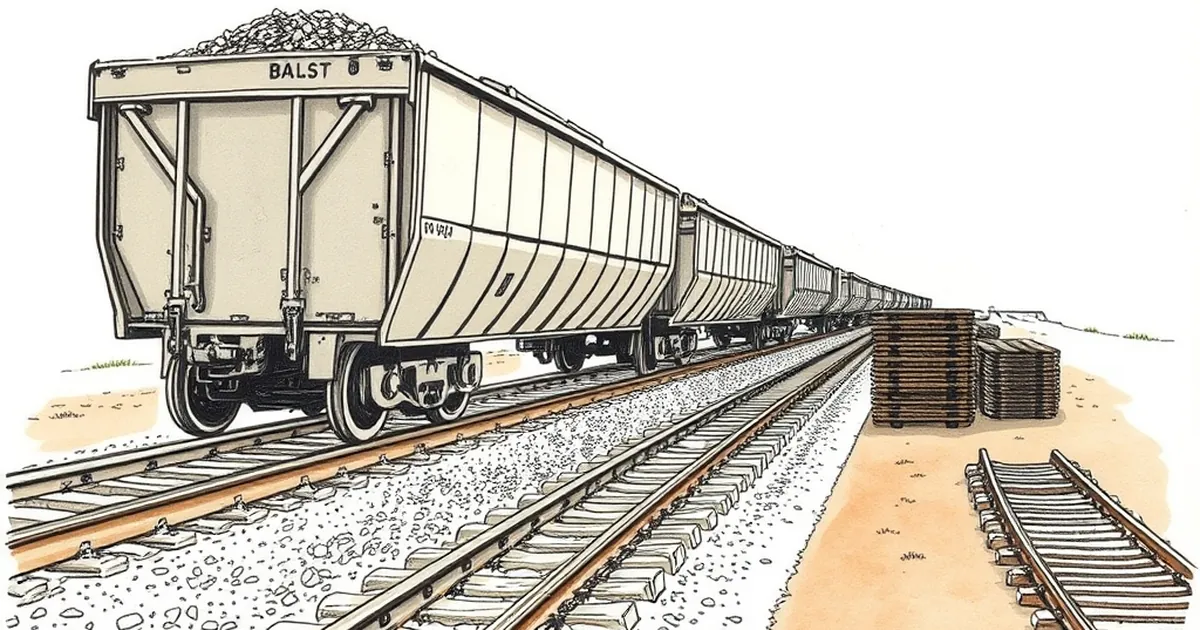
On a bright morning in early spring, a freight rake loaded with thousands of tonnes of granite chippings rolls into a construction yard near a town that does not yet have a railway station. The line it will eventually serve is still a line on a map, a corridor of survey stakes and cleared undergrowth. So why is the ballast already there?
The Counterintuitive Logic of Railway Construction
Anyone who has watched a Polish rail upgrade from behind a fence knows the sequence looks wrong. You expect track first, then the finishing touches. In reality, the stone comes early — sometimes years before the first rail is laid. That is not a planning error. It is how modern railway construction actually works.
Ballast is the crushed stone bed that sits under the sleepers, spreading load, draining water, and holding the track geometry in place. Without it, a rail line is just steel on concrete. But the ballast does not simply arrive at the end of the job as a cosmetic layer. It arrives in stages, and the first stages happen while the corridor is still mostly earth and drainage.
The reason is logistical. A single kilometre of double-track line can swallow several thousand tonnes of ballast. Multiply that across a project like the ongoing upgrades on the E65 corridor or the rail component of the CPK programme, and you are talking about volumes that would overwhelm any supply chain trying to deliver at the last minute.
Why the Stone Comes First
Ballast is heavy, cheap per tonne, and expensive to move. The economics push contractors to secure quarry capacity and rail access to the site as early as possible. If a quarry in Lower Silesia or the Świętokrzyskie region has to reserve production slots, that reservation happens long before track-laying crews appear.
There is also a physical constraint. Freshly laid track needs a stable, well-drained formation beneath it. Pre-placing ballast — often as a "blanket" or sub-ballast layer — allows the formation to settle and consolidate under load before the precise work of tamping and aligning begins. Rushing that step is how you get track that shifts within a season.
What Actually Happens on Site
The sequence on a typical Polish upgrade runs roughly like this. Groundworks and drainage come first, then the sub-ballast blanket, then the first deliveries of main ballast. Track-laying machines follow, dropping sleepers and rail onto a bed that is already roughly in place. Only then does the tamping fleet arrive to lift, pack, and align everything to millimetre tolerances.
That means the ballast train is not delivering a finished product. It is delivering raw material to a site that is still, in a very real sense, a building site.
The Quarry-to-Corridor Chain
Poland has a strong aggregate base, and rail ballast is a demanding product: hard, angular, resistant to abrasion, and within tight grading limits. Quarries that supply it work to rail specifications, and the logistics are planned around train paths rather than truck convoys. A single ballast train can carry what would take dozens of lorries, which matters enormously on rural roads near a construction corridor.
This is where the early arrival pays off. Contractors who lock in quarry output and rail paths early insulate themselves from the seasonal crunch that hits every large infrastructure programme in Poland at once. When several upgrades and the CPK rail links are competing for the same wagons and the same stone, the project that booked first wins.
The Example That Sticks
I keep coming back to a story from a regional upgrade in Wielkopolska a few years ago. Residents near a small village watched ballast trains unload for the better part of a year before a single metre of rail appeared. Local frustration was loud — "they're dumping stones in a field" was the gist of it.
Then the track-laying machine arrived, and the line went down over a bed that was already compacted, drained, and settled. The tamping work that followed was faster and cleaner than on comparable sections where the ballast had been placed late. The "field of stones" turned out to be the foundation that made the rest possible. It is a small illustration of a principle that scales across the whole network.
Reading the Sequence as a Signal
For anyone watching Polish rail investment — residents, local officials, contractors, even investors in construction and logistics — the arrival of ballast trains is a useful indicator. It tells you the project has moved past planning and groundworks into the phase where real money and real material are flowing.
It also tells you something about the maturity of the supply chain. A corridor with ballast on the ground has secured quarry output, rolling stock, and site access. Those are the bottlenecks that quietly delay projects, and they are resolved earlier than most observers realise.
What to Watch Next
After the ballast comes the sleeper and rail delivery, then the tamping and welding fleets, then signalling and electrification. Each stage has its own logistics and its own visible markers. If you want to track a Polish rail project without reading the tender documents, learn to read the site: the stone tells you where the programme stands.
A Practical Note for Anyone Following Infrastructure
Next time you see a rake of hoppers unloading grey stone onto what looks like an empty field, resist the urge to conclude that the project is running backwards. The ballast is there because the engineers are thinking three steps ahead — about drainage, about settlement, about the quarry slots and train paths that have to be booked months in advance.
The forward-looking point is this: as Poland pushes through its largest rail investment cycle in decades, the projects that finish on time will be the ones where the stone arrived first. Watch the ballast trains. They are the quiet herald of track that is still to come.