November 2026
A 10-line slot pays 6% less than the same game in megaways
A 10-line slot and its Megaways cousin can look identical yet return about 6% less, and the math behind that gap shapes what your złoty plays against
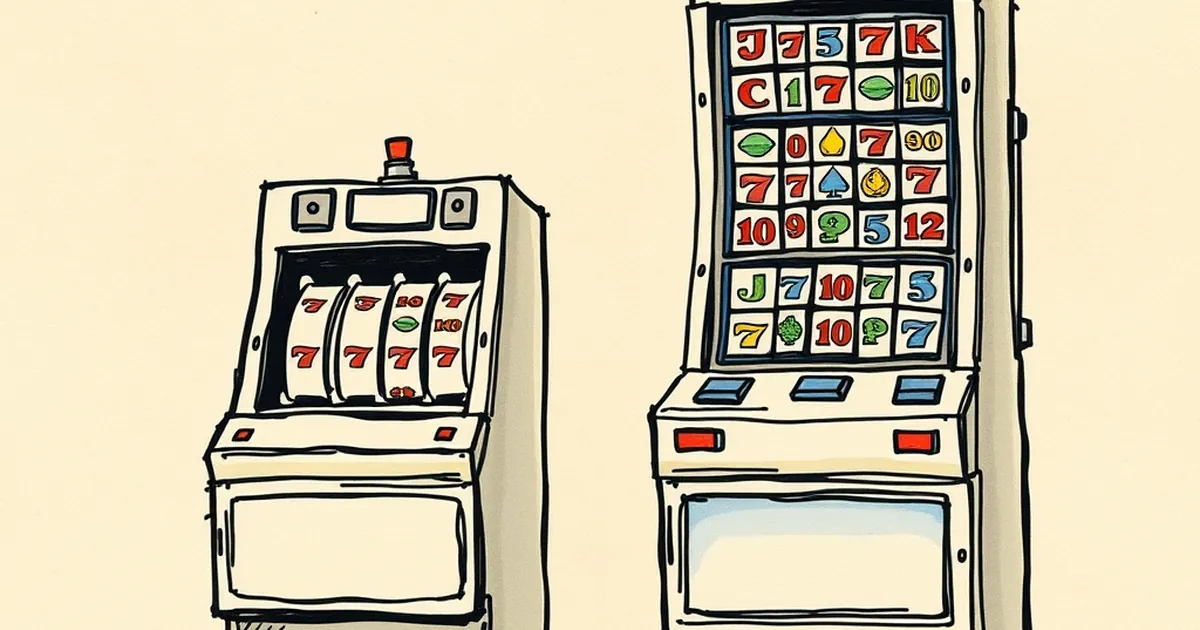
A 10-line slot and its Megaways cousin can share the same theme, the same provider and near-identical artwork, yet return roughly 6% less to players over the same number of spins. That gap is not marketing spin — it falls out of how the two math models are built. And in Poland, where the legal online market runs through a single state monopoly, the practical question is not which version is prettier but which one your złoty is actually playing against.
Take a concrete pair. A 10-line three-reel slot with a fixed 95.0% RTP and a Megaways version of the same franchise at 96.5% are not unusual neighbours in a provider's catalogue. On a 100,000-spin sample at a flat 1 zł stake, the difference in expected return is 1,500 zł — money that stays with the operator rather than the player. The "6% less" in the headline is the relative gap between those two figures (1.5 divided by 96.5), and it is the number worth remembering the next time a lobby lists both games side by side.
Why line count changes the math, not just the look
A classic 10-line slot has a fixed set of paylines. Ten ways to win, evaluated left to right, with a paytable that assigns a multiplier to each winning combination. The reels are weighted so that certain symbols appear more often than the artwork suggests, and the RTP is tuned by adjusting those weights and the paytable values until the target return is hit.
Megaways does something structurally different. Instead of a fixed line count, each reel carries a variable number of symbols — commonly two to seven — and the number of ways to win is the product of those symbol counts across all reels. With six reels at up to seven symbols each, the maximum is 117,649 ways. The paytable is recalibrated for that far larger combination space, and the volatility profile shifts with it.
The practical consequence: a 10-line game has a small, predictable combination set, which makes it cheap to build and easy to tune to a conservative RTP. A Megaways game has a much larger combination set, which is more expensive to balance and typically lands at a higher RTP because the maths has more room to distribute returns. Neither is inherently "fairer" — but the numbers differ, and they differ in a direction players can measure.
The volatility trade nobody mentions
Higher RTP does not mean steadier play. Megaways titles routinely run at high or very high volatility: long dry spells, then large cascading wins when the reel heights align. A 10-line slot at 95.0% often feels gentler spin to spin, with smaller but more frequent returns. A player who chases the 96.5% figure without adjusting stake size and session length can lose a bankroll faster on the "better" game. RTP is a long-run average over hundreds of thousands of spins, not a promise about your next 50.
What the Polish market does with this
Poland's regulated online casino market is small and tightly held. Under the 2017 amendment to the Gambling Act, online casino games are offered only by the state operator, Totalizator Sportowy, through its Total Casino platform. Private offshore sites still attract Polish players, but they sit outside the regulated framework, and the legal exposure — for the player and the operator — is real.
That structure changes the RTP conversation. On a monopoly platform, the game catalogue is curated by one operator, and the RTP of each title is set by the provider and disclosed in the game rules rather than competed over. Players cannot shop across five brands for the best-paying version of the same slot. The 6% gap between a 10-line game and a Megaways game therefore becomes a choice within one lobby, not a reason to switch operator.
For players who do use offshore sites — a persistent reality despite the monopoly — the gap matters more, because those sites compete on exactly this kind of number. A 96.5% Megaways title and a 95.0% 10-line title from the same provider may sit three clicks apart, and the difference compounds over a year of regular play.
The 1 December 2025 licensing picture
Poland's regulator has been steadily tightening enforcement against unlicensed operators, and the Ministry of Finance publishes a list of blocked domains that runs into the thousands. The direction of travel is toward stricter domain blocking and payment interception rather than liberalisation. For a player weighing a 10-line slot against a Megaways version, the more important question in 2026 may be whether the site hosting either game is on that list at all.
How to read the RTP label without being fooled
The RTP figure on a slot's info screen is a theoretical return over an infinite spin count. It is computed from the game's reel weights and paytable, not measured from your session. Two games with the same 96.0% RTP can behave completely differently in a 200-spin session because their volatility differs.
Three practical checks before you spin:
- Compare like with like. Put the 10-line and Megaways versions of the same franchise side by side in the game rules. The RTP is usually stated in the paytable or help screen, and the gap is often 1.0 to 1.5 percentage points.
- Check the max win cap. Megaways titles frequently advertise 10,000x to 50,000x maximum wins; 10-line slots often cap far lower. A higher RTP with a low cap and a higher RTP with a high cap are different products.
- Look at the bet range. A 10-line slot at 1 zł per line costs 10 zł per spin. A Megaways game at 0.20 zł per spin costs the same per spin but spreads the stake differently. The RTP applies to total stake, not per line.
The number that actually matters for your session
Expected loss per 100 spins at a flat 1 zł total stake: about 5 zł on a 95.0% game, about 3.5 zł on a 96.5% game. Over 1,000 spins that is 50 zł versus 35 zł. Those are averages, and variance will swamp them in any single session — but they are the honest way to compare two games, and they explain why the 6% relative gap is worth a moment's thought before you pick.
The open question
If the same franchise can be built at 95.0% in 10-line form and 96.5% in Megaways form, the choice of which version a lobby promotes is a commercial decision, not a mathematical one. Polish players on the regulated platform have no competing operator to defect to; players on offshore sites have too many. The interesting question for the next few years is whether RTP disclosure becomes a genuine differentiator in a market this concentrated — or whether, as enforcement tightens and the legal lobby narrows, the 6% gap quietly stops being a choice anyone gets to make. Set a loss limit before you spin either version; the maths is on the provider's side over any session short of a few hundred thousand spins.